





Volume Ladder
 Author:
 This is the fate of every skinny kid in the gym. He wants to get big, but his body has other ideas. His body needs coercion to start growing. I'm sure you remember how the gains were easy to achieve in the beginning, but over time they kept getting smaller and smaller until they were practically nonexistent.
The parameters of strength training have to be changed regularly to disrupt the homeostasis in the body, and in response to this, the growth of new muscles, from time to time it is advisable to include a certain bomb that will force even the most stubborn parts to grow.
Let's mention muscle fibers in simple terms. We have slow-twitch muscle fibers, which are red fibers, otherwise also oxidative. Then fast fibers, which are divided into oxidative glycolytic and glycolytic. If we want to target hypertrophy, the most effective way is to stimulate the oxidative glycolytic and glycolytic fibers. It is the Volume Ladder method that is suitable for this muscle stimulation.
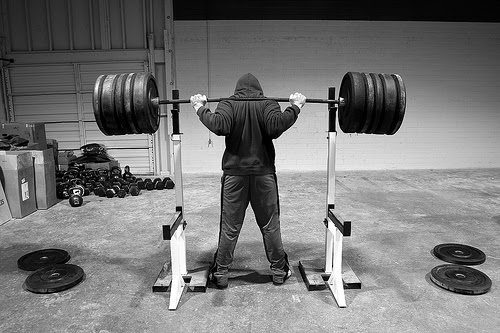
Scientists claim that if we load the motor units with a large volume of work, the body's adaptation will be reflected in the growth of muscle mass. A large training volume does not only show an increase in muscle mass, but also a contribution to the burning of body fat.
The basics of the Volume Ladder system
It's like a ladder. Start at the bottom, get to the top and back down again. The Volume Ladder is simple like this.
- Start with one repetition
- Add 1 rep in each subsequent set until you get to 10 reps in a set
- Now go back down again by taking away 1 rep in each subsequent set until you get to 1 rep in the set again.
If you're just a little proficient in math, you'll come up with 100 magical, growth-providing reps.
You may immediately think this looks almost identical to German Volume Training, and you're kind of right. The main difference between the two workouts is that VL is a lot easier on your psyche, in short it's not as hardcore, the total volume of work is spread out over more sets. If you've ever tried GVT, I'm sure you'll agree with me that around the 7th or 8th set you feel like quitting. With VL, you add reps every set, so it's much easier to meet the prescribed volume of 100 reps.
Volume Ladder Variations
Single Ladder: choose one exercise per set and pause somewhere between 15-60 seconds between sets. If you can't make it through the higher sets, stretch the breaks a bit. Always choose the exercise that will give you the most benefit.
Double Ladder: pick one exercise for a given set and put it in a superset with its antagonist. Pause similar to Single Ladder. Examples would be horizontal deadlift and horizontal press ( squats + lying press ), vertical deadlift and press ( standing presses and lunges ), or a dominant hip exercise and a dominant quadriceps exercise ( Romanian deadlift and leg-press ).
Top-Bottom Double Ladder: This combines exercises for the top and bottom of the body. This variation is also very good for improving your GPP ( general physical fitness ) and fat loss.
If I had to name my favorite pair, it would be, for example, a hip exercise with vertical pressure or a quadriceps exercise with horizontal pressure.
Training intensity
60% of max for one repetition seems like a good starting point. Very few individuals are able to complete the ladder with more than 75% of the maximum. If you try the Single Ladder, choose percentages a little higher, if the Double Ladder, a lower percentage than the Single to start with.
If you use this scheme, or any similar program, you should always be careful to be precise in the breakdown of sets and reps, intensity, pauses between sets, and only count reps performed with strict technique.
The best exercises
| Muscle group | Exercise |
| Quadriceps | Back squat, Front squat, Leg-press |
| Hips | Deadlift, Deadlift from rack (Rack pull) |
| Shoulders | Any overhead press |
| Back | Deadlifts ( especially!), Shrugs, Pull-ups |
| Chest | Bench-press with dumbbell or one-arm dumbbells |
| Other | Personally I have not tried this method on small areas, they will be sufficiently stimulated when exercising larger muscle parts. However, if your ambitions are truly bodybuilding, of course you can exercise the small parts this way. |
Frequency
Volume Ladder is not something that can be used on a long-term basis. It is more of a shock program for the parts that don't and don't grow. I've never worked out this way for more than two weeks in a row, but several of my clients have done the program for 6 weeks in a row and had great results.
What to expect?
Pain! Especially in the beginning, it will be a shock to the body. If you want to gain mass fast, try this program. One client of mine worked out like this every first two weeks of the month and gained 30 pounds of muscle in 10 months. Yes, he's 16 years old, so his body reacted even more violently, but those are great results in themselves.
Great results can come especially if you combine this routine with other, equally challenging workouts and good food.
This method is also very suitable for Crossfit. Friends of mine who are preparing for a strength and endurance competition similarly did one big superset with minimal breaks using the Bench-press style with 100% bodyweight, Shrugs and Lifts. They started with 10 reps in each set of the exercises and took one rep off in each subsequent set - so 10-10-10-9-9...1-1-1.
Source: Chad Coy
No posts have been made yet.








