





Two-phase training for radical results
 Author:
 Want to bulk up alarmingly fast? Do you have a relatively uncommitted daily schedule and want to see how you would look if you pushed a little harder? Do you want friends you haven't seen in a while to stare and ask, "What the hell did you do to yourself?"
Then this is the article for you
Depending on the season, coaches of high-level athletes and teams commonly increase training volume by including two training units per day. Think about any competitive athlete such as weightlifters, swimmers, American football players or track and field athletes - they all train twice a day.
However, when it comes to strength training and bodybuilding, the general rule of thumb tends to be to give the muscles plenty of time to rebuild between workouts. It is even said that the same muscle must not be trained within 48 hours.
Well, we're not beginners. And we're not pussies.
We know what we're doing in the gym, and our goal is to get as big as possible. So we can take a less conservative approach. Some people might even call it crazy.
Let them stay lean and mean. If your goal is to be big and strong, twice a day is the way to go.
That's the way to do it.
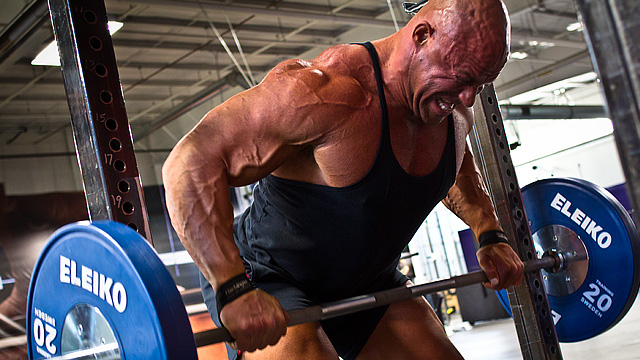
Positives
Training twice a day can break frustrating stagnation, barriers to growth, and allow for more intense workouts whenever you pick up an iron.
If only because shorter training units make it easier to focus on the quality of the exercises and get the most out of each set and repetition. It puts the emphasis on quality, not quantity. The ability to "re-focus" and recharge between training units helps you approach each workout with commitment, instead of stumbling between longer workouts once a day.
If you're losing weight or trying to sculpt, incorporating a two-phase workout (and a clean diet) is like adding gasoline to a raging fire. Research shows that splitting 30 minutes of moderate-intensity cardio into two 15-minute units, with about six hours of rest in between, can burn more calories than slogging through the whole 30 minutes at once (Almuzaini et al., 1998).
Researchers attribute this to increased EPOC (excess post-exercise oxygen consumption) - and it has only been observed during moderate-intensity cycling. Imagine the possible increase in EPOC during two high-intensity training sessions with a load!
Here are the most essential training parameters for maximizing your muscle-building potential (Schoenfeld, 2010):
Mechanical Tension: the external forces of the weights acting on the muscles resulting in muscle contraction.
Metabolic stress:The accumulation of metabolic byproducts, referred to as metabolites (e.g., lactate, hydrogen ions, and inorganic phosphate) that indirectly mediate muscle and cell enlargement, during and after weight training.
Muscle Damage: Refers to microtears resulting from intentional weight lifting, commonly accompanied by muscle soreness.
Rules
You may be familiar with two-phase training protocols targeting a different body part in each workout. However, for hypertrophy purposes, it's better to train the same muscle groups in both morning and evening workouts as described in the Black Book of Training Secrets (Thibaudeau, 2006).
Give the workouts 6-8 hours apart and make sure you get enough nutrients in. A poor diet will directly limit your ability to train at the level this program requires. This is not the time to fast on your new diet. Do it, and you can say goodbye to recovery and progress. Adopt hypertrophy-promoting eating habits, including a diet around training, and prepare for growth.
Do this program for four weeks.
Add weight to the barbell in each workout while keeping other workout parameters constant.
Strictly monitor the length of your breaks. The purpose is to come in, destroy yourself, and leave to recover. Sitting on your butt between sets and updating your Facebook status won't help anything.
Take it easy on week five. This will allow your body to recover to a level higher than before the program started, which is traditionally called supercompensation (Zatsiorsky & Kraemer, 2006).
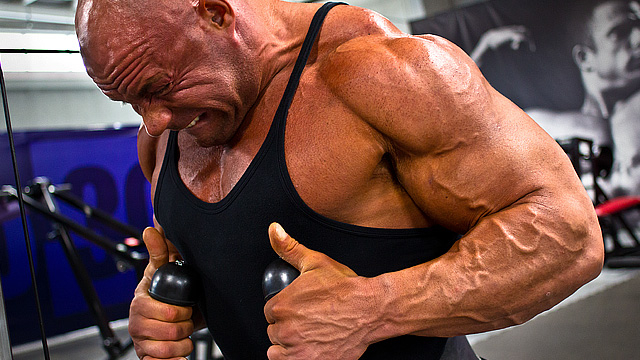
Morning workouts
Focusing on complex exercises jump-starts the nervous system. It will also cause associated synergistic muscle contractions, improve structural balance, and reduce the potential for injury associated with constant training in open kinetic chains.
In these morning workouts, use a controlled tempo with extended time under tension - the ideal tempo is 3122*.
The * denotes a repetition cadence where the axis is lowered for 3 seconds, followed by a 1 second pause in the bottom position, a 2 second concentric or ascending phase, and all finished with a 2 second contraction at the top of the movement.
Avoid failure during this workout as you will need some energy for the second workout of the day. At the end of the workout, which should last no more than half an hour, you should feel pumped and stimulated, not tired. If you leave the workout completely drained, you'll need to ease off the gas next time.
Evening workouts
This is where the bodybuilding stuff comes in. Isolated exercises play a bigger role, although the same rules apply - a slow tempo and a hard two-second contraction at the top of each rep.
Recommended


Nebbia Legíny se síťkou s vysokým pasem IMPACT 479
GymSupps XGen
Nebbia Washed-off Tepláky s kapsami NO SHORTCUTS 372
And here's the surprise. Remember how you didn't practice until failure in the first practice? Well, here's where you're gonna get your kicks.
Make the last set of each exercise a crash set. When you reach failure, take 20% off the load and continue the set. Repeat until failure/absolute exhaustion. This maximizes pumping, muscle damage, and metabolic load.
However, if your workout lasts more than 30 minutes, it's time to hang up the Conversky. You're done.
Program
|
NO |
AFTER |
TUE |
ST |
THU |
FRI |
SO |
|
|
DOP |
Free |
Legs |
Chest & Triceps |
Free |
Back & Biceps |
Shoulders & Abdominals |
Free |
|
ODP |
Free |
Legs |
Chest & Triceps |
Free |
Back & Biceps |
Shoulders & Abdominals |
Free |
Legs
NEXT
|
Exercise |
Series |
Repetition |
Tempo |
Break |
|
|
A |
Back squats |
4 |
6-8 |
3122 |
90-120 s. |
|
B |
Leg Press |
4 |
8-10 |
3122 |
90 s. |
|
C |
Romanian deadlifts |
4 |
8-10 |
3122 |
90 s. |
AVAILABLE
|
Exercise |
Series |
Repetition |
Tempo |
Break |
|
|
A |
Glute-Ham Raise |
3 |
12-15 |
4132 |
60 s. |
|
B |
Knee extension |
3 |
12-15 |
4132 |
60 s. |
|
C |
Hip Thrust |
2 |
20 |
4132 |
60 s. |
|
D |
Sit-up calf raises |
2 |
20 |
4132 |
60 s. |
Chest & Triceps
NEXT
|
Exercise |
Series |
Repetition |
Tempo |
Break |
|
|
A |
Bench Press |
4 |
6-8 |
3122 |
90-120 s. |
|
B |
One-arm push-ups (positively inclined bench) |
4 |
8-10 |
3122 |
90 s. |
|
C |
Barbell push-ups with weights |
4 |
8-10 |
3122 |
90 s. |
AVAILABLE
|
Exercise |
Series |
Repetition |
Tempo |
Break |
|
|
A |
Cuts with opposite pulleys from above |
3 |
12-15 |
4132 |
60 s. |
|
B |
Furnace Dec |
3 |
12-15 |
4132 |
60 s. |
|
C |
Single arm triceps extension (negative incline bench) |
2 |
20 |
4132 |
60 s. |
|
D |
Triceps extensions with one arm overhead |
2 |
20 |
4132 |
60 s. |
Back & Biceps
NEXT
|
Exercise |
Series |
Repetition |
Tempo |
Break |
|
|
A |
Overhead Shrugs with weights |
4 |
6-8 |
3122 |
90-120 s. |
|
B |
Pull-ups with chest support |
4 |
6-8 |
3122 |
90 s. |
|
C |
Upper pulley retraction (30° tilt) |
4 |
8-10 |
3122 |
90 s. |
AVAILABLE
|
Exercise |
Series |
Repetition |
Tempo |
Break |
|
|
A |
Pull over with overhead pulley |
3 |
12-15 |
4132 |
60 s. |
|
B |
Pull over with bottom pulley on negatively inclined bench |
3 |
12-15 |
4132 |
60 s. |
|
C |
Biceps single arm lifts with wrist extension (positively inclined bench) |
2 |
20 |
4132 |
60 s. |
|
D |
EZ axis lifts on Scott bench |
2 |
20 |
4132 |
60 s. |
Shoulders & Abdominals
NEXT
|
Exercise |
Series |
Repetition |
Tempo |
Break |
|
|
A |
Military Press |
4 |
6-8 |
3122 |
90-120 s. |
|
B |
Arnold's pressures |
4 |
8-10 |
3122 |
90 s. |
|
C |
Shoulder shrugs with one arm |
4 |
8-10 |
3122 |
90 s. |
AVAILABLE
|
Exercise |
Series |
Repetition |
Tempo |
Break |
|
|
A |
Face Pull |
3 |
12-15 |
4132 |
60 s. |
|
B |
One-armed arm curl with deflection |
3 |
12-15 |
4132 |
60 s. |
|
C |
External rotation in supine position |
2 |
20 |
4132 |
60 s. |
|
D1 |
Reversed abbreviations |
2 |
20 |
Checked |
60 s. |
|
D2 |
Farm walk |
2 |
20 |
no |
60 s. |
What to expect
The cumulative workload of this program is higher than most others, and your body may show signs of shock after the first week. Remember though, this is not a strength program, it is a volume program.
If you're interested in increasing your squat, press, and deadlift values, move on to the next article. This one deals with increasing muscle size - and that's it.
Now that we're clear on that, focus on stimulating your muscles by following the prescribed tempo and tension in your muscles. Volume programs like this one focus on increasing sarcoplasmic hypertrophy, and although microtrauma plays a role - pumping and time under tension are equally, if not more essential.
Make sure you are mentally prepared before each workout. It takes a lot of concentration to practice all sets and maintain the prescribed pace until the last rep. Be disciplined - it will yield results that we are sure will please you.
Summary
It's a simple equation - train more often (sensibly) and you'll get better results. Take a page out of the book of great athletes like Michael Phelps, Ledainian Tomlinson and Michael Jordan have already used this method to their athletic advantage, and apply the same mindset to bodybuilding training.
This can be the difference between increments that make people's chins drop and having someone ask you that notoriously hated question: "Do you work out at all?"
This article was written by Jon-Erik Kawamoto and Lee Boyce, translated by Jaromír Uhlíř
Sources
Almuzaini, K.S., Potteiger, J.A., & Green, S.B. (1998). Effects of split exercise sessions on excess post-exercise oxygen consumption and resting metabolic rate. Can J Appl Physiol, 23(5), 433-443.
Schoenfeld, B.J. (2010). The mechanisms of muscle hypertrophy and their application to resistance training. J Strength Cond Res 24(10), 2857-2872.
Thibaudeau, C. (2006). The black book of training secrets. Enhanced Edition. F.Lepine Publishing.
Zatsiorsky, V. & Kraemer, W. (2006). Science and practice of strength training, Second Edition. Human Kinetic
No posts have been made yet.








