





Try these 8 exercises on one leg!
 Author: Šárka Randáčková
 Some people think that exercises on one leg serve only as rehabilitation. They are wrong. Such exercises can also be used to build real strength and volume.
Unilateral work can be just as effective as bilateral work (if not more so) for building muscle, increasing athletic skills, and promoting health and longevity... It can also be used to increase squat performance.
Let's cleanse you of those hackneyed exercises and look at some new variations. Here's a list of eight brutally effective rarities that you simply must try.
1. Zercher split squats with the front leg lifted
Compared to a regular split squat, lifting your front leg allows for deeper hip flexion and a greater range of motion. Plus, there will be a huge stretch under tension, which will increase the gains dramatically.
This variation is all about vertical movement, which engages the quadriceps and glutes primarily. It will also work the adductors, internal rotators and hamstrings. All of these muscles are essential for athletic performance.
The Zercher hold gives it a whole new dimension. You will need to be clenched from head to toe, ensuring maximum mechanical tension, minimal joint loading and essentially zero axial load. Plus, it will destroy your mid-body, upper back and improve your ability to be clenched and breathe under load. All of this enhances performance in the squat.
2. Back lunges with barbell in front
Forward and backward lunges are different than other single leg exercises. It is a dynamic exercise, which adds an element of athleticism. They test reflexive stability in all three planes.
The backward version is better in that it engages the gluteal area, rectus femoris, vastus lateralis and vastus medialis (VMO) more. It is also gentler on the knees as it allows more control, less angles in the shins, lower shearing forces and minimal load on deceleration.
The front dumbbell makes the exercise even more effective because it increases the demands on stability, which will destroy your center of the body and test your coordination and motor control.
The demands on the upper body are also not low. The upper back and shoulder blade stabilizers must maintain tension in the thoracic spine and keep the shoulder blades turned up.
In addition, this exercise places essentially zero load on the spine, which, along with the low load on the knees, makes the entire movement quite beneficial.
Tip: If you have trouble with the weightlifting grip, opt for the crossed arms.
3. Split squat with the back leg lifted
This is a brutally effective strength-building exercise that saves your joints and spine. Leaning on the rack eliminates some limiting factors and maximizes the load. You won't have to worry about grip, mobility or coordination or balance. You'll be able to load more weight, generate more force, handle a higher volume of work, and create more mechanical tension. Higher increments will do it all.
It's a great exercise for elite athletes, beginners, people suffering from back pain, limited shoulder movement, knee pain, or anything else. The axial load is reduced and the spine is held in a good position. Shoulder problems are eliminated and the whole body has to work to maintain tension.
4. Squat on one leg
The non-working leg is completely out of the way, which adds a number of functional benefits such as improving pelvic and joint stability and inter and intra muscular coordination, increased strength of some not so often exercised muscles such as the adductors, glute medius and hip external and internal rotators.
In addition, any exerciser will be pleased to know that one study has identified this exercise as excellent for building muscle and strength.
The research sought to disprove the idea that the load on the exercising leg during the single-leg variation is half that of the double-leg exercise. To do this, the researchers used a model based on segmental load distribution and found two things.:
- The combined body weight exerted during single leg exercises over the hips is 16% higher than for the two leg exercises (84% vs. 68%).
- Exercises on one leg equal 1.62x the intensity (per leg) of exercises on both legs (overall).
Thus, a single leg squat loads the working leg much more than a regular squat loads both legs, which means you get the same result with much less load.
The relative comparison came out as follows.
- Squat on one leg without added load > 1.0x squat with own weight
- Single leg squat + 10% bodyweight load = 1.5x squat with self weight
- Squat on one leg + 50% bodyweight load = 2x squat with own weight
- Squat on one leg + 100% bodyweight load = 3x squat with own weight
I used 50 kilos of external weight in a vest and chains for 8 reps as an example - that's about 50% of my weight which equates to about 200 kilos on back squats per rep according to this study.
Add in the fact that single leg squats involve constant tension and strong intramuscular activation, and it works out that they can be a great alternative for building bigger legs, and help make for better classic squats as well.
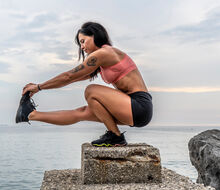
5. Heavy pushing of the sledge
This is one of the most foolproof (but effective) exercises on one leg. It can be used for everything from strength training, to conditioning and everything in between.
You can put a ton of weight on it and it still remains joint friendly. Or you can train it in longer stretches, building muscle for your glutes, hamstrings, and calves.
It can also improve athletic skills by improving drive from the knees and hip separation, exposing the body to acute angles that mimic acceleration, and targeting the dynamic force from one leg that must be applied toward the ground.
Additionally, the sled push is extremely demanding from a cardiovascular standpoint, making it an excellent conditioning exercise.
In addition, it is very gentle on the joints as it puts no strain on the spine and minimal strain on the knees and hips. Moreover, it is basically an exercise without a negative phase, which makes it an ideal choice for deload periods, high frequency training or rehabilitation.
6. Deadlift with Trap Bar and one leg in front
Think of it as a hybrid exercise, as it actually combines a deadlift with a trap bar and a single leg variation (the non-exercising leg remains on the ground).
However, the support of the standing leg makes a major difference because it eliminates any stability issues.
You can load up more (roughly 70-80% of the normal deadlift with trap bar), which is unprecedented for a single leg exercise.
Additionally, this exercise eliminates some problems because it encourages a spiraling motion that puts more load on the back of the hips. It requires a low trunk position during the beginning of the deadlift, which engages the glutes more and extends the range of motion.
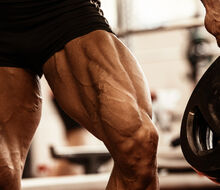
7. Kang's split squats with lifted back leg
This variation isn't used much and combines something like good morning and squat. You start with a downward bend and at the bottom you get into a squat. Then you reverse the process.
You are reaping the benefits of both exercises and exercising your glutes and hamstrings in one exercise.
This is basically a Kang squat on one leg. It's an effective quadriceps and posterior chain exercise with all the benefits of single leg training.
Try sets of 10-12 reps on each leg. Start with your torso perpendicular, work out the negative part of the exercise and perform an upward bend.
8. Lunge walk
This variant combines forward lunges, backward lunges and walking into one movement. It starts with a backward lunge with the lead leg, moves into a lunge walk with the other leg and finishes with a forward lunge with the lead leg again.
The joke is that the exercise never actually ends. The legs alternate with minimal rest. The result is a monstrous lunge that creates a huge metabolic load and destroys both legs at the same time.
Additionally, the instability of alternating legs targets hip flexor strength and, at the bottom of the exercise, joint instability.
Try cramming in 2-3 sets at the end of a lower body workout, either for distance or high reps.
Benefits of training on one leg
- It has direct transferability to sports and everyday life.
- Builds more strength and muscle.
- Improves lower body health and functionality.
- Addresses asymmetries/imbalances.
- It is gentle on the joints.
Another beauty of training on one leg? It works well in terms of creating a training program. It can be used in any way. As a main exercise for 4-6 reps per leg, as an auxiliary exercise for 6-10 reps, or as a metabolic load/pump for 15+ reps each leg.
A good rule of thumb. Train on one leg in different patterns, focus on alternating load, heavy, weight, sometimes do a good pump, etc.
Source: www.t-nation.com - 8 Brand New Single-Leg Exercises
Author.
Recommended
HMS Magnetický veslařský trenažér ZM1502
MM Hygiene Sprcha ve spreji
HellGel 80g 5+1
Nebbia Sportovní racer back podprsenka AGILE 471
Author: Šárka Randáčková No posts have been made yet.








