





The most progress you'll ever make
 Author:
 At whatever time you choose, most people in the gym are newbies. Maybe that means you are, too. But that's not necessarily bad news - not always.
Most people who visit the gym quit within a month. You know the types. They're backpedaling around the single-arm machines, aimlessly heading from machine to machine, glancing around at the other trainees, with a wish to become slightly big and strong written in their eyes.Some of them stick with their wish longer, but they don't yet have a precise plan for how to achieve their goal. They don't have a program that can bring them visible progress in strength and volume. It could be you. But you too can quit if you don't see any progress.It's not bad to be a beginner. Many advanced people would certainly like to start over, but with the knowledge they have gained over time. Your beginner months, if you progress through them correctly, will bring you faster progress in strength and volume than you will ever achieve afterwards, even faster than steroid users. As long as you follow the right steps. For now, it only remains to be seen if you will progress further or quit, like many beginners before you.

Basic training truth
Right off the bat, you need to understand a simple truth about training and use it to your advantage. You don't get bigger and stronger by lifting heavier and heavier weights, you get bigger and stronger by recovering from lifting heavier and heavier weights.Everything else can be derived from this simple rule of load and adaptation. Never forget it.
Beginner
The beginner is so poorly adapted to load that any stress coming from strength training will lead to as rapid progress as his body can regenerate. Thus, the progress of a complete novice in the gym takes 48-72 hours!!!Once an 18 year old with no past experience of strength training starts training, anything harder than what his muscles have encountered so far will be a stimulus for adaptation. It would be an exaggeration to say that pedaling a bike will improve his bench press performance. However, once he starts to load up on adaptive stresses and moves from not having been strength trained before to the category of training on the right plan for a few months and then even training and racing for a few years, he will acquire a different organism. This is due to the body's adaptation to the ever-repeating prolonged increase in stress. It gradually reaches a level where any progress is very hard and deliberately mined out of the body. The trainee has reached the limit of his genetic capabilities. (see picture)
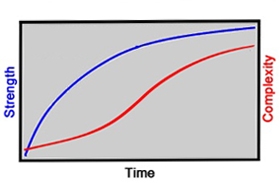
This common fact is known as the principle of diminishing returns, where the trainee goes from simple, effortlessly and painlessly gained progress to complex, expensive and painful progress. The important thing for you is that simple, quickly and effortlessly gained advances are only gained if you use your time correctly.The most common path a beginner takes is to learn from the end of someone else's path when advances are hard-won. Copy Mr. Olympia training, preferably pre-contest preparation. Mostly such are published in bodybuilding magazines.You really only need a program to get you into the right volume and intensity of training, you don't need any advanced techniques at this stage designed to mine tiny steps of progress after years of training.
It needs to be simple
A fundamental characteristic of beginner training is that it must be as simple as possible. Don't look at it as anything other than a blessing. The next phases of your training won't be easy or challenging, so enjoy the one time when it is easy. Variations of training based on exercise selection, frequency of muscle groups exercised, volume of exercise and intensity of training, all as uncomplicated as can be.
Seven exercises - that's it
For the next few months, you just need 7 exercises. Anything else is one of the reasons beginner's progress slows down. Of course, everyone will start asking why on earth we have so many machines in the gym when I don't really need them, I can guarantee you that we'll only do squats, benches, deadlifts, push-ups (call them overhead presses if you want, just don't confuse it with shoulder exercises), repositioning and hunches. You may be able to do one-arm exercises at some point, or you may be told to by your training, so we can count that too, but that's it.What will make our workouts different is not the number of exercises, but the training volume. Increasing strength by increasing volume is the key. And the process of achieving more strength will force the body to become more powerful. Performing the same volume for a million exercises is not what will get you to your goal. Basic exercises and increasing volume in the combination of ways I show you will stress the entire system, not just selected areas.A program that contains 12-15 different isolated exercises will not work for a beginner because it will not stress the entire system as much as it needs to. The beginner needs the highest hormonal response which will cause rapid adaptation and change in the body.
Training frequency based on the degree of recovery
The training frequency is based on the level at which the beginner can recover after a strength load. A beginner is not as "relatively" strong as his potential, so he cannot exert the kind of effort that would limit his capacity to recover from a load in a short time. This means recovery in 48-72 hours and this means training 3 times a week will be most beneficial for a beginner.Higher frequency will be detrimental to recovery and lower frequency will mean low stress to elicit an adaptive response from the body.All successful beginner programs are really the same. The one I will present is a variation of two training days. Day A and Day B. So on the first week, you get a combination of A-B-A, and on the second week, you get B-A-B.
 Training A
Before the prescribed sets, do a few sets with a light load to warm up.
- Squat - 3 sets x 5 reps with the same weight
- Deadlift (overhead) - 3 x 5 with the same weight
- Deadlift - 1 x 5
- Shrugs - 3 x max reps with a 5 minute break between sets
Workout B
Perform a few sets with a light load to warm up before the prescribed sets.
- Squat - 3 x 5 with the same weight
- Bench press - 3 x 5 with the same weight
- Repositioning - 5 x 3 with the same load
That's it. No finishing sets for "long head biceps", "quadriceps depth", etc. The hours spent on the pulley will be very suitable for an 8-time Mr. Olympia, but if you want to have a weight at least as high as your IQ (90 is a slight moron I hope you have more), I strongly suggest you focus heavily on those 7 exercises.The relocations are there to help you with the deadlift and teach you a certain kind of strength suitable for other sports. Plus it is a type of movement that is not that hard to master, unlike others. And before anyone asks... waist pulls are not a staple.
An important key
There is an important key to the workout. Every exercise, every workout you do, always increase the weight of the barbell by a small amount. Start with the free axis and add weight the next workout. For small muscles like shoulders and arms (overhead press, bench press), increase by 2.5kg, for the big muscles that work during squats, increase by 5kg, only after a few workouts, once you get to a relatively heavy load, increase by 2.5kg. For deadlifts, increase by 7.5kg. Firstly, this is an exercise where you will be relatively stronger than with the squat because of the shorter movement path and less demanding on the synergy of the muscle groups, and secondly the deadlift is only done once every two workouts. Once you reach a weight on the barbell that is relatively heavy but you can still perform the prescribed number of reps correctly and correctly with it, stay at the same weight for the next workout but add two more sets. Only the following workout increase the weight by 2.5kg and repeat the process.Don't be greedy about the barbell weight. Remember that increasing the weight too soon will mean a reduction in your progress. It is therefore much better to spread your first peak over a longer period than to do it quickly over a few weeks.
Regeneration
Since recovery is the true success of any program, you need to eat and sleep in sufficient quantities. You simply won't make progress if you don't subordinate your goal to your lifestyle.You'll need enough calories, protein with vitamins and minerals to fuel your basal metabolism and add to it the prerequisites to build more muscle mass. Caloric intake from protein is highly underestimated. You should take in 1500-2000 kcal of these calories above your basal metabolism, which can end up being well over 6000 kcal per day.Sleep is the period when your hormones, energized by training, will work to rebuild and strengthen the muscles you use, using the building blocks you supply. Remember, six hours is not enough. Eight may not be enough either. Don't shortchange your hormones when they can work.Not every beginner needs to struggle with being underweight. Older or bulkier beginners are likely to have the opposite problem. Then a quality whey protein as a nutritional supplement is essential. On the other hand, a classic 18 year old beginner with a height of 180cm and a weight of 69kg will need the aforementioned quanta of food - meat, rice, milk per day.How much is good? Is 10-15kg in 4 months good, 60% of which will be muscle mass? How about doubling your squat and deadlift performance in that time without having to resort to steroids? You have to want it and you have to go for it. It's gonna cost you the disappearance of that pile of buns on your belly, because you're gonna gain fat too.
Rapid muscle gain is associated with fat gain
Always. I understand it can be uncomfortable for some people. The modern concept of body beauty focuses on visible abdominal muscles and low subcutaneous fat, and someone may have trouble momentarily abandoning that concept to become more massive.Fat comes much easier than muscle mass. At the same time, bodybuilding is about shedding excess subcutaneous fat when the time comes to take such a step.
The final picture
So this was the key to making the most of your time at the beginning. Your body will adapt if you ask it to. You've got to give it a reason to get bigger and stronger every workout, and you've got to give it time to adapt in between workouts, which we call recovery. Do that and you will get bigger and stronger very quickly. Don't do it and you will be one of the many new and time frustrated members of your gym.You need something other than a million stretches on the peck deck.
Mark Rippetoe by PW
No posts have been made yet.








