





The Complete Guide to Powerlifter Equipment #1 Belts
 Author:
 You can only achieve good performance after years of hard training, following a proper diet and understanding the principles of recovery. But if you don't have the right equipment, you'll still be robbing yourself of the best performances or risking your health unnecessarily. For this reason, we've put together a series of articles that together will be a sort of complete guide to the world of the powerlifter. Well, in the first part of our series we'll take a look at belts, which are probably the most popular (not only) lifter accessory. But is it necessary? Who will appreciate it? And which one is best for maximum performance?
What is a belt good for?
Even if you've never tried a belt yourself, you've probably seen someone using one a few times at the gym during heavy sets of deadlifts, squats or other complex exercises. And you may have wondered what it's good for. So, it would be useful to clarify this at the very beginning of the article - a classic exercise belt is primarily aimed at increasing intra-abdominal pressure, which hand in hand is related to better performance, better stability and safer exercise execution.
You probably know from experience that there's actually nothing to using a belt - you just tighten it, breathe into your belly and apply a little pressure. The process that this activates is called increasing intra-abdominal pressure and is extremely important not only for delivering maximum performance, but more importantly for your safety. This is because higher intra-abdominal pressure reduces the possibility of spinal compression (increased pressure), which is obviously desirable to protect against various disc herniations and other complications associated with lifting heavy objects. Indirectly, then, intra-abdominal pressure is of course also related to improved stability, which is extremely desirable for any of the basic exercises.
What types of band are there? And which is the best?
Just a cursory glance at each belt and you'll probably be clear that each one serves a different purpose and is suited to different situations. The truth is that there are a number of brands and models on the market, and sometimes it can be very challenging (especially for novice athletes) to choose a quality belt. The five most common belts you'll come across in the gym are:
Bodybuilding belts
The most common type of belts that are seen in gyms are what we might call bodybuilding belts for our purposes. This is because, unlike lifter belts, they are relatively thin and have the front side narrower than the back. For this reason, they do not interfere with exercise and can be used for a variety of exercises. A typical example is the Power Natural PS-3000 from the proven Power System company. The unquestionable advantage is the great mobility with the belt, but the disadvantage is that it develops only significantly less intra-abdominal pressure than you can achieve with thicker and wider belts.
If you need to lightly firm the lumbar spine and you don't want to take the belt off after every set, then a bodybuilding belt is quite possibly a good choice. But if you want to lift heavy maxes, it's not so good.
Weight belts
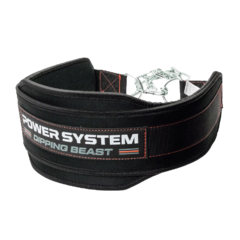
Belts designed to add weights have a vastly different purpose, yet it's worth pointing out for completeness. In addition to the leather part, they also have a steel chain to add weights - so their function is not primarily to improve stability and intra-abdominal pressure, but to allow you to add weight for deadlift, squat or benchpress exercises - they are completely unsuitable.
Slimming and shaping belts
Although in recent times they are rather on the decline compared to the past, from time to time you will come across various "slimming" and body-shaping belts in the gym. An example is the Madmax slimming belt. Although these belts can have an effect on, for example, correct posture and relieve pain in the lumbar spine, they are also unsuitable for basic exercises. They are usually made of neoprene, which is compressive and thus may help to improve stability, but certainly does not significantly affect intra-abdominal pressure. Their advantage is that you can wear them for the whole workout - and even wear them outside the gym. For example, if you have a sedentary job that gives you back pain, you can use it at work.
Recommended
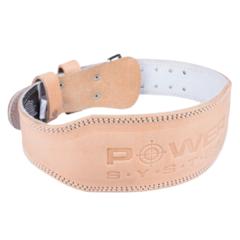
Power System Opasek Power natural PS-3000
Velcro belts
This variant of belts is not so common, but you can still see it occasionally - true, mostly on "holiday athletes" who go to work out only occasionally, but are 100% equipped. To give you an idea, the Body Conform belt from MadMax fits this description. Although many product descriptions may tell you that this type of belt will be a great replacement for any lifter or bodybuilder's belt, from my own experience I don't recommend it too highly. Velcro simply cannot be relied upon, as it has a tendency to loosen at times, plus over time the entire velcro mechanism can become damaged and therefore malfunction. The buckle straps are much more secure.
Powerlifting belts
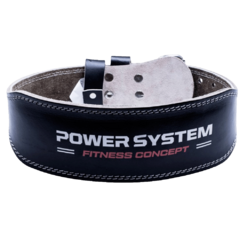
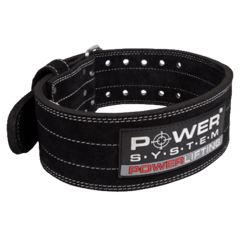
The best for last. The fifth and most used belt among more experienced power-oriented athletes is the so-called lifter belt. This is characterized primarily by the fact that, compared to a bodybuilding belt, it is thicker, wider and, last but not least, the same all around - it never widens or narrows. And without any exaggeration, it must be said that lifter belts are the best investment for any of you who plan to lift heavier weights and need to develop maximum intra-abdominal pressure and the best stability. The vast majority of them work with either a classic buckle that tightens with a snap, or with barbell buckles that need to be placed in specific holes according to your waist size. Both are good options, but the snap buckle can snap out on its own after a few years, whereas with a thorn buckle there is more or less nothing to go wrong and you can still rely on it after many years.
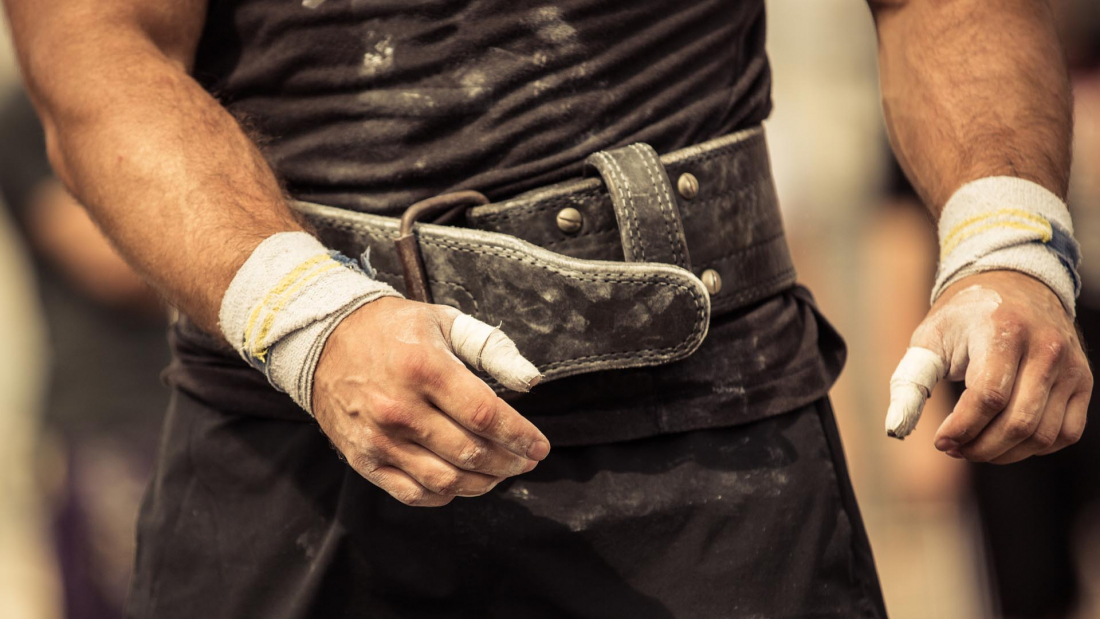
"The Lifter belt is the same width along its entire length, which creates the right intra-abdominal pressure."
How often to use it?
Many athletes may tell you that a belt is a useless thing and using one has a number of negatives. And as we'll explain below, with very frequent use, a belt can actually do more harm than good. But it's important to remember that not every athlete is able to exert sufficient intra-abdominal pressure without a belt. Thus, it can happen that even a person who lifts 50kg will blow out his disc due to poor intra-abdominal pressure. And in such a case, the use of a belt might well be in order. While a belt (like no other equipment) cannot compensate for poor technique, it can at least ease the load on the spine during basic exercises. Still, you should try to function without it. The belt is a great helper for heavy sets, but I definitely don't recommend putting it on at the beginning of a workout and taking it off in the locker room.
At the same time, it's also worth mentioning that the belt should not be used too often by beginners and those of you who don't know much about the technique of the basic exercises. The problem is that by using the belt, you can eliminate the involvement of certain muscles that would be much more involved when working out without the belt.If you exercise with a belt from the beginning, you may find that after a while you will lift almost nothing without it, or you may not have at all fixed the correct movement pattern that the exercise requires. In other words, without the belt your technique will be much worse than with it. And while you won't find many powerlifters without a belt, there are exceptions. One such athlete who deserves real respect was Konstantin Konstantinovs, who even set the then-current world record for the deadlift without using a belt - he lifted an incredible 426 kg.

"Konstantin Konstantinovs managed to pull 426 kg without a belt."
Which belt to choose?
Having been powerlifting for several years, I have tried a number of different belts and have come to the conclusion that if you rely on a quality brand, you are set for life. Sometime in 2015 I bought a PS-3800 lifter belt from Power System and even after five years I can say that it looks like new and shows no signs of daily use. And it is a matter of about 550 CZK. Of course, if you want a nicer design, you can reach for the BEAST belt, or you can find a whole range of other belts on the market - but the PS-3800 also fulfills its purpose.
In case you are going to compete in powerlifting, of course, be sure to study the rules about the use of the belt in the federation. For example, for the GPC the following applies:
- The belt must not be wider than 10cm.
- The belt must be no thicker than 13mm
And thus choose one that has the necessary parameters. However, the PS-3800 has raced with me across federations without any problems.
What to take away from today's article?
The following is what you should take away from today's article, in which we have hopefully covered the issue of belt use comprehensively enough:
- A properly used belt will help you achieve optimal intra-abdominal pressure, which is essential for good performance, proper stability and prevention of various injuries.
- Although there are different types of belts, the best belt for lifting heavy weights is a powerlifter's belt, which is the same width throughout its length. For value for money, for example, the PS-3800 belt is a great choice and can last for several years if used properly.
- You should only use the belt for really heavy sets, but it's definitely not a good idea to not take it off for the entire workout. Similarly, the belt should not be used too much by beginners who do not know the correct technique of basic exercises. However, it will definitely help you during maxes.
No posts have been made yet.








