





Strength training for fat loss
 Author:
 I see enough here and elsewhere that to reduce fat you need to perform 15 or more reps in a set. But that is not the case. If you read carefully the interviews with bodybuilders we feature here, you will have read many times that their training is not that different in the volume and pre-contest phases.
What is the reason for this? The following article will answer this question, plus many other equally important insights.
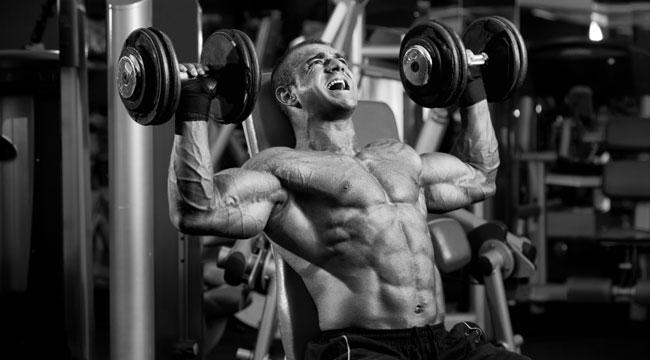
Cut to the bone
In the early days of bodybuilding, in the 40s, 50s, and 60s, the word muscularity meant being big and having plenty of mass. There was little value in being "chiseled" or, if you prefer, "lanky." At this time, people like Vince Gironda (who pioneered the chiseled look) were overlooked by judges at competitions precisely because of their unusual appearance, which was not "in."
Champions of the past like John Grimek, Steve Reeves, Steve Stanko and others carried a solid mass of muscle on their frame and some of them had decent definition. But none of them were "chiseled." As long as you had at least a little "bulging" abdominal muscle, it was ok.
Fast forward to modern times. It's all about being sculpted, chiseled, gouged out, chiseled up, and whatever else you can think of by those names. Do you have muscles? Then you should be able to show them off! In every gym in the world, people are trying their best to get rid of every gram of fat and achieve a chiseled look, exposing their hard-built muscles to the maximum.
You see people spending hour after hour on the treadmill or stationary bike tormenting their bodies with high volume workouts with virtually no breaks. Some of them even risk their freedom by taking illegal drugs to promote faster fat burning. In that case, we should see countless perfectly worked-out bodies in every North American gym, right? Yes, we should, but we don't!
How is that possible? The problem is certainly not a lack of effort. Yet most people go about it the wrong way. People make poor choices that diminish their efforts to lose body fat and often sacrifice their muscle mass. They will probably reduce their body weight, but the result is that they are a smaller and weaker version of themselves.
One of the critical factors in shaping up is training. For years, people have told me that to achieve muscle definition, I need to increase the number of reps, shorten the pauses between sets, and combine exercises into supersets. They rationalize this method by saying that high volume training "burns" more calories, which translates to lower fat levels. Finally, the rationale is that short pauses will increase the secretion of growth hormone (GH), a hormone that plays an important role in fat loss.
The problem is that in the real world, this method is far from the best you can choose. And that's even without the "anabolic support" that helps reduce the negative impact of the above method. Some people find a good "bulking diet" right the first time (after eating fast food and other junk food with their lives) and follow a high volume training approach. They achieve fantastic results, based on which they claim that high volume training is the main reason for their success. Of course, that dramatic transformation was caused by drastic changes in diet, not a poorly designed training program.
Listen, I'm about to tell you the biggest secret you'll ever know. Nutrition is the most important factor when it comes to fat loss. The energy work system (=cardio) is a close second, and weight training has little to do with directly stimulating fat loss. And get that tattooed on your forehead!
GH or bulshit
I'll say it once and for all: the role of strength training during dieting is that it prevents muscle loss or even stimulates muscle growth. Many current "gurus" proclaim that strength training consisting of many long sets of high reps (15 - 20 or more) and short rest intervals (30 - 60 seconds) can burn fat.
Their logic is that this form of training increases growth hormone washout. Because GH is a lipolytic (increases fat utilization) hormone, they defend this training method by claiming that it leads to an increase in GH and that leads to significant fat utilization.
This theory, while interesting, is not applicable in the real world. Why? Consider, a bodybuilder injects hGH in minimum doses of 2 - 4 IU per day for at least 3 months, which are needed to make noticeable changes. A large portion of bodybuilders claim that a dose of less than 4 IU per day will not cause any changes in body composition.
Doctors recommended GH dose is between 0.2 - 0.5 IU/kg per day so for a 90kg individual this means a daily dose between 2.6 - 6.5 IU. And that's for medicinal use, which is often too little for the needs of bodybuilders.
Let's compare, natural body GH production varies between 1 IU - 2 IU per day (so about 0, 25 - 0, 5 IU during exercise). Thus, some slight transient increase in GH levels due to strength training, and therefore changes in body appearance, is unlikely.
Train hard to stay hard
Strength exercises performed at high intensity (70-100% of 1RM) are better than low-intensity exercises (40-70% of 1RM) in dieting. Higher intensity training helps you maintain strength and muscle while on a weight loss diet, which is much better than high-volume, low-intensity training.
You need to train hard and heavy basic exercises to gain as much muscle mass as possible. When you are dieting it is imperative that the body is given a stimulus to maintain as much muscle mass as possible. Believe it or not, the human body is programmed to survive rather than to be a super-massive man or a stunningly beautiful woman. The body tries to conserve fat rather than muscle mass because it consumes energy. If caloric intake is reduced, the body "switches" to "survival mode" and it is the muscle tissue that is excess and energy consuming, which is broken down into amino acids and further transformed into glucose, which is used for energy.
In order to maintain your hard-earned muscle mass, you have to give your body a reason to maintain it. Is that reason to lift light weights? No. You need to keep lifting heavy weights or you are putting yourself at risk of wasting muscle mass.
Many "muscle" magazines have brainwashed us into believing that we need to train with high repetitions to gain muscle definition. This is absolutely ridiculous! Sure, you use a little more energy during your workouts, but think about this: the higher the volume of training you do, the more energy you need after it to recover. The more glycogen you burn during your workout, the more carbs you need to recover and make some progress. If you're on any kind of reduction diet, chances are you would reduce your carbohydrate intake entirely. You need more carbs, but so far you're giving your body less!
Further, when you're on a hypocaloric diet, your body reduces its anabolic load, meaning your body can't synthesize as much protein into muscle as it normally does when you eat as in volume. Super-high work volume training leads to large microtrauma in muscle structures; large muscle microtrauma requires an increase in protein synthesis, which of course your body cannot achieve in this state. Of course, utilizing Maximum Strength HOT-ROX will allow you to maintain or even build muscle on a hypocaloric diet, plus it will help you burn some fat.
Thus, with high volume, low intensity training while dieting, you are breaking down more muscle mass rather than building it. That's not exactly good news! About the only pros of this approach are that it promotes blood flow to the muscles and nutrient supply to them. But if your caloric intake is so low, what are you supplying those muscles with?
To reiterate: in order to stimulate fat loss I have to use a diet and energy work system. I use strength training to maintain muscle mass and strength, or build some mass.
So that's the very basics.

Rules for training for fat loss
So what type of training are we talking about? Take advantage of the tips below:
1. Use primarily compound (multi-joint and multi-muscle) exercises
If you're on a hypocaloric diet, your workout can't be extra-voluminous somehow. Therefore, the work volume of your workout should be chosen carefully so that it has optimal benefit for you. Isolated exercises should be at the end of your workout to work specific weaknesses, but with minimal parameters.
A good rule of thumb is that you should use exercises that allow you to use the most weight. This will help you maintain muscle mass during the dieting period. Therefore, focus on squats, deadlifts, various forms of push-ups, pull-ups and some weightlifting exercises if you know how to do them.
2. Keep your workout volume low
During a reduction diet, your body has a reduced ability to recover. This makes it impossible to adapt to a high volume of training. Therefore, your workouts should be short, less than an hour, preferably 30 to 45 minutes. In your workout, do 3 - 5 exercises (three if you train one muscle part, 5 if you train two), 3 - 4 working sets of each.
3. Train with high intensity
Training intensity should be between 4 - 8RM. So you should perform sets of 4 - 8 reps, close to failure (1 rep) in the first two work sets and to failure in the last work set. I don't recommend training to failure on every set while dieting.
4. Rest enough between sets
You are training to build muscle. If you have to cut weights every set, then you are not resting enough!
A good way to determine the length of a training break is heart rate. When you feel that your heart rate has already slowed down since the last set, you can move on to the next one. It is usually considered that the break should last 2 - 3 minutes. Some people can be able to keep the pauses to 60 - 90 seconds, but it is better to start on longer pauses and gradually shorten them. It is important to maintain your performance.
5. Keep the negative movement under control and explode on the positive
The eccentric (negative) phase of the movement should be performed in a slow manner (3-4 seconds) while the concentric phase should be performed explosively. This will ensure maximum force production and stimulate the fast motor units that have the greatest growth potential.
6. Training frequency should be 3 - 4 times a week
If you want to lose fat, you should perform some form of energy system work (ESW) or "cardio". If you are dieting, avoid doing strength training and ESW in the same day (apart from a ten minute warm up before training if necessary).
Remember that your body reduces adaptive capacity when you are on a reduction diet, therefore too much physical activity leads to muscle loss.
7. Limit advanced techniques
You can use a few advanced techniques such as rep tempo contrast and iso-dynamic contrast until the intensity is high enough. But don't perform these techniques too often as it is very demanding on the body.
8. Superseries are good
Superseries can be used as long as the intensity is high enough. But if you perform superseries, remember to count 2 exercises, not one.
9. Increase the load
Try to increase the load in your workouts, even if it costs you all your strength (of course, you must not let the form of execution deteriorate). Increasing the load is a clear command for the body to maintain muscle mass!
10. Take a pre-workout stimulant and caffeine
Since you're lifting heavy weights in training, I find the combination of a pre-workout stimulant and caffeine to be a good choice before training. It will help you maintain strength and improve your mood, so it won't be so hard for you to endure the agony of a weight loss regimen.
Got it?
Hopefully, at this point, the mission of the article is already clear to you: during a reduction diet, the main role of strength training is to maintain muscle mass, or even stimulate muscle growth. You must not look at strength training as the main initiator of fat loss! Fat loss is primarily the result of diet and systematic energy work.
It is true that if you do high volume training with short rest periods, you will be "pumped up" and sweat a lot, and maybe this will be a measure of "hard" training for you and maybe make you think you are losing fat. But you can't simply decide the effectiveness of a training program based on how tired you are! Effectiveness is measured by your progress, and I've given you the best tip on how to achieve it.
Use this information and you'll achieve fat loss while maintaining muscle mass or even building it even more. What can give you more than this?
What is the cause of this? The following article will answer this question, plus many other equally important insights.
Cut to the bone
In the beginning of the bodybuilding era, in the 40s, 50s, and 60s, the word muscularity meant being big and having plenty of mass. There was little value in being "chiseled" or, if you prefer, "lanky." At this time, people like Vince Gironda (who pioneered the chiseled look) were overlooked by judges at competitions precisely because of their unusual appearance, which was not "in."
Champions of the past like John Grimek, Steve Reeves, Steve Stanko and others carried a solid mass of muscle on their frame and some of them had decent definition. But none of them were "chiseled." As long as you had at least a little "bulging" abdominal muscle, it was ok.
Fast forward to modern times. It's all about being sculpted, chiseled, gouged out, chiseled up, and whatever else you can think of by those names. Do you have muscles? Then you should be able to show them off! In every gym in the world, people are trying their best to get rid of every gram of fat and achieve a chiseled look, exposing their hard-built muscles to the maximum.
You see people spending hour after hour on the treadmill or stationary bike tormenting their bodies with high volume workouts with virtually no breaks. Some of them even risk their freedom by taking illegal drugs to promote faster fat burning. In that case, we should see countless perfectly worked-out bodies in every North American gym, right? Yes, we should, but we don't!
How is that possible? The problem is certainly not a lack of effort. Yet most people go about it the wrong way. People make poor choices that diminish their efforts to lose body fat and often sacrifice their muscle mass. They will probably reduce their body weight, but the result is that they are a smaller and weaker version of themselves.
One of the critical factors in shaping up is training. For years, people have told me that to achieve muscle definition, I need to increase the number of reps, shorten the pauses between sets, and combine exercises into supersets. They rationalize this method by saying that high volume training "burns" more calories, which translates to lower fat levels. Finally, the rationale is that short pauses will increase the secretion of growth hormone (GH), a hormone that plays an important role in fat loss.
Recommended

Nebbia Crop mikina s dlouhým rukávem a kapucí GYM TIME 259
Czech Virus Natural Coenzyme Q10 60

Nebbia RE-FRESH Mikina 591

Nebbia 3/4 podprsenka s vysokou podporou TIMELESS 474
The problem is that in the real world, this method is far from the best you can choose. And that's even without the "anabolic support" that helps reduce the negative impact of the above method. Some people find a good "bulking diet" right the first time (after eating fast food and other junk food with their lives) and follow a high volume training approach. They achieve fantastic results, based on which they claim that high volume training is the main reason for their success. Of course, that dramatic transformation was caused by drastic changes in diet, not a poorly designed training program.
Listen, I'm about to tell you the biggest secret you'll ever know. Nutrition is the most important factor when it comes to fat loss. The energy work system (=cardio) is a close second, and weight training has little to do with directly stimulating fat loss. And get that tattooed on your forehead!
GH or bulshit
I'll say it once and for all: the role of strength training during dieting is that it prevents muscle loss or even stimulates muscle growth. Many current "gurus" proclaim that strength training consisting of many long sets of high reps (15 - 20 or more) and short rest intervals (30 - 60 seconds) can burn fat.
Their logic is that this form of training increases growth hormone washout. Since GH is a lipolytic (increases fat utilization) hormone, they defend this training method by claiming that it leads to an increase in GH and this leads to significant fat utilization.
This theory, while interesting, is not applicable in the real world. Why? Consider, a bodybuilder injects hGH in minimum doses of 2 - 4 IU per day for at least 3 months, which are needed to make noticeable changes. A large portion of bodybuilders claim that a dose of less than 4 IU per day will not cause any changes in body composition.
Doctors recommended GH dose is between 0.2 - 0.5 IU/kg per day so for a 90kg individual this means a daily dose between 2.6 - 6.5 IU. And that's for medicinal use, which is often too little for the needs of bodybuilders.
Let's compare, natural body GH production varies between 1 IU - 2 IU per day (so about 0, 25 - 0, 5 IU during exercise). Thus, some slight transient increase in GH levels due to strength training, and therefore changes in body appearance, is unlikely.
Train hard to stay hard
Strength exercises performed at high intensity (70-100% of 1RM) are better than low-intensity exercises (40-70% of 1RM) in dieting. Higher intensity training helps you maintain strength and muscle while on a weight loss diet, which is much better than high-volume, low-intensity training.
You need to train hard and heavy basic exercises to gain as much muscle mass as possible. When you are dieting it is imperative that the body is given a stimulus to maintain as much muscle mass as possible. Believe it or not, the human body is programmed to survive rather than to be a super-massive man or a stunningly beautiful woman. The body tries to conserve fat rather than muscle mass because it consumes energy. If caloric intake is reduced, the body "switches" to "survival mode" and it is the muscle tissue that is excess and energy consuming, which is broken down into amino acids and further transformed into glucose, which is used for energy.
In order to maintain your hard-earned muscle mass, you have to give your body a reason to maintain it. Is that reason to lift light weights? No. You need to keep lifting heavy weights or you are putting yourself at risk of wasting muscle mass.
Many "muscle" magazines have brainwashed us into believing that we need to train with high repetitions to get muscle definition. This is absolutely ridiculous! Sure, you use a little more energy during your workouts, but think about this: the higher the volume of training you do, the more energy you need after it to recover. The more glycogen you burn during your workout, the more carbs you need to recover and make some progress. If you're on any kind of reduction diet, chances are you would reduce your carbohydrate intake entirely. You need more carbs, but so far you're giving your body less!
Further, when you're on a hypocaloric diet, your body reduces its anabolic load, meaning your body can't synthesize as much protein into muscle as it normally does when you eat as in volume. Super-high work volume training leads to large microtrauma in muscle structures; large muscle microtrauma requires an increase in protein synthesis, which of course your body cannot achieve in this state. Of course, utilizing Maximum Strength HOT-ROX will allow you to maintain or even build muscle on a hypocaloric diet, plus it will help you burn some fat.
Thus, with high volume, low intensity training while dieting, you are breaking down more muscle mass rather than building it. That's not exactly good news! About the only pros of this approach are that it promotes blood flow to the muscles and nutrient supply to them. But if your caloric intake is so low, what are you supplying those muscles with?
To reiterate: in order to stimulate fat loss I have to use a diet and energy work system. I use strength training to maintain muscle mass and strength, or build some mass.
So that's the very basics.
Rules for training for fat loss
So what type of training are we talking about? Take advantage of the tips below:
1. Use primarily compound (multi-joint and multi-muscle) exercises
If you're on a hypocaloric diet, your workout can't be extra-voluminous somehow. Therefore, the work volume of your workout should be chosen carefully so that it has optimal benefit for you. Isolated exercises should be at the end of your workout to work specific weaknesses, but with minimal parameters.
A good rule of thumb is that you should use exercises that allow you to use the most weight. This will help you maintain muscle mass during the dieting period. Therefore, focus on squats, deadlifts, various forms of push-ups, pull-ups and some weightlifting exercises if you know how to do them.
2. Keep your workout volume low
During a reduction diet, your body has a reduced ability to recover. This makes it impossible to adapt to a high volume of training. Therefore, your workouts should be short, less than an hour, preferably 30 to 45 minutes. In your workout, do 3 - 5 exercises (three if you train one muscle part, 5 if you train two), 3 - 4 working sets of each.
3. Train with high intensity
Training intensity should be between 4 - 8RM. So you should perform sets of 4 - 8 reps, close to failure (1 rep) in the first two work sets and to failure in the last work set. I don't recommend training to failure on every set while dieting.
4. Rest enough between sets
You are training to build muscle. If you have to cut weights every set, then you are not resting enough!
A good way to determine the length of a training break is heart rate. When you feel that your heart rate has already slowed down since the last set, you can move on to the next one. It is usually considered that the break should last 2 - 3 minutes. Some people can be able to keep the pauses to 60 - 90 seconds, but it is better to start on longer pauses and gradually shorten them. It is important to maintain your performance.
5. Keep the negative movement under control and explode on the positive
The eccentric (negative) phase of the movement should be performed in a slow manner (3-4 seconds) while the concentric phase should be performed explosively. This will ensure maximum force production and stimulate the fast motor units that have the greatest growth potential.
6. Training frequency should be 3 - 4 times a week
If you want to lose fat, you should perform some form of energy system work (ESW) or "cardio". If you are dieting, avoid doing strength training and ESW in the same day (apart from a ten minute warm up before training if necessary).
Remember that your body reduces adaptive capacity when you are on a reduction diet, therefore too much physical activity leads to muscle loss.
7. Limit advanced techniques
You can use a few advanced techniques such as rep tempo contrast and iso-dynamic contrast until the intensity is high enough. But don't perform these techniques too often as it is very demanding on the body.
8. Superseries are good
Superseries can be used as long as the intensity is high enough. But if you perform superseries, remember to count 2 exercises, not one.
9. Increase the load
Try to increase the load in your workouts, even if it costs you all your strength (of course, you must not let the form of execution deteriorate). Increasing the load is a clear command for the body to maintain muscle mass!
10. Take a pre-workout stimulant and caffeine
Since you're lifting heavy weights in training, I find the combination of a pre-workout stimulant and caffeine to be a good choice before training. It will help you maintain strength and improve your mood, so it won't be so hard for you to endure the agony of a weight loss regimen.
Got it?
Hopefully, at this point, the mission of the article is already clear to you: during a reduction diet, the main role of strength training is to maintain muscle mass, or even stimulate muscle growth. You must not look at strength training as the main initiator of fat loss! Fat loss is primarily the result of diet and systematic energy work.
It is true that if you do high volume training with short rest periods, you will be "pumped up" and sweat a lot, and maybe this will be a measure of "hard" training for you and maybe make you think you are losing fat. But you can't simply decide the effectiveness of a training program based on how tired you are! Effectiveness is measured by your progress, and I've given you the best tip on how to achieve it.
Use this information and you'll achieve fat loss while maintaining muscle mass or even building it even more. What can give you more than this?
Support your performance with quality supplementation!
In our shop you can choose from a lot of proteins, gainers, amino acids(bcaa, glutamine, ...), vitamins and minerals, creatines,fat burners and much more. So don't hesitate and step it up a notch!
No posts have been made yet.








