





Stack-10, or training of tens
 Author:
 You need to know this:
- We're going to talk about a workout designed to jumpstart your gains. You'll be repeating one exercise until you're insane.
- You'll do sets of ten reps, starting with an empty axis and adding weight 10% at a time until you can complete those ten reps.
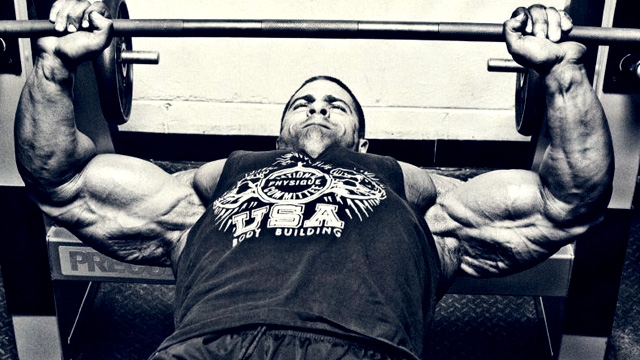 The strategy is simple - no tricks, no cheating, no subtle adjustments that make it look like you're improving when you're really not.
This training cycle will reward you not only with renewed muscle growth and strength, but also with increased work capacity and mental toughness.
I call this the Stack-10 workout (stack dozens on top of each other). I'll start by outlining its benefits, and then add some advice on how to squeeze the most out of this brutal six-week cycle.
THE STACK-10 CYCLE
First, pick an exercise or a large muscle group you want to pump up over the course of six workouts.
Although this works best with complex, large-axis exercises like squats, bench presses, and overhead presses, you can also use single-arm dumbbells, kettlebells, or other types of equipment.
The idea is actually to use a column instead of a traditional pyramid. Instead of dropping reps in every other set, you'll still hold 10, except for that last set, which won't allow you 10 anymore.
In the example below, I'm applying this to a large axis back squat and an exerciser who has a current max of about 185 pounds.
It works like this: You start with an empty axle for 10 reps, then you do 10 with 45 pounds, then 60 pounds, then 85, 100, and so on until you reach a weight that won't allow you 10 reps. For a squatter with a max of 185, it might look like this:
Series 1: 20 x 10
Series2: 45 x 10
Series3: 60 x 10
Series4: 85 x 10
Series5: 100 x 10
Series6: 125 x 10
Series7: 145 x 6
Seven days later, your only goal will be to do those 7 sets again and do more reps on the last one. For example, 8.
Once you've mastered the 145 10, your next workout will include an eighth set of 165. When you first add more weight, don't expect to do too many reps with it.
Here's an example:
Series Week 1 Week 2 Week 3 Week 4 Week 5 Week 6
1 20 x 10 20 x 10 20 x 10 20 x 10 20 x 10 20 x 10
2 45 x 10 45 x 10 45 x 10 45 x 10 45 x 10 45 x 10
3 60 x 10 60 x 10 60 x 10 60 x 10 60 x 10 60 x 10
4 85 x 10 85 x 1085 x 10 85 x 10 85 x 10 85 x 10
5 100 x 10 100 x 10 100 x 10 100 x 10100 x 10 100 x 10
6 125 x 10 125 x 10 125 x 10 125 x 10 125 x 10 125 x 10
7 145 x 6 145 x 8 145 x 10 145 x 10 145 x 10
8 165 x 3 165 x 5 165 x 6
In this example, the trainee has achieved 10 reps in Week 3. In the next workout, one week later, he added an eighth set. His goal was then to add reps to that series for the next two weeks.
Note: Use the rest-pause method in the middle of a set to get more reps. For squats, this would be to rest a little with the axle on your back, do the reps, then pause again for a few breaths and do more reps.
UNIQUE BENEFITS

Stack-10 does what all other efficient cycles do - it makes you bigger and stronger. However, there are a few other benefits as well:
It provides a proper warm-up. Warm-ups are underrated and often poorly performed. It is not only essential for safety, but also for performance.
I usually roll my eyes at endless pre-workout cardio/stretching/activation cycles, BUT I still think most exercisers should do more reps during their warm-up. Primarily because doing so will better train the movement and its motor scheme.
It improves specific work capacity. Work capacity is the ability to tolerate more work without a significant decrease in performance.
It builds mental stamina. Mental toughness is not genetically determined. It can be trained. Suffering through increasingly difficult sets of tens, trying to squeeze more and more out of yourself for six weeks, is a great way to develop this very essential quality.
It increases the volume of training. Intensity is important, but so is volume. The fact is that both play a significant role in developing volume. If you're skipping volume and going for heavy ones, this cycle will increase the diameter of your muscle fibers, which of course will also add strength.
Stability and consistency. Whatever number you reach on your heaviest set will be the weight you can handle on your worst day, not your best. In the end, you didn't save yourself for that series, you earned it with a few hard 10s. This is what makes each of the heaviest series especially important and meaningful.
PROBLEM SOLVING
Before you get into Stack-10, please read the following suggestions. They mean the difference between success and failure.
If your maximum is much smaller (or larger) than the example used, use smaller (or larger) weight jumps. Each successive set should generally be 10% heavier than the one before it.
Ideally, 3-4 days later you should do another workout focusing on maximal strength (3-6 sets, 1-3 reps per set, sufficient breaks). This will provide sufficient stimulus for both volume and maximal strength. These two abilities are synergistic and both should be trained regularly, regardless of the goal.
Eventually, you'll get stuck with this workout as much as any other. Because of this, it only lasts six weeks.
If you get stuck before completing 6 weeks - if you can't improve on your last set from the previous week - take that as a sign that you haven't fully recovered from your last workout. So when you consider your first workout, treat yourself conservatively. There's no need to go in unnecessarily aggressive.
Use this cycle for only one exercise, at least in the beginning. Use it to overcome stagnation on an exercise you can't seem to get moving. When you finish the 6 weeks, try it on the next exercise, etc.
Resist the temptation to continue this cycle indefinitely. I assure you, it would get ugly. Instead, after six weeks, switch to something more intensity-focused for that exercise.
GET YOUR BODY
If you have an exercise that you just can't get better at, use the Stack-10 method. If you work hard, this plan will work.
No posts have been made yet.








