





Shyb - a complex exercise that you definitely must not miss in your training!
 Author:
 Shyby probably needs no long introduction. An exercise you've surely seen countless times, it may look simple at first glance, but many people fail when they try to perform it. Shifts, however, are something that shouldn't be missing from anyone's workout! In fact, it's an exercise that engages multiple muscles at once, you don't need any special equipment for the basic version, and it's done with just your own weight. Shrugs are a very effective exercise in building the wide V-shaped back that is the dream of many of us, and they are also suitable for exercisers of all levels and ages, including children and teens.
Although at first glance this looks like a very simple exercise, the opposite is true. However, practice makes perfect, and absolutely anyone can learn to do shrugs! Don't give up on the initial failure and come with us to see how to actually do shrugs correctly and what benefits this exercise offers!
Article content:
- Theoretical window - what are the shifts?
- What benefits does this exercise offer to the body?
- How to do a proper push-up?
- Try the variations!
- Some tips on how to master your first push-up
- The more you weigh, the more you have to lift
- What to take away from this article
A theoretical window - what are the push-ups anyway?
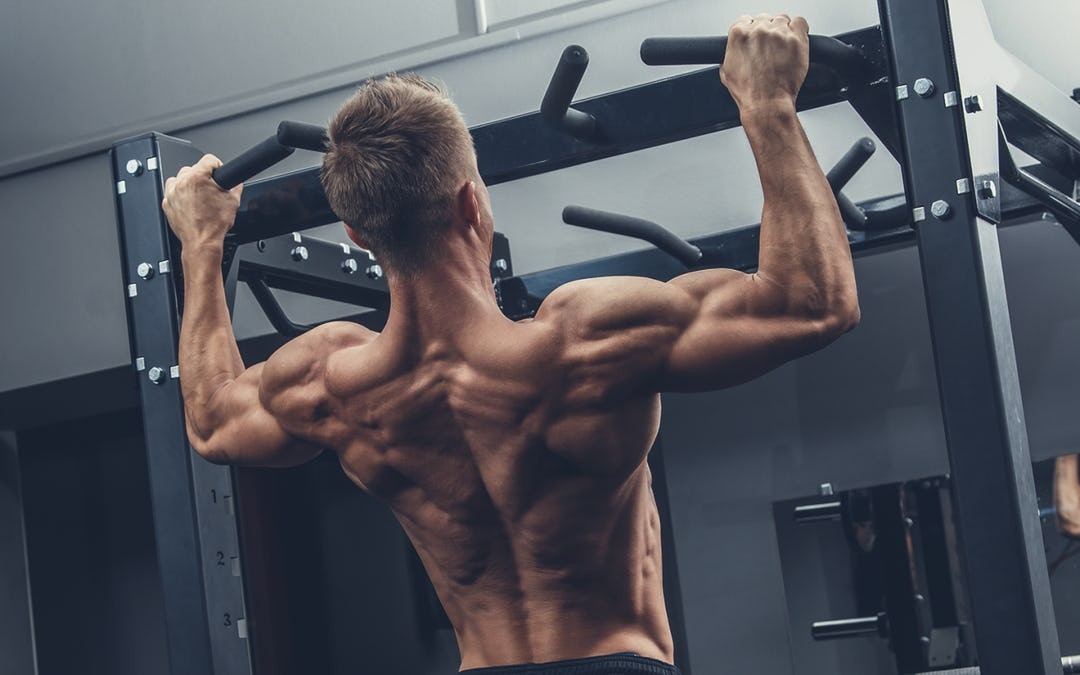
Very broadly and simply - a push-up is an exercise where you hold onto a barbell and try to pull yourself up from a hanging position.The movement of pulling yourself up to the trapeze activates several back muscles, such as the latissimus dorsi, trapezius, rhomboids, scapulae, biceps, forearms, and requires stabilization of the core (deep abdominal muscles) to keep the body stable enough. You can see the basic movement for the hunch in any superhero or action movie, where the main character is hanging from a rock or skyscraper somewhere and gracefully pulls himself up.
What benefits does this exercise offer the body?
We already know what shrugs are and that they are used quite often by superheroes - but apart from making you feel like a superhero, shrugs offer many more benefits for the body and its development and are even suitable for children and teenagers to develop strength and build the right posture. In the following paragraphs we will summarize at least 4 of the most important ones.
Shifts for a strong body and correct posture
As part of our job responsibilities, many of us spend most of our days at the computer or standing over a desk with our backs hunched, which is not good for our backs and posture at all. The other thing that is absolutely not conducive to a correct posture is chest training, especially popular with gentlemen, where if the chest is constantly prioritised over other areas, including the back, or the technique is not used correctly, muscle imbalances develop.
If we are constantly hunched over a computer or machine and our training plan looks like "everyday is chest day", we are developing a disability called upper crossed syndrome. In upper crossed syndrome , specific muscle groups are weakened and shortened. The name "crossed syndrome" refers to a pattern of crossing between muscles that tend to weaken or shorten. Each shortened muscle has a weakened muscle opposite it, so it is always necessary to relax the overloaded (stiff/shortened) muscle and strengthen the weakened one.
At first glance, upper crossed syndrome may be characterized by a specific forward head posture, a rounded shoulder posture, or a backward curvature of the thoracic spine - what we popularly call a hunchback. In addition to the visible symptoms mentioned above, upper crossed syndrome can also manifest itself as irregular pain in the cervical spine, which can even go as far as causing severe and life-altering headaches. Shoulder, chest and mid-back pain are no exception .
Hips can be very effective in helping to combat the development of upper crossed syndrome, rounded shoulders and poor posture, helping to create the foundation for a strong and balanced body.Because hunches require the activation of several back muscles, they can help to build strong back muscles, and help us to have a correct posture, and also to reduce our muscle imbalances and create a foundation for further growth. Especially because of this, hunches are one of the appropriate strengthening exercises that can be performed by children and adolescents.
When we do push-ups, we engage several muscle groups at the same time
Shrugs require the involvement of several muscle groups to achieve the intended result of pulling the body up. This is another big advantage of push-ups because they require active work of the upper torso, including most of the back muscles. In addition, we also engage the deep abdominal muscles during the push-ups to ensure body stability. This is very nice because with one exercise we exercise several different muscle groups at once, which is very effective and can also serve as a time saver.
Shrugs are an exercise for athletes of every level and age
Shifts are an exercise that offers a variety of options, allowing for creativity and customization for every level of athlete. The standard execution in an overhead trap can be simplified by using a resistance band, a sparring partner or an assistive machine. If you don't have the strength to pull yourself up, you can try concentrating on the eccentric part of the movement, for example by jumping up to the top position and slowly lowering yourself down. This will help you build up enough strength to eventually make the bend look the way it's really supposed to.
Shrugs, an exercise of many faces!
Variation and variety in training are very important for development. Shrugs are an exercise that can be performed in many variations. For example, you can use a narrower grip instead of the classic wide grip, or try the underhand grip, which is such a beginner's version and is a little easier. If the body-only version is too easy for you, you can use an auxiliary weight. Such a high level are then for example one-arm push-ups, etc.
How to do a proper push-up?
Now we know what the push-up is good for, that it is a very complex exercise for developing the upper body and correct posture, we know that it can be performed in many variations and that it is suitable for athletes of all levels, but how to do it?
First, let's say that the hunch is an exercise that should primarily involve the broad back muscles, trapezius, rhomboids and scapular muscles that control the correct position and fixation of the shoulder blades, and also the biceps and forearms for light support , but their work should not dominate. The shoulder blades should point downwards. Elbows pushing down towards the back not forward... Here is how the bend should probably work:
- Start by grasping the bar structure above you so that your hands are slightly wider than your shoulders.
- Firm up your midsection, lower back, and butt muscles to get your entire body perfectly toned.
- Pull your shoulder blades down and towards you.
- You will begin to pull yourself up, keeping in mind that your elbows need to point down.
- Your chest should be "busted out" and pointing towards the trapeze.
- Keep your neck vertical and look straight ahead.
- Once you get to the top position, make sure your head is in a neutral position, do not pull your chin up to get higher, this could put undue pressure on your cervical spine.
- Slowly and smoothly lower yourself down, your arms should be at about 95% of full extension.
- Don't forget to breathe!
If the written description doesn't tell you much, check out the training videos from the supertrainer, which not only explain the technique but also demonstrate it.
Be careful of "half-performing" to do more reps, because you are not working through the full range of motion; if you want to make progress, focus on quality, not quantity. Shrugs are an exercise that creates incredible room for error.Shrugs can be performed very easily through poor technique, engaging multiple biceps while under-utilizing the broad back and other muscles that are supposed to be primarily used in this exercise, or all sorts of "swinging" and jerky movements to help you come up. Rather than doing a million reps, make sure you are doing the exercise technically correct and to the maximum extent possible. If you are not in a condition to do the exercise with your own weight, don't be afraid to use an assisted machine.
Try variations!
In addition to the standard push-ups that we just explained and demonstrated, you can use all sorts of variations that we mentioned above. It's very easy to influence muscle engagement by grip - you can use a wider or narrower grip, or not involve your thumbs in the grip, for example. Choosing a thumb grip will give you more forearm and grip training, but some people say that it's harder to feel their back engaging with this grip and soprefer to go for a thumbless grip, which allows the back to be better isolated. On the other hand, for a lighter version, you can use what are called chin ups - underhand grip shrugs that engage the biceps more. For ideal upper body development, it is highly advisable to combine and alternate the variations, and you can avoid stagnation.
Some tips on how to master your first push-up
Build strength
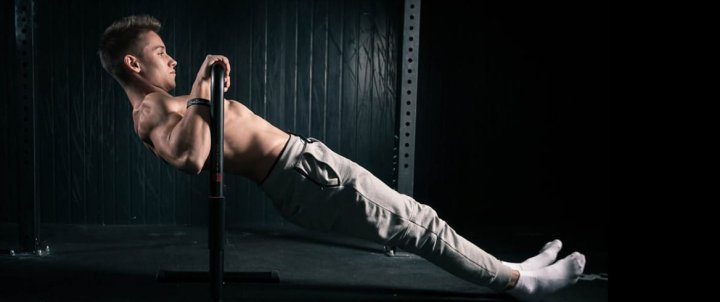
Push-ups are an exercise that requires plenty of strength in the arms and back. To build strength, it's a good idea to incorporate some pulling exercises, such as horizontal pull-ups with TRX, using rings, or you can also use a Smith machine, with your feet supported on the ground , for horizontal pull-ups. Alternatively, start with incomplete reps on the trapeze, but it's important not to get stuck on them.
The more weight you lift, the more you have to lift
A perfectly logical rule of thumb, although you don't need any extra weight to perform the basic version of the exercise, you do need to lift your own - if you're overweight it can be really hard to perform the exercise. How to do it? Not only will you feel better, but such a lightweight might help you do that first push-up !
Start with assistance
There's absolutely nothing wrong with using either a lunge machine, a sparring machine or a resistance band. It's definitely better than swinging like a monkey on the trapeze and pulling your body up with maybe your ears. The machine will also help you concentrate and perform the exercise in a really technical way thanks to the strong fixation, it's just important to choose the right resistance weight so that you don't bounce around on the machine like you're on a trampoline. The resistance rubber is for intermediate users, and you can use different levels of resistance and move up to the point where you can put the assistance down altogether. Again, choosing the right resistance is very important. Don't forget to keep your mid-body strengthened and your breathing regular!
Use the magic of the negative phase
Negative reps are great for people who are simply unable to pull themselves up. Negative execution involves helping yourself to the top position (by bouncing off a bench, for example) and slowly lowering yourself down - this builds eccentric strength as well as strength so that you are able to perform the concentric phase. Try to concentrate on the slow phase of lowering yourself down, and be mindful of precise form. Do about 8 repetitions with a 10 second negative phase and gradually increase the number of repetitions or lengthen the eccentric phase until you are able to do the push-up.
Engage the training pyramids
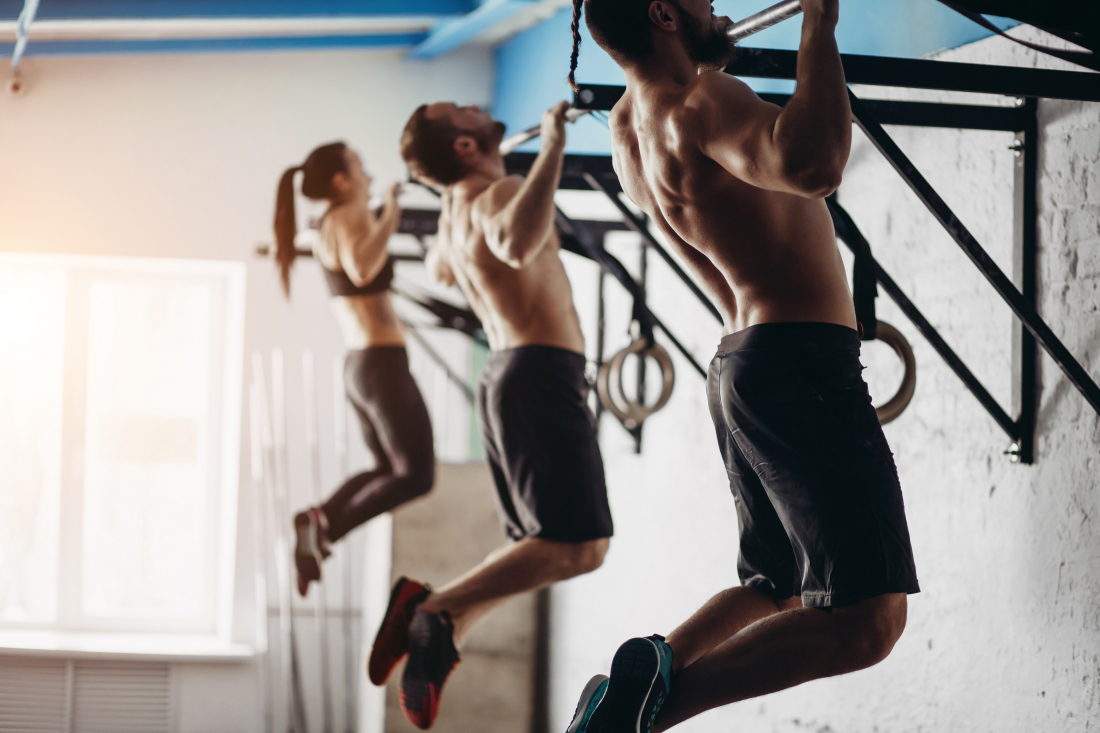
If you can already do a push-up but have trouble doing more at once, try the pyramid method. For example, do two push-ups and take a 20-30 second break . Do three push-ups, take another 30-second break. After that , do five reps and take a 30-minute break again. This method is great if you are unable to do 12 or more reps at a time. It will help you gradually work your way up to being able to keep increasing the number of reps performed in a row. Likewise, you can use this method when you start performing the dips with added weight.
Don't give up!
The hunch is not an easy exercise, but patience and training make the master! Don't get discouraged by initial failure and keep working on your weaknesses. Don't neglect exercises such as pull-ups and mid-body stabilization, which are absolutely essential to performing the hunch. Don't be afraid to use more experienced teammates to help you with your push-ups, or exercise equipment that will make performing a push-up a little easier.
What to take away from this article
Shrugs are one of the fundamental exercises that should not be missing from any training plan. While their technique is not exactly simple, it is an exercise that is very important for proper posture and will help you build the wide V-shaped back that is the dream of many of us. The Shyb is also a complex exercise that engages several muscles at once, making it very effective. Since the hunches help build the foundation for proper posture, they are also a very good exercise for kids and teens. Today we've looked at the benefits of incorporating them into your workout, how to get the hunches to look right, and we've also given some tips on how to actually do that first hunch.
Recommended
Nebbia Crop mikina bez rukávů MUSCLE MOMMY 258
Nebbia Honey Bunny crop top 821
Nebbia Washed muscle back stringer GOLDEN AGE 791
Nebbia Dámský crop top s vysokou podporou INTENSE Mesh 842
Sources:
https://juniperpublishers.com/jpfmts/pdf/JPFMTS.MS.ID.555669.pdf
https://www.researchgate.net/publication/311091421_Electromyographic_analysis_of_muscle_activation_during_pull-up_variations
https://www.medicalnewstoday.com/articles/318897.php
https://www.ncbi.nlm.nih.gov/pubmed/15319765
https://www.ncbi.nlm.nih.gov/pmc/articles/PMC4916995/
https://www.ncbi.nlm.nih.gov/pubmed/23952043
No posts have been made yet.








