





Repetition rate to maximize results
 Author:
 Strict adherence to training variables is a must for natural exercisers if they want to achieve maximum results in the gym, whatever the goal - burning fat, gaining muscle mass, increasing strength, or improving athletic performance.
If you look at most gyms, almost every exerciser (at least I hope) has a plan that consists of certain exercises, a few prescribed sets, a predetermined number of reps, and a rest interval between each exercise/set.
So if we take an example, the first two exercises of a workout could be prescribed like this.
Superset 1:
| Exercise | Series | Number of reps | Length of rest |
| A1 Lunges (Chin-Ups) | 6 | 4-6 | 120 seconds |
| A2 One-arm pull-ups in front bend (DB Bent Over Rows) | 6 | 6-8 | 120 seconds |
The table above has one big minus - it's not a properly written plan, it's missing the one variable that makes all the difference in whether you make new strength and muscle gains or just waste time and effort.
This is REPEAT TEMPO.
Surprisingly, a lot of you are now looking at what I'm talking about. So let's break everything down carefully.
I came across tempo repetition a few years ago when I read one of the older strength training books called Get Buffed! by none other than legendary Australian strength coach Ian King. In his rendition, it was a three-number variation.
His work was eventually followed by the most successful trainer of all time, Charles Poliquin, who expanded three numbers to four during his career.
The four-number variant has remained stable to this day.
These two giants of strength training are considered the founders and then popularizers of tempo reps. However, tempo has been used much earlier, with Bulgarian weightlifters incorporating it into their training since the 1950s! When I met another training idol, Pierre Roy (article HERE), during my internship in Canada, he stated that he had been using the tempo principle with his athletes since the 1970s.
The first study demonstrating the positive benefits of the slowed eccentric phase and its benefits over the accelerated negative phase was published in 2016... This is why practice will always be one step ahead of scientific knowledge.
Understanding pacing - a four-number conundrum
As we can see in the figure below, we always have to distinguish 4 different numbers.
Each of them indicates the length of each phase (in seconds).
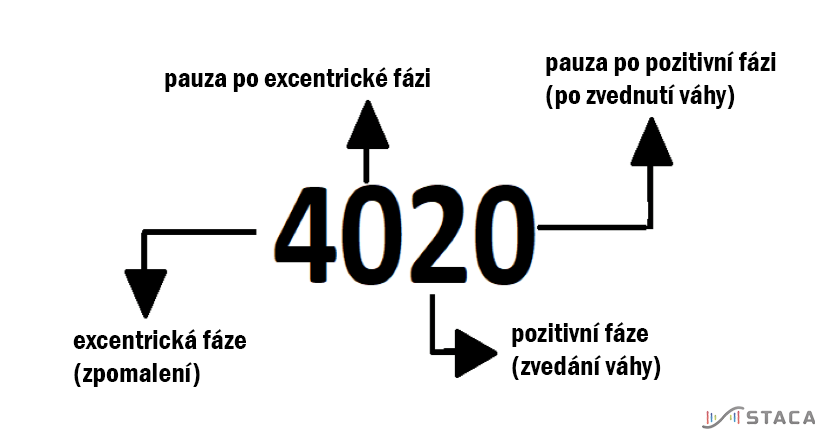
First number = negative (eccentric) phase
The first number always indicates the slowing down of the weight when the muscle lengthens.
If we translate this into practice, this is, for example, slowing down on the way down for squats, lowering the dumbbell to the chest for bench presses, slowing the weight down for push-ups, or slowing the dumbbell down to the shoulders when performing overhead presses.
The number 4, the four-second weight deceleration, is most often cited.
Second number = pause after eccentric phase
After the weight deceleration, a pause, if any, follows. For squats, this is a pause in the bottom position, for bench presses it is a stop at the chest, for crunches and a stop at full arm extension, and for overhead presses it is a pause when the weight is placed on the shoulders.
Third number = positive (concentric) phase
The third number indicates the length of time the weight, or self weight, is lifted during which the muscle shortens and contraction occurs. So if we are lifting the squat up from the bottom position, how long do we lift the bench press up from the chest, etc.
Typically number 1 is used, meaning you simply lift the weight up without thinking long and hard.
! If you see an X, you must lift the weight with maximum effort and as much speed as possible !
Fourth number = pause after the concentric phase
The pause after the concentric phase will vary greatly depending on what exercise you are performing.
When performing a squat, it is the pause at the top position before starting the downward movement that will not give us a significant problem. On the other hand, this phase will be considerably more difficult if we are performing, for example, push-ups, because it is a pause in the top position (isometric contraction). If the last number in the tempo for the push-ups is, for example, 5, you must stay up for 5 seconds before you start to lower yourself down.
Why change the tempo of the reps
Now you're probably wondering why we're saying all this and how tempo can be used and applied immediately in your training.
As I mentioned earlier, tempo is the most overlooked aspect of strength training. However, how much of a difference can a change in rep tempo make in the overall context of the results achieved?
Huge!
There are a few basic reasons to vary rep tempo (again, these are basic recommendations that can vary based on training goal, stage of training, current physical and mental capacity, what muscle or muscle group you are training).
1. Extending the length of time under load (TUT = time under tension).
Time under tension can be defined as the amount of time a muscle is put under tension using a certain weight.
Let's say that two exercisers are performing push-ups with single-arm presses on a flat bench.
The first one will do 12 repetitions at a fast pace, so the whole set will take him some 15-24 seconds depending on the speed of the positive phase.
The second will opt for a controlled slowing down of the one-armed squat for 3 seconds, after completing 12 reps the time under load will be approximately 40-48 seconds.
The difference is noticeable at first glance. Who do you think will get the better training effect?
If we divide TUT by goal, we can distinguish the following in general terms:
| Goal | Number of repetitions | Time under tension (time under load) - in seconds |
| 1. Relative strength | 1-5 | 1-20 |
| 2. Functional hypertrophy | 6-8 | 20-40 |
| 3. Hypertrophy | 8-12 | 40-70 |
| 4. Strength endurance | 13+ | 70+ |
(Source: strength3e.com)
So it's always important to choose a goal and set your training variables accordingly, including the use of rep tempo.
2. Overcoming plateau (stagnation).
If we strictly stick to one plan for a long time, we will exhaust its potential in a short period of time and will not improve further. Critically assess what progress you have made recently - do you have more strength, more biceps or quadriceps volume, can you do more work in less time?
If so, you're doing it right, if not, it's high time to tinker with your training plan and one of the means would be manipulating rep tempo.
For example, do you want to bulk up your muscles? Logically yes, everyone wants more muscle!
Instead of the obligatory 12 fast reps, slow down the negative phase to 4 seconds. The weights will logically go down a bit at first, but after some time you will reap the rewards in the form of increased strength and muscle mass. If a muscle is exposed to a new stimulus, it will have to adapt to it.
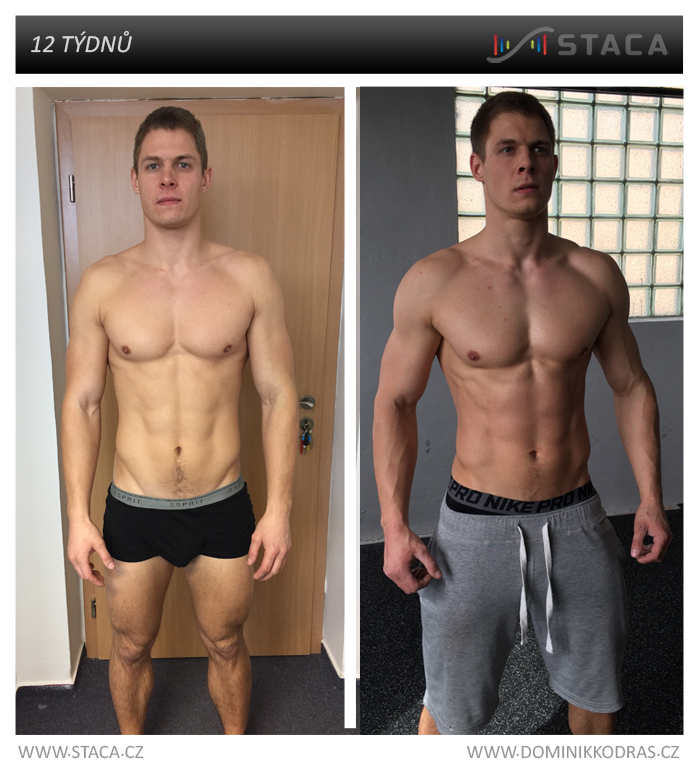
(Image - Jiří Polický and his transformation after changing his training plan and strategically incorporating repetition tempo. Source: www.dominikkodras.cz)
3. Injury prevention by strengthening tendons and tendons.
In the event that we are constantly lifting weight uncontrollably, we will soon reach a point where the body starts sending warning signals and sooner or later an injury will occur. Engage the muscles, concentrate on contracting the right muscles and muscle groups.
It's proven that slowing down the negative phase results in strengthening tendons and ligaments, so take advantage of this benefit and ensure you can lift pain-free for as long as possible. Also, by doing this, you can prevent unnecessary injuries that can sideline you from the game for an extended period of time.
4. Rapid increase in maximum strength.
When it comes to building maximum strength, a slowed down negative phase has a greater effect than a fast execution. It targets the type IIa muscle fibers that are critical for maximum force production. So if your goal is to increase maximal strength, slowing down the negative phase will definitely help you do that.
5. Preventing "cheating".
Don't get me wrong, cheating and forced reps are sometimes a really effective tool to overcome stagnation, but if you help yourself this way all the time, you're depriving yourself of most of your results. While a controlled tempo won't allow you to use as much weight (male ego aside), you'll reap the benefits of better muscle feel.
Note: To produce maximum results, the pace of repetitions must be varied, as if the muscle is exposed to an unchanging pace for a long period of time, stagnation will occur. This rule is even more true for elite athletes, who need to change pace more often than other exercisers, taking into account the stage of training, the type of sport, the composition of the muscle fibres, etc.
I would also like to point out that if the technique of the exercises is inadequate, the pace of repetitions will indeed stimulate the production of new results, but they will not be the same as when you have the correct technique of the exercises. If you're doing half squats instead of the "ass to grass" variation, if you're not fully extending your arms on the push-ups and touching the barbell to your chest on the bench press, you can't expect the best results!
How to do it?
I hope the list of benefits above is enough to get you to try varying the rep tempo.
For the next 3 weeks, try slowing down the negative phase to 4 seconds for each exercise performed, a tempo of 4010.
Chart your results, because maybe even this little trick will help you overcome the stagnation you may be experiencing now. However, it is important to mention that in the long run and training periodization, you need to vary the tempo!
Example of a lower body workout using tempo reps, focusing on quadriceps hypertrophy:
| Exercise | Series | Number of reps | Tempo | Length of rest |
| A1 Front Squat, heels elevated | 4 | 4-6 | 4210 | 10 s |
| A2 Hacken squat on machine (Hacken Squat on Machine) | 4 | 8-10 | 4010 | 10 s |
| A3 Leg Press (horizontal or 45' incline) | 4 | 12-14 | 3010 | 180 s |
| B1 Trap Bar Deadlift | 3 | 8-10 | 3010 | 10 s |
| B2 Reverse DB Lunges | 3 | 8 on each leg | 2020 | 90 s |
| C Leg Extensions | 1 | 100 | 2010 | Do the prescribed number of reps in as few sets as possible with as few pauses as possible! |
P.S. Use the pre-prepared cart after the workout, otherwise it will be hard to get home :)
Good luck incorporating tempo reps into your training plans!
Dominik Kodras,
co-founder of STACA and external editor of bodybuilding.com
No posts have been made yet.








