





Plyometrics - Part 1
 Author:
 Today we are going to look at a specific training method that has nothing to do with weights, machines or the gym, but it caught my attention because even on this website there are a lot of people who go to the gym to improve their fitness, but they don't do bodybuilding or fitness as such.
Their efforts may be, for example, to develop lower or upper limb dynamics, which is important in a variety of sports - football, hockey, volleyball, etc. ... even combat sports cannot do without this principle of training.
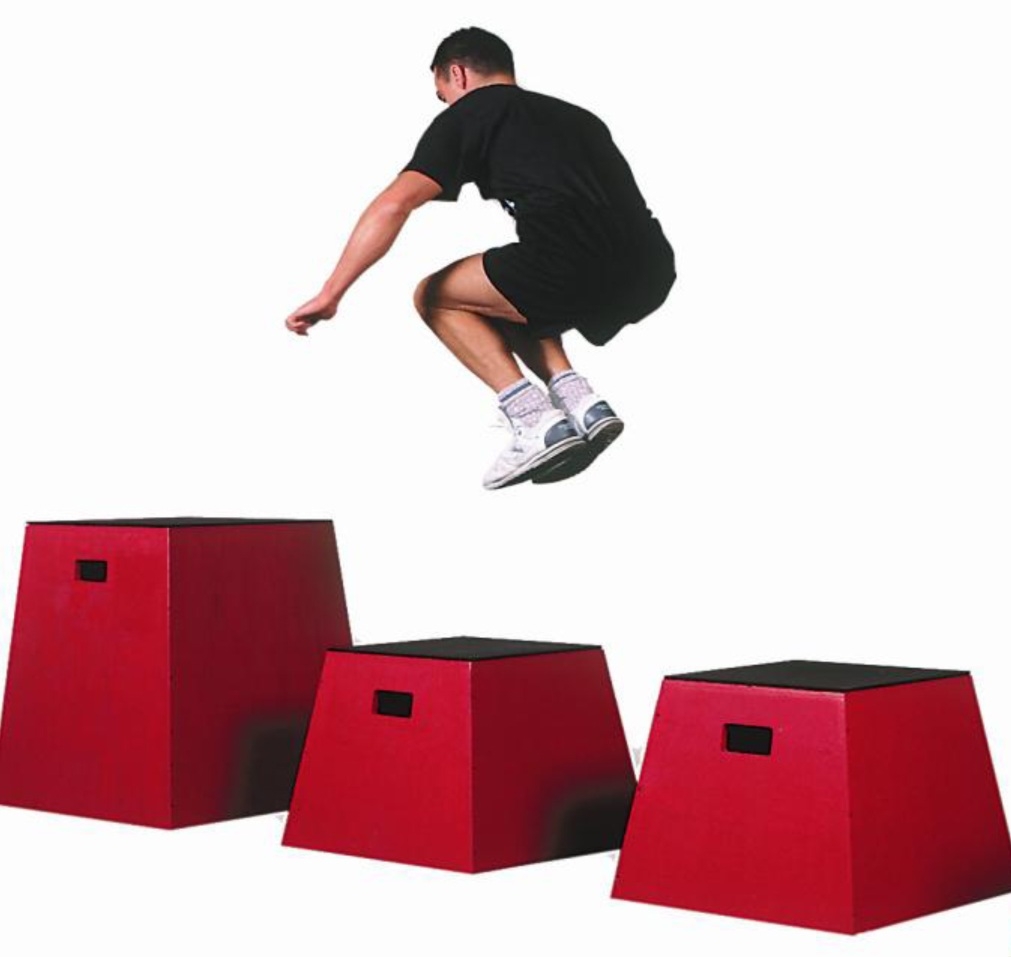
Plyometrics is certainly not a new training method, it has been used for years by athletes in various sports, it just hasn't been called plyometrics. Plyometric training is specific work to increase explosive power. It is a training method that is used along with other strength development methods in a complete training program that aims to improve the relationship between maximal and explosive strength. The purpose of plyometrics is to improve neuromuscular activity and develop fast-twitch muscle fibers (the fibers that play the largest role in producing explosive force).
Of course, for experienced trainers, the concept of plyometrics should not be a big unknown. Virtually every athletic discipline builds on the principles of these exercises. It was developed primarily for explosive and dynamic events such as the 100m sprint or the high and long jump, but is now used by a wide range of sports from track and field to volleyball.
What plyometrics does is that it dramatically increases the amount of explosive force in the muscle fibres. How does it do that? It simply tricks the nervous system to develop the most force in the shortest amount of time.
The origin of plyometrics
Many people and athletes mistakenly think that such a "revolutionary" way of exercising could only have been invented by scientists in the USA or some European superpower. They were wrong. Plyometrics started to be used in the 1970s by Soviet high jumpers and athletes. However, it became more widely used only later, as most coaches argued these statements:
- Plyometrics can be dangerous and has caused tendonitis in many cases.
- It does nothing to improve performance: it creates no stimulus for muscle growth, does not help burn body fat
Yes, it may have caused tendonitis, but if we look back to the training units of Soviet athletes. No wonder- even if the unit of plyometrics training is short, the longer the time it takes to recover.
The myotic reflex
This reflex exists, in layman's terms, to protect muscles from tearing or other injury. We can define it as follows:
When a muscle is suddenly and extremely stretched, the nervous system sends a signal to the muscle to immediately contract (shrink).
It is part of the autonomic nervous system, we are not aware of it, we cannot control it ( like the heartbeat). The myotatic reflex is very important for jumping. Understanding and using the myotic reflex can reveal hidden strengths and abilities. However, not everyone can (wants to) understand this fact. Plyometrics is the only type of exercise that can harness this reflex. When you absorb an impact from an elevated point, the muscles are suddenly and extremely stretched and shortened- this activates the myotic reflex.
Types of muscle contractions
To understand plyometric exercise, we need to see what types of muscle movements exist.
There are 3 basic types of muscle tension and contraction:
- Concentric - the muscles contract, e.g. lifting a weight.
- Isometric - muscles are tensed but do not move, e.g. when holding one position
- Eccentric - muscles are stretched, e.g. when squatting
Tests have shown that the isometric phase is 10% stronger than the concentric phase and the eccentric phase is 60% stronger than the concentric phase. Therefore, we can say: lift 100 lb., hold 110 lb. in place. , and under control we do a squat with 160 lb.
The basic principle of plyometrics
From the previous paragraph, we learned that the eccentric phase is the "strongest" phase. For complete simplicity, we can explain the exercise process as follows: Plyometrics overload the eccentric phase immediately during exercise. Even with gravity, your nervous system thinks the body weighs 3-5 times more than it actually does.This is how we can "trick" the nervous system. This is the real principle of plyometrics!!!
Plyometrics helps to improve the strength and dynamics of the skater's rebound. The basic training methods include the Bounce, which is the alpha and omega of this exercise.
The lunge is a whole body affair:
Recommended

Nebbia Washed-off mikina bez rukávů BEASTIN' 361

Czech Virus Supreme Magnesium Complex
Nebbia Bubble Butt Legíny 2.0 MAXIMUM PUSH-UP 306

Synephrine 100cps 1+1
The more advanced exercises also focus on the fact that the jump is a full-body affair. Many would-be experts have not yet realized that the jump is not just about training leg strength. Leg strength is only part of the entire complex of muscles involved in the jumping phase. For better explosiveness and momentum, the whole body needs to be trained!!!!
Safety rules
- You must be a good athlete
- Always wear good shoes
- Jump on a soft surface ( grass, mat )
- Always start exercising after a thorough warm-up
- Land as lightly as you can with as little noise as possible
- Keep adequate rest between units- about 1 week
- Never exercise with an injured or sore knee
Conditions for performing plyometrics
- Minimal pressure on the knees and knee flexion
- Maximum upward excursion after impact
- Maximum shoulder swing
- Minimum time on the mat
- Impact as blunt as possible - not like a brick
- Always after a good warm-up
- Always perform STS at the beginning of a workout when you are fresh and have the most strength
- Don't test your jump over and over again, this isn't a one month thing
- Hard work --- rest
- Stop thinking that the jump depends only on leg strength !!!
Rest - the biggest mistake
Lack of rest is probably the biggest and most common mistake in plyometric exercises. Many uninformed athletes perform this type of exercise 3 or more times a week. Many of them assign plyometrics to their aerobic exercise- a BIG MISTAKE. Muscles need to recover and adapt after intense work. In the rest phase, the body adapts to the pressure that was put on the body during the exercise phase and the muscles become stronger.
The exercise phase
- pressure is exerted on the body
- overload outside of normal movement
Rest phase
- the body "heals" from the pressure
- progress is made
- R.E.M sleep and nutrition are very important
So how much rest is needed? This aspect usually leads the individual to distrust the program. A bare exercise routine usually takes 20 - 45 min. per week and rest 4 - 7 days? This can never help me. But it is true.This is the principle on which STS is based. Intense exercise in a short time and then proper rest.
Overtraining or lack of rest often leads to rather negative results!!!
Guidelines for optimal results
Minimal knee flexion:
One of the most common mistakes in jumping is bending too much at the knee. The more the knee is bent, the longer it takes for the muscles to shorten and thus the vertical jump is reduced. Many athletes try to get into as much of a squat as possible in preparation for the actual jump. They think this will give them more power to their legs, but the opposite is true. Therefore, the optimal knee bend is between 20 and 25 degrees.
Maximum lunge after the upward impact:
In plyometrics, you are "tricking" your nervous system into performing as much power as possible in the shortest amount of time. This needs maximum effort. You have to put everything you have into each repetition. Every jump has to be as big as possible. If you don't bounce off the ground as much as you can and fool your nervous system, the exercise is useless.
Maximum arm swing:
Maximum arm swing is the critical point of the jump. The arms create much of your momentum in the jump. Think of your arms as pendulums lifting up a lot of weight. Always swing your arms as hard as possible.
Minimum time on the mat:
The longer you are in contact with the ground, the less the myotic reflex is engaged. You want to get off the item as quickly as possible. For example, imagine there is hot lava on the ground and your feet are bare. Get off the ground as fast as you can.
Land as lightly as you can:
You need a smooth impact ( Eccentric Phase ) to make an explosive transition to the jump ( Concentric Phase ). If you've ever seen a really good player, a "high flyer" on the dugout, you've probably heard that he made almost no noise - in fact, he absorbed the impact on the ground easily. The transition from the rebound to the jump shot must be light and controlled to maximize the vertical jump.
Always perform warm-up exercises:
Remember that plyometrics is physically difficult and needs maximum effort. You must be prepared to make fast and powerful movements.
Always perform STS at the beginning of your workout when you are fresh and have the most strength:
If you perform plyometrics when you are tired, your movements will be slow and you will not be able to concentrate properly on the exercise.
Don't test over and over again to see if your jump has improved:
Plyometrics 04We are all eager to see if we are able to jump higher. We don't want to wait for the results to come in. But please, let's be patient. Improvement is not a matter of overnight or a week. The biological process simply doesn't work that way. Let's give it time. Give yourself a chance to develop, to let your body adapt to the load. Try to test your jump every six weeks, even more. You might be surprised what happens. If you test yourself after every workout, you won't see a difference and you'll just get depressed.
Stop thinking that the jump is all about the legs:
The lunge is not performed only with the legs. It is not an isolated movement.The jump is performed with the whole body and needs proper coordination of all parts of the body. This is the only way to create maximum vertical speed.
The physical component of the jump
Let us ask ourselves a very important question: How high can we jump according to the laws of physics? The answer to this question is here:
The vertical velocity of our center of gravity.
The arms and legs only transmit the movement of our centre of gravity.
Movement = Weight + Speed
Weight - the most important part of the weight is concentrated in the center of gravity of the body. Everything else is attached to the center of gravity.
Velocity - in this case we are thinking about the speed of the jump. Your goal is to maximize your rising speed.
From a physics standpoint, we can develop tremendous velocity by adding speeds!!! We can explain this with a simple example:
When we stand, throw the ball at, for example, 20km/h...
But now imagine you are running at 10km/h and you throw the same ball again at 20km/h. How fast is the ball going now?
Answer: 20km/h + 10km/h = 30km/h
We can use this advantage very well in jumping. By stacking the speeds of our body parts, we can create speeds you might not expect:
1. Upward swing of the arms
2. Head and back straighten
3. Hips push forward
4. Legs straighten and bounce off the mat
5. The calves "swing" the feet down
Remember, the movements come in a row one after the other:
PROCEDURE
1. Swing arms up +
2. Head and back straighten +
3. Hips push forward +
4. Legs straighten and bounce off the mat +
5. Calves "swing" the feet down =
Vertical speed of the centre of gravity
The stacking of body part speeds is very important for the jump and we must remember that these movements must follow one another, not in parallel. Like a wave that starts gently rising and gains more and more power and speed towards the shore.
Impact:
In impact, the motion is absorbed in the same sequence as in the jump, but in reverse order. The more you spread the motion, the softer the impact.
Basic Exercise
In the continuation of the article on Plyometrics, we will talk about the basic exercise and expand and explain some of the laws.
Theoretical preparation for the exercise
Force generation during the jump phase
In order to generate as much force as possible, you need to build up as many muscle fibres as possible. The only difference between a strong movement and a somewhat slower and lighter movement is the number of fibres activated. Each fiber produces the same amount of force. It is plyometrics that gets the most muscle active. fibers. That is why you must always concentrate on the exercise as much as possible.
The goal of plyometrics: to activate the maximum number of muscle fibres!!!
Speed is only one component of the jump, so the athlete must always remember the power phase as well. To be successful, it is necessary to make sure that our jump contains both a speed component and a strength component. Only by combining these components together will we get the maximum effect.
In the next section we will look at the appropriate exercises for this type of training.
[Source: volleyball-metodika.cz]
No posts have been made yet.








