





Overhead lift in powerlifting
 Author:
 When people think of weightlifting exercises, they usually think of relocations, expressions or markets. Although all three of the exercises mentioned are great, there are many variations that can be useful for building muscle size, strength and power.
One such variation is the overhead lift. This article will explain the merits of this exercise and suggest ways to incorporate it into your training. I will also explain step by step how to perform this exercise.
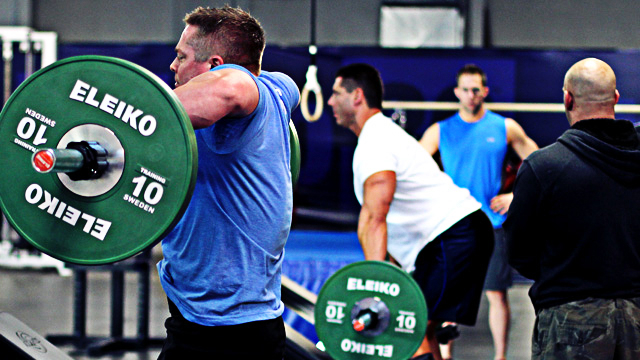
Advantages of the overhead lift
For most athletes, power (the ability to apply force quickly) is more important than maximal strength. Power, or speed force, is the amount of work done per unit time. Research shows that in terms of power production, weightlifting movements are superior to those of lifters.
In addition, the movement pattern used for the high lift is very similar to those commonly used in many sports. Most of the power produced in a reposition or market is generated in the second part of the deadlift (from the knees roughly to the sternum).
In both the relocation and the market, the weightlifter drops below the centerline as it reaches the sternum. However, this catching phase does not help the overall force production in these movements.
The advantage of the lift is the fact that the athlete does not have to catch the axis. As a result, he or she can usually use a heavier load. This is especially advantageous for athletes who have trouble in that catching phase and have to use lighter weights because of it.
The heavy load and high momentum are the cause of the high power production (for men it is an average of 52 watts per kilogram).
Another advantage of weightlifting movements is the extremely low incidence of injury. As long as they are performed with correct technique, they are as safe as any other training technique.
In addition, weightlifting movements can reduce the incidence of injury by improving movement awareness, strengthening muscles, tendons and ligaments, and improving coordination.
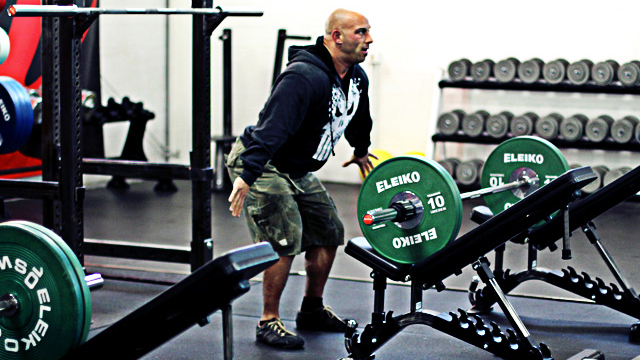
Incorporation into a training program
Strength training typically combines low repetition counts (1-6) and extended breaks (2-6 minutes). Such a combination allows for greater load, reduced fatigue, and thus allows the maintenance of axis speed and technique.
If we are concerned with greater axis speed, we can use loads between 30 and 70% of 1 RM. This can be used in sports where speed is more important than power production ( high jump, volleyball).
Conversely, in sports where force production is essential (Am. football, wrestling), it is good to use loads between 70 and 100% 1RM.
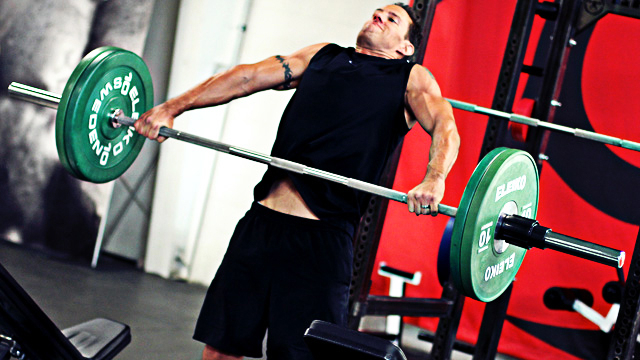
Proper execution of the pitching lift
It is easy to say that a pitching lift is like performing a three-quarter reposition. However, since all weightlifting exercises are technically demanding and great technique is absolutely essential, we'll explain it step by step.
Teaching this movement has several variations. I prefer to start from the bottom, with the foot position.
- Biomechanically, the repositioning is very similar to a vertical lunge. Because of this, it's a good idea to choose the position of your feet for the overhead lift based on their position during the lunge. Usually this means feet about shoulder width apart and toes straight ahead.
- Once the feet are in place, you can move to the hand position. Grasp the axis with a wide overhand grip, thumbs on the axis and pointing towards the center of the body. Slowly move your hands until your thumbs are lightly touching the outside of your feet.
- The next step is to get a good grip. Once you have good technique, you can start using decent weights, which will have some of those requirements for the strength of your grip. The most secure is the lock (thumb around the axis, fingers around the thumb and axis). It may be uncomfortable at first, however it is the way to go if you are serious about this exercise. It is easier to learn this movement from the vis, where the axis rests on the thighs, just above the patella.
- With your legs and arms in the correct position and a locking grip, straighten the axle and let it slide back down over your knees. Arms should be stretched and rolled out so that elbows are pointing at the end of the axle. The head should be in a neutral position and the back arched.
- In this position, the shoulders should be just slightly in front of the axis. If they are not, this can be improved by taking a step back to bend the knees, which will get the shoulders into the desired position. Once you can assume the correct starting position, you can begin to learn the movements that lead to the actual lift. It's important to check the starting position before each rep until you can get it right without even thinking about it.
- The first in the sequence of teaching movements is a shoulder shrug with a lunge. With your body center firm, you perform the jump, fully extending your knees and hips as if you were trying to jump and touch your head to the ceiling. At the top of the movement, the ankles, knees hips and shoulders should form a straight line.
- Using the inertia from the jump, aggressively hunch your shoulders as high as you can without bending your elbows. Do not allow the axis to swing away from the body. The axis should slide over the thighs to about hip level.ñ Once you have mastered the starting position and shoulder shrug with the jump , you can move to the next step, the bottom of the deadlift. It's just a continuation of the lunge and shoulder shrug, where you add a pull to bring the axis to belly button height. At the top of the lunge with the shoulder shrug, let your elbows bend a little until the axis gets to the desired height. As you move into this bottom position of the deadlift, it is important to keep the axis close to your body and your elbows over your wrists.
- The final movement to learn is the top of the deadlift. Again, this is just a continuation of the movements you already know. At the top of the bottom part of the pull, continue with the pull until the axis reaches sternum height. Concentrate on keeping your elbows above your wrists and the axle close to your body. At the same time, the ankles, knees and hips will be fully extended
Summar y
The overhead lift is a great option if your goal is to improve your ability to produce power. The high force production this exercise allows is due to the high loaded weight and the speed the axle travels.
The lift, like other weightlifting movements, is very safe if you master it with proper technique. As far as training programs go, the lift can be used in both muscular strength training and strength endurance training.
The method of teaching the lift described above will allow most athletes to learn it quickly and safely. In the end, all you have to do is work up a good sweat.
Written by Allen Hedrick, translated by Jaromír Uhlíř
No posts have been made yet.








