





More training volume for stronger arms
 Author:
 I finished last in almost every race, but I was glad I made it through without injury. The next day I wasn't so happy. My legs and lower back were a little sore. But my arms looked and felt like they had been trampled by a horse. My fingers, wrists, forearms, elbows and biceps were so sore from lifting rocks and Conan's bike that I considered seeing a doctor.
Not that I wasn't training. I did farmer's walk (trunks), log press (log), zher squats, sled pulls (sled drag), heavy squats and deadlifts. I did everything you'd expect from a budding strongman. But I didn't train my arms straight at all. Big mistake.
I learned my lesson: If you want to compete among strongmen, train your arms.
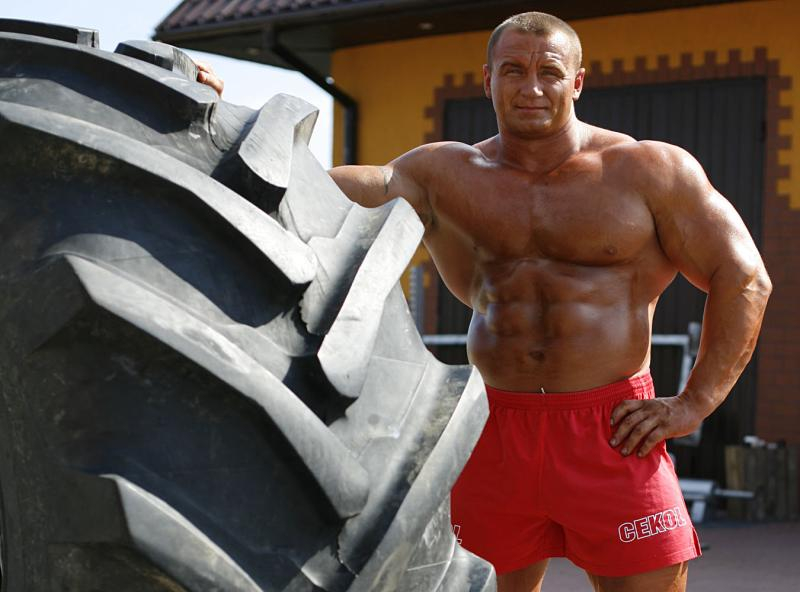
There was a time when I wouldn't have needed that lesson. When I first started training, big arms weren't just a byproduct of my efforts. They were the main goal. They were the reason many of us started training. It didn't matter if you worked out for sport, strength, fitness, or to look good naked. Muscular arms were an indicator of strength and vitality.
What has changed?
Somehow the idea that real arm training was only for bodybuilders and stunted men got into our heads. We gradually forgot that bigger and stronger arms can help us in many sports. In American football, for example, players use their arms to control their opponents. Defenders have to have enough strength to bring their opponent to the ground. Neither overall strength nor mid-body strength can substitute for hand strength.
Add to the volume
When I talk about real hand training, I don't mean a few sets of lifts and extensions at the end of the workout. The following program is for six weeks and breaks some of the current rules about volume and training length. You have to be willing to take on new challenges. That's why you'll be doing more than 20 sets in each workout, and you'll be working out for 60 to 75 minutes.
I've written down two different arm workouts that you will alternate. They recommend splitting it into three days, with the arms on the first, legs on the second, and chest and back on the third.
Recommended workout layout:
- Day 1: Hands #1
- Day 2: legs
- Day 3: rest
- Day 4: chest, back
- Day 5: rest
- Day 6: arms #2
- Day 7: legs
- Day 8: rest
- Day 9: chest, back
- Day 10: rest
- Day 11: repeat cycle
Series and repetition
Adapt them to your capabilities. Aim to add load slowly, rather than destroying yourself completely in the first workout.
I also don't write anything about warming up. Add that as needed.
Breaks
Adjust them as they suit you. The bigger you are, the more breaks you'll probably need. But don't take breaks longer than three minutes.
Small and well-trained women will be fine with 45 to 60 seconds of breaks.
Load
Go to failure
Tempo
The first two exercises of each workout emphasize functional hypertrophy and maximal strength. Do each repetition explosively and as quickly as possible. Always run in a controlled manner.
The goal of the remaining exercises, which you will perform at 2010 tempo, is to exhaust as many motor units as possible while maintaining constant tension in the target muscles. It doesn't have to be precise, but you need to deploy and hold the tempo. Think of it like pedaling a bike up a hill where the tension in your legs doesn't stop. That's how to pace 2010. The movement doesn't stop during the series.
Hand Training #1
A1) Big axis lift (cheating), series with pause, slow release
Help yourself finish the reps with your hips, lowering the weight to the starting position slowly. Series with pause require a short pause after each rep (explained below).
Load: use a weight that you think you can do only 3 reps with decent technique. You'll probably have to adjust the weight a few times before you find one that will allow you to do about 4 (no more than 6) reps with cheating.
Sets/reps: 3 sets, 4 reps with a pause (leave the axis resting on your thighs for 2 seconds after each rep).
Tempo: 42X0 (lower weight 4 seconds, pause 2 seconds, lift explosively, no break at the top).
Breaks: 90 seconds.
A2) Triceps extension with EZ axis lying on the floor, series with pause
Lie with your back on the floor. Keep the axis on the floor behind your head. From here, you will always push it from complete rest. After each repetition, the axis will be on the floor for 3 seconds. If you own rubberized discs, prop up your dumbbell so the starting position is not so low.
Load: use a weight that will allow you to do 3 reps without a break with decent technique.
Sets/reps: 3 sets, 6 reps with a break.
Tempo: 33X1.
Breaks: 90 seconds.
B1) Bicep single arm deadlift on a positively inclined bench.
Set the bench at 60 degrees. Use an underhand grip.
2 to 3 sets, 4 to 6 reps.
Tempo: 2010.
10 seconds.
B2) EZ axis lift on Scott bench.
Begin each repetition with arms outstretched. Come about three-quarters of the way up.
Sets/reps: 2 to 3 sets, 6 to 8 reps.
Tempo: 2010.
10 seconds.
B3) Bicep lift on pulley.
Use a broken grip and a narrow underhand grip.
Sets/reps: 2 to 3 sets, 6 to 8 reps.
Tempo: 2010.
Breaks: 90 seconds, circle repeats.
C1) Triceps extension with one arm.
Take two one-handed dumbbells, lie down on a flat bench. Elbows pointing to the ceiling and palms up (underhand grip) throughout the movement. Lower the one-handers to your ears and touch your front shoulders at the bottom.
Sets/reps: 2 to 3 sets, 4 to 6 reps.
Tempo: 2010.
10 seconds.
C2) Triceps extension with big axis.
Use a large dumbbell and lower it to your forehead.
Series/reps: 2 to 3 sets, 6 to 8 reps.
Tempo: 2010.
10 seconds.
C3) Triceps Pulley Squeeze
Use a straight extender and overhand grip.
Sets/reps: 2 to 3 sets, 8 to 10 reps.
Tempo: 2010.
Breaks: 90 seconds, circle repeats.
Hand Training #2
A1) Pushpress, series with pause.
Use a shoulder-width grip. Keep your elbows below your midline and begin the movement by bending your knees. Push the axis overhead and slowly lower. Pause for three seconds in the bottom position.
Load.
Set/Reps: 3 sets, 4 to 6 reps with a break.
Tempo: 33X1.
120 seconds.
A2) Weighted push-up, rest-pause series
Add some weight and hang from a trapeze bar. Use a shoulder-width overhand grip. Keep your body as vertical as possible. This will better engage the biceps. Stay at the top for a second, slowly lower yourself down and immediately start the next rep. Do 2 to 3 reps, come down, hold for 15 seconds and do another 1 to 2. Again, take a 15 second break and do the last 1 to 2 reps.
Load: use a weight that you can do 3 reps of regular push-ups with.
Sets/reps: 3 sets, 6 rest-pause reps.
Tempo: 31X0.
120 seconds.
B1) Triceps extension with EZ axis
Set the bench to a slightly positive incline (15 degrees) and lower the axis to your forehead.
Sets/reps: 2 to 3 sets, 4 to 6 reps.
Tempo: 2010.
10 seconds.
B2) Barbell push-up.
Keep the body upright. This will better engage the triceps.
Sets/reps: 2 to 3 sets, 6 to 8 reps.
Tempo: 3010.
Breaks: 10 seconds.
B3) Triceps pulley press.
Use a rope.
Series/reps: 2 to 3 sets, 10 to 12 reps.
Tempo: 2010.
Breaks 90 seconds, circle repeats.
C1) Zottman biceps single arm curl.
Lift the one-armed arms up with an underhand grip. In the top position, rotate and lower them with an overhand grip. On the bottom, rotate the wrists back to the underhand and repeat the execution.
Series/reps: 2 to 3 sets, 4 to 6 reps.
Tempo: 2010.
10 seconds.
C2) EZ axis overhand lift.
Series/reps: 2 to 3 sets, 4 to 6 reps.
Tempo: 2010.
10 seconds.
C3) Hammer deadlift, 10 minutes, 10 seconds.
Both arms working simultaneously.
Series/repetitions: 2 to 3 sets, 6 to 8 repetitions.
Tempo: 2010.
Breaks: 90 seconds, circle repeats.
Good arms
Do this workout four times each. If you break it up as I suggested, it should take you about 40 days. Try to outdo yourself each workout and the reward will not pass you by. You will have bigger and stronger arms.
How strong? After I landed the aforementioned competition in 2007, I started doing high volume split hand training. In nine months, I improved the log press from 170 pounds to 215, and I lost 8 pounds during that time. (In pounds, that's 77 - 97 - 3.6 )
Written by Eric Minor, translated by Jaromir Uhlir
No posts have been made yet.








