





Introducing the seven best strength exercises!
 Author: Šárka Randáčková
 Increasing strength is not just about adding discs in the three main exercises. It also takes some thought in the composition of the workout.
Here are the top seven exercises you're probably not practicing. We'll go over what they target, and how they'll help you get stronger in the three most important exercises.
1 - Squat with weights on your belt
Target muscles:
Quadriceps
How it helps:
If your hips shoot forward and your chest drops when you squat, this might help.
- Adaptation of the nervous system is primarily responsible for developing strength (1).
- Higher loads are more productive here than lower loads (2).
- Unfortunately, high intensity can be detrimental in the long run due to the accumulation of fatigue if not well attended to (3).
- When we look at lower body exercises, the biggest fatigue factor is axial load (4). This refers to the position where the spine is subjected to compression loading.
- This version of the squat breaks down the axial load, which is excellent because you can train with a lot of intensity, and you don't generate nearly as much fatigue compared to a traditional squat.
2 - Floor Press
Target muscles:
Chest, shoulders, triceps
How it helps:
Do you ever get stuck in a bench mid-performance? This will help.
- Most exercisers get stuck in the middle of a benching movement.
- In a triple-legged bench, your back is arched and you start the exercise by adding momentum with a leg drive. This is great in competition where you need to use every advantage. In training, however, it can be good to break it down strategically.
- In the floor press, you don't use your legs and the beginning of the leg drive is right at the hardest point of the bench. This will train your weakest point and increase your strength without using the jersey.
3 - Reverse hyperextension
Target muscles:
Lower back, hamstrings, glutes
How it helps:
Does your lower back round when you deadlift? This will help.
This exercise was invented by Louie Simmons. It's quite popular, but a surprising number of people still don't know about it.
- Strength athletes generally don't train for muscle. And that can become a limiting factor.
- If your quadriceps can handle 300 pounds and your lower back can only hold 200, your back will be limiting you!
- Here's a time for a little bodybuilding. Reverse hyperextension not only trains the glutes and hamstrings, but targets the lower back first and foremost (5).
- Training your lower back will help you to tighten it up so that it can take more load during squats and deadlifts.
- Another positive of this exercise is that it doesn't cause too much fatigue, and it's even regenerative thanks to the decompression (5).
4 - Squat with safety axis
Target muscles:
Quadriceps and midsection
How it helps:
If your hips shoot up and your chest drops forward during the squat, this should help.
- It's an effective variation of the low-axis squat. It's traditional for people's hips to go up too quickly during the squat and the chest to drop. Their squat then looks more like a good morning.
- This is most often caused by weak quadriceps. This variation of the squat works with torque.
- Since you're upright, your knees have to exert more torque in order to stand up (6).
- This will give your quadriceps a workout. Since you can't squeeze the axis normally, you don't have as much upper back stiffness. This increases its strength and works the middle of the body.
5 - Squeezing the rubber
Target muscles:
Triceps
How it helps:
This is another preventative exercise for those whose bench press gets stuck mid-movement.
- Supplemental work is often overlooked in strength training because it's not specific enough. Mistake.
- Increased muscle fiber diameter directly contributes to an increased ability to generate force (7).
- And since the triceps is essential in benching, it needs to be trained.
- To understand why the rubber band press is better than other triceps exercises, we need to understand torque (8).
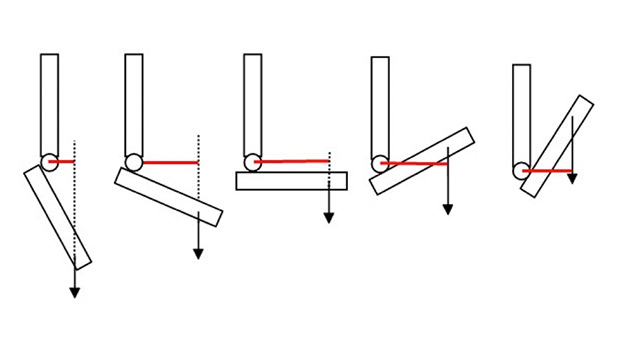
- This diagram shows the execution of the squeeze.
- Linear force (the external load during the squeeze) is the downward pointing arrow.
- The ring (elbow) is the axis of rotation.
- The distance between the linear force and the axis of rotation is represented by the red line.
- The distance between the linear force and the axis of rotation affects how much torque is required. The greater the distance, the more torque.
- Therefore, a flexion of 90° will create the highest torque requirement. As you compress, the torque decreases.
- But because the rubber puts up more resistance the more it stretches, the torque requirement does not decrease (8).
- So the triceps here are working maximally throughout the length of the movement.
6 - Pendley deadlift
Target muscles:
Lower back, lats, upper back
How it helps:
Prevents instability during the bench press and back rounding during the deadlift.
- Deformity is a change in shape and size due to mechanical forces (9).
- You can observe this when you' re approaching 1RM and your technique is going away (your back rounds, hips flare up, etc).
- The spinal flexion during a squat can be as much as 40% (10). Such deformation reduces mechanical efficiency, and ultimately the weight you can lift.
- Pendley deadlifts train the lower back, lats, and upper back. This will increase the overall ability of the back to contract and resist deformation at weights approaching the maximum.
7 - Good Morning from the stops
Target muscles:
Lower back, hamstrings, glutes
How it helps:
For the squat, this will help with tightening the midsection. For deadlifts, this can prevent lower back rounding and tightening issues. Overall, this strengthens the posterior chain, which will increase the maxes in the above exercises.
- Increasing strength through this exercise will again drive torque. So it's time for the next diagram:
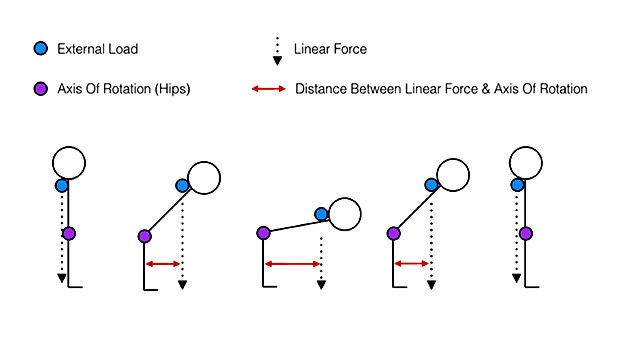
- At the bottom is the linear force furthest from the axis of rotation (here, it's the hips).
- The muscles around the hips and spine that must contract for the hips to reach extension are the hamstrings, glutes, and spinal extensors.
- Good mornings increase the overall strength of the posterior chain, reducing strain during core exercises and increasing the ability to withstand higher loads.
Recommended
Nebbia Bandeau podprsenka BACK CHECK 612
Nebbia FIT & SMART cyklistické šortky FIT 575
Prom-in Health Balance 2.0
Eurovo Service Tekuté vaječné bílky
Source: www.t-nation.com -The 7 Best Strength Exercises You Don't Do
Author: Daniel DeBrocke
Translated by Jaromír Uhlíř
Author: Šárka Randáčková No posts have been made yet.








