





How to increase the intensity of your workout
 Author: Šárka Randáčková
 During my reign over Olympia, I was known for my training intensity. More accurately, I was able to push my streaks to complete failure and often beyond. To do this, I used several techniques that put maximum stress on the target muscles.
In this article, I'll show you a few of those techniques, plus a few that I didn't use but worked well for others.
Training to Failure
Before the actual techniques, let's talk about how to get the muscle to momentary failure. If you can't do that, it's pointless to attempt any additional techniques. You need to name the difference between a bodybuilder and a weightlifter.
A weightlifter wants to get as much weight as possible from point A to point B. If that means a swing and the shortest path, then so be it. He's not interested in straining the muscle. A bodybuilder looks at reps exactly backwards, and wants to make the target muscle work as hard as possible, with minimal help from the surrounding muscles and the swing.
That's why I insist so hard on strict, controlled execution. I do the positive part of the movement explosively, but I never drop the weight afterwards because I would miss out on all the negative part of the fun.
Some scientific evidence even claims that it's the negative part of the repetition that does the most damage. By repairing this damage, muscles grow and get stronger.
Always remember that there are three types of strength, each of which can be expressed as part of a repetition:
- 1) Positive - lifting weights
- 2) Static - holding the weight with the muscle in full contraction
- 3) Negative - lowering the weights
This does not apply to all exercises, as some do not show much resistance in full contraction. Two good examples are the end of the squat and the deadlift. There, most of the pressure is actually on the joints at the end. For most other exercises, however, you can measure static force by attempting to hold in the contracted position.
If you can't do that, you're obviously using a swing to move the weight, not pure muscle power. Mark Dugdale demonstrated this nicely on his DVD A Week in the Dungeon. He completed a series of heavy pulley pull-ups and immediately looked at me and was a little surprised when I said, "Shit job!" I explained that he hadn't held a single rep in a position where the bar was touching his body. He wasn't pulling it with the lats, he was swinging it towards himself. To perform the exercise correctly, he had to take the weight off.
This makes it very easy to check technique and ensure that you actually fail the muscle you want at the end. I always tell people to try to relax overall to isolate only the muscles that are supposed to work.
Anything extra is usually wasted energy. I'm a fan of heavy training, of course, but you have to remember that bodybuilding isn't about weight - it's about training a muscle as hard as humanly possible. I hope you now understand what it means to train a series to failure. Now we can talk about what techniques to use in training to failure.
1. Forced reps
Right off the bat, it should be said that forced reps are an art, and you need a good partner for them. The idea is to add just enough assistance to overcome the point where the weight stalls, and add one or two reps for positive failure. This is the most commonly used intensification technique in my opinion. In every gym in the world, you'll see someone come to the bench, load up far more than they can handle, and have a partner pull it off with them from the first rep.
And what's that for? It's all about ego and that number on the barbell, of course. But that's back to weightlifting. A guy like that usually doesn't have much muscle on his chest because he never really trains hard enough to stimulate any growth. I want it to look like you're doing five or six reps complete by yourself before a partner gets involved and double-assists you over that point where you get stuck. In my opinion, anything above two forced reps at the end of a set is useless.
2. Negative reps
We mentioned above that the negative part of the repetition is at least as important as the positive, maybe even more so. In the 1970s, the inventor of the Nautilus machine, Arthur Jones, even promoted a workout where partners lifted all the positive reps and the trainees' own weights were just slowly lowered. This proved impractical. For one thing, it sometimes took two fairly strong partners.
Imagine lifting 250 pounds for someone on a squat so that they're just lowering it. And secondly, it was quite dangerous. It's because we're all weakest in the positive part of the movement and strongest in the negative. If you can do 150 on the bench, you could probably lower 200, 220. That's a huge strain on your joints, ligaments and ligaments. Especially if you wanted to train like that regularly. It's much more practical and safer to reach failure with a given weight, and then get two or three assists from a partner into a contracted position from where you slowly lower the weight, thus exhausting the negative force as well. The one of the three that usually leaves you last. A lesser-known method is what's called "negative stressed training," where you lift the weight with both limbs but lower it only once more.
Common examples are leg extensions, biceps on the machine, rowing on the machine with chest support, leg press or bench on the machine while seated. Naturally, this will only work on machines where both limbs are moving one platform.
Recommended

Nebbia Crop top tričko POWERHOUSE 279

Nebbia Bezešvá lift-up sportovní podprsenka FLOW SEAMLESS 495

Nebbia Dlouhá everyday HERO mikina s kapucí 580

Nebbia NATURE-INSPIRED Sportovní crop top “Racer back” 549
3. Series with a break
These have recently enjoyed renewed popularity thanks to DC training. They borrowed them from me, I borrowed them from Mike Mentzer, and Mike borrowed them from Arthur Jones. The basic idea is to take several short breaks during the series to allow the use of heavier weights.
That way, you get several positive failures during a series. The considerable advantage of series with a pause is that they allow the muscles to adapt to much heavier weights, and that the strength from these will carry over to the regular series.
4. Shagged sets
Shazed sets have been with us for many decades and their principle makes sense. If you fail a biceps curl with 50 pounds, it doesn't mean that muscle can't handle another workout. If you immediately drop to 40, you can continue until you reach failure again. This is ideal for those who train without a partner.
5. Cheating
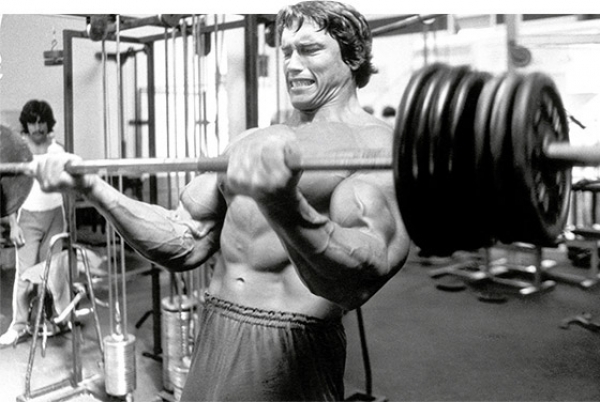
Cheating has also been called forced reps without a partner. This is true if you perform it correctly. But if it's not making your sets harder and you're doing too many reps and too early in the set, you might as well stop it. You should perform most reps strictly until you reach positive failure, and only then engage cheating for an extra rep or two.
To be really productive, you need to stop these reps at least slightly in the contracted position and start slowly.
6. Pre-fatigue
The last technique is one that I personally have never insisted on twice. The premise is that you reach failure on an isolated exercise and move on to a complex one as quickly as possible. Common examples are leg extensions and leg presses or pec dec and bench press.
My problem is that if you know you're going immediately to a complex exercise, you'll at least subconsciously leave some energy in reserve. That way you don't make the first exercise a failure.
See if it works for you, but I've always preferred to preload in the form of simply completing all sets on an isolation exercise, like a Nautilus machine or pull over, before moving on to something like a pulldown on a close pulley or rowing with a single arm.
Intensification techniques: use them only occasionally or suffer the consequences!
The above techniques can be incredibly effective at increasing intensity and stimulating muscle growth. That is, if you use them judiciously; by which I mean occasionally. But in large quantities, even good things are counterproductive.
These techniques are very recovery intensive. Excessive use will quickly lead to overtraining, and you could end up seeing your results deteriorating instead of improving.
So be careful, and only use them when necessary, and on weak areas. Also, don't use them in every set, but save them for the last set of each exercise, and rotate the parts. We understand each other.
Also remember that in addition to using them sparingly, you have to get the muscles to positively fail first for these techniques to do you any good.
Source: musculardevelopment
Author: Dorian Yates
Translated by Jaromír Uhlíř (Cha Cha)
Original Article Title: 6 Techniques to Boost Training Intensity
Author: Šárka Randáčková No posts have been made yet.








