





How to get huge arms
 Author:
 Get huge arms
I think it was Bertil Fox who said his arms were 16 inches at 16, 17 inches at 17 and 18 inches at 18... I don't remember much of his growth from there, but I definitely remember mine. (1 inch is 2.54cm) I was able to emulate Bertil's achievements until I was 18 inches at 18. That's where I got stuck. I was crushed by this meta.
All I needed to do up to that point was lift resistance by adding weight. By the time the gains stopped, I got to biceps one-arms weighing 36 pounds. I was lifting 86 pounds on the biceps on a straight axis. I was doing push-ups between benches with seven discs in my lap, each weighing 20 kilos.
So how do you make a decent arm crazy? With a little bit of that "luck," I irritated, inflamed and damaged my elbows from the never-ending effort to add weight. This forced me to slow down and start thinking about the muscles I was supposed to be training.
It worked and I finally got down to 19 inches
At the time, the universal goal was to have 20 inch (about 50cm) arms. I finally got there. But it took me a few years of using smaller weights and better technique. I had to be more creative in general. I'm happy to report that my hands have reached the 21 inches they are today.
Although I don't train the biceps much at the moment because it is ahead of the triceps, let me show you some of the things that helped me get from eighteen to twenty-one inches.
Based on the reports I'm getting, I suspect many of you have already gotten to hand stagnation. Thus, I hope the following ideas will be as useful to you as they have been to me.
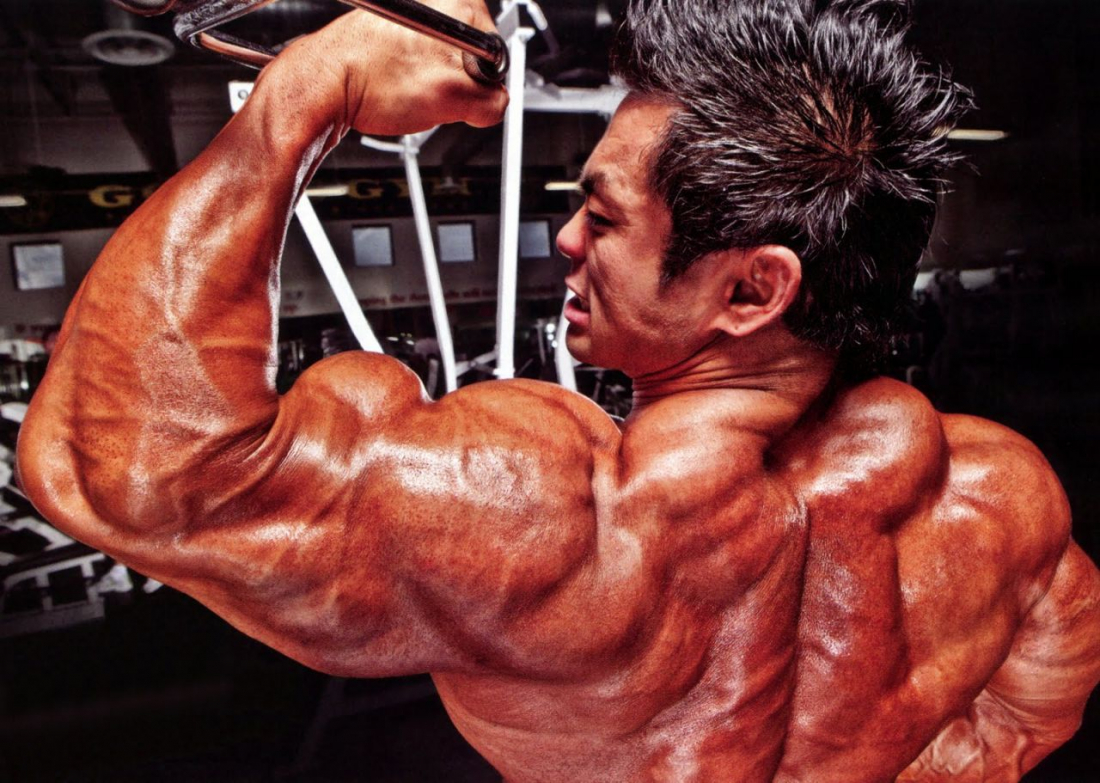
Key points
The key points for hand training are as follows:
- train triceps and biceps together - maximize pumping
- Exercise composition
- Controlled negative phase and positive phase with maximum stretch
- short breaks
Here is an explanation of why these points are important.
Train biceps and triceps together
There's something to maximal arm pumping. You won't find a better way than training biceps and triceps in one workout.
- You can alternate sets for biceps and triceps. For example, do a series of biceps lifts and a series of triceps pulley presses. Alternate like this throughout the workout.
- You can alternate it after multiple sets. For example, you could do 4 sets of single arm lifts while seated, and then 4 sets of push-ups between benches.
- You can also take this workout "straight through." Do all the biceps work, and then all the triceps work.
I like to combine the two. However, if I had to pick a favorite, it would be alternating biceps and triceps for one set each.
Exercise composition - biceps
Respect the brachialis (deep arm muscle), the forgotten muscle!
Exercise your brachialis first. Make this often overlooked muscle, located between the biceps and triceps, a priority! I call it Lee Priest's muscle because his has always been so prominent.
One of the things you'll discover about bodybuilding is that it's a lot about creating an illusion. Exercising the brachialis is one way to sculpt a massive arm because as it improves, it actually pushes your triceps away from your biceps and makes the arm appear wider.
There are many exercises that can be used to train the brachialis:
- Hammer cross body lifts (my favorite)
- hammer raises (close second)
- overhand lifts with straight or EZ axis (very good)
- hammer raises with a cable on the bottom pulley (use sparingly)
If one of the exercises on the list is the one you want to start your workout with, use one of the first two instead.
Here's another key: squeeze the single arm as hard as you can during reps. Jim Seitzler gave me this advice when I was helping Mike Francois. Jim told me it was a way to get out of a rut, but as with many other training tips straight from the battlefield, he didn't explain why.
Check out the video on performing the hammer cross body lifts.
Train the lower biceps as a second. Imagine someone like Vince Taylor, someone with full lower biceps, and I guarantee you his arms look huge. I'm not saying you can isolate the lower biceps from the rest of the muscle. However, I am saying that there are movements that, when performed correctly, will definitely get the blood flowing to that particular area and thus train it harder.
For example, the Scott bench press has always been favored by the best. Larry Scott himself is the king of the long, full biceps.
Here are some options:
- EZ-axis, straight-axis, single-arm Scott bench presses
- any hammer raises where the arm is fully extended in the bottom position
- machine lifts with the hands on the mat (can be placed at different angles)
I never start with these exercises. They are exercises that simply need to be done with pumped arms.
A big part of my program is to sequence the exercises so that you stay healthy and can fight the iron for a long time. I don't think it's safe to start a workout with a heavy lift on a Scott bench (specially not with a straight or EZ axis) if your biceps aren't at least half pumped. I've seen a few people tear their biceps because they started with this exercise. It's not a pretty sight.
These exercises go nicely with the hammer raises that were mentioned above, because those also engage the lower biceps when performed through the full range of motion. It makes sense to start with hammer raises on the brachialis to warm up the lower biceps before you destroy it.
I've included a video of a machine deadlift on Scott's bench for illustration. Although my favorite is the one with the EZ axis.
Perform basic exercises such as straight-axial lifts or one-arm pull-ups last. They are like bench presses for the chest. It's best to do them when the muscle is full of blood and less prone to tearing or straining. In this order, the targeted muscle is most likely to fail first, not the ligament or tendon.
When you have the muscles fully pumped from top to bottom, it's time to unleash the power of the core exercises on them. To make it even harder, perform them with a three-second trigger.
Choose as heavy a weight as you want, but the execution must remain flawless.
Exercise composition - triceps
Practice the compression type exercises first.
Athletes often complain that French presses, scull crushers and other extensions destroy their elbows. I agree. It's happened to me, too. So, start your triceps training with crunches - ideally with a rope to get the blood rushing in there.
If you warm up and blood your triceps and elbows first, supine extensions shouldn't be a problem later and shouldn't just be about pain.
Continue with some of the push-up movements. You can even start with them, but I prefer to have some blood in my triceps before I start the push-ups. I like to go heavy, hence it's probably safer to rank them second.
Finish the workout with extensions. So far it's been about clenching and moving heavy weight. Now that your arms are loose, it's time to finish them off. Here are the ideal triceps extensions. In addition to keeping the joints healthy, it's wonderful to end the workout with a movement that "stretches" the exercised muscle. You can have different types of extensions in your arsenal.
EZ-axis extensions in the supine position on a positively inclined bench/skull crushers - watch the video
Controlled negative phase and positive phase with maximum strain
If you've read my previous articles, you know I'm a big fan of three-second triggers. Let's talk about how to incorporate these techniques into your biceps training.
Trigger biceps exercises for three seconds. Three-second triggers work better for some exercises than others. It also depends on the batch. For biceps, this works for pretty much all exercises. Here are the general rules for inclusion in a biceps workout.
Don't overdo it! As you know, the eccentric phase of the movement is where the muscles get a lot of work. Combine that with the fact that the biceps is a small area and you have a recipe for overtraining. There's no need to do it every set. I would recommend running three seconds on one exercise (3-4 sets) or one set of each exercise (still only 3-4 sets).
I personally like the straight-axis or single-arm option best at the end of a workout when my arms are already hugely pumped. You won't be able to load that much weight, but you'll feel this exercise like you never have before.
Check out the video of the EZ axis deadlift:
Use heavy negative reps on the barbell push-up machine. I absolutely love them. It's a great, safe way to overload the triceps.
Check out the video of me performing negative pushups on the machine:
Use the contraction with maximum strain at your discretion. For some body parts and exercises I like constant tension, sets without breaks, etc. As for biceps and triceps, I believe most exercises should include a strong squeeze at the end of each exercise.
Try to use this technique more in the beginning to middle of your biceps workout and at the beginning of your triceps one. This hard clench will drive blood to the muscle, which will further intensify the three-second negative phase.
I think this technique works better with a rep range of 6-8 rather than say 12-15. It's like doing a concentrated lift with a very light one-handed barbell - you can feel the contraction, but it's not "hard."
An exercise called concentrated lifts on a positively inclined bench is really good for a hard contraction.
Squeeze the one-arms together and squeeze the soul out of them.
Watch the video to get an idea of the execution.
As I wrote above, all variations of the pulley press work extremely well for maximum contraction during triceps exercises.
Short breaks
I really see no reason to take long breaks when doing small muscle groups. Seriously, if you're passing out from panting after eight reps of the straight-axis deadlift, your conditioning is a joke. After spending a little time Googling, you'll find that many studies show increased hypertrophy due to shorter breaks. But do that on your own time. This article is more about "common sense."
Shorter breaks are simply another way to increase intensity.
Blood flow. Shorter breaks will improve pumping. I know many believe pumping is overrated. I disagree. My best arm workouts over the years have always been the ones when I was most pumped. I'm sure that proper pre-workout and training supplementation will do a great service, however, I believe that short breaks will pump your arms to bursting if you maintain technique and a manageable weight.
How long should the breaks be? Here are a few tips to try:
10-second breaks. Add them to your workout occasionally. For example, do 4 sets of biceps raises with an EZ axis, 8 reps each, and 10 seconds of breaks. You won't even need much weight to destroy your biceps. This exercise is best for shocking the muscle.
30 second breaks. I normally use this length of breaks before competition. It's enough time to recharge before the next set, but not so much that I lose focus. If you alternate biceps and triceps exercises, the timing will come pretty much spontaneously.
45 second breaks. I use this length in the off period. I see no reason to go over 45 seconds. This is the maximum length of breaks allowed.
Notes: I don't actually track my breaks. And you won't in a few workouts either, once you get used to a sharper training pace. Autoregulation works.
Workout volume
The training volume for biceps and triceps is less than for the larger muscle groups. With these intensification techniques, a higher number of sets is simply unnecessary.
As with the other parts, I like to gradually increase the volume, train at it for about six weeks, and then decrease it again. The intensity doesn't change, but the changes in volume split my training.
My twelve-week program for arms looks like this:
Phase 1: Weeks 1-3 - Use medium volume. Number of sets 6-8 total for biceps and 8-10 total for triceps. Two, maybe three exercises.
Phase 2: Weeks 4-9 - Use high volume. We will add volume each week. Your body will adapt to the intensity you added in the first phase, plus we will add load throughout the next six weeks.
Typically, this will be 9-12 sets for biceps and 12-16 sets for triceps, with more high-intensity sets added each week. We'll use three or four exercises. You'll enjoy these six weeks.
Recommended

Mars Snickers Low Sugar High Protein Bar

Nebbia Kraťasy FIRST PICK 379
Nebbia Sportovní podprsenka se střední oporou ICONIC 230
Nebbia Washed volné cargo šortky LEGACY 787
Phase 3: Weeks 10-12 - Use medium to low volume. This will be 4-6 sets for both biceps and triceps. The total volume of the sets is now decreasing, but those sets will be the hardest you've ever worked out in your life. We normally use two exercises at this stage.
Deload: 2 weeks - as with any heavy program, there is a rest phase that will benefit your nervous system that has been getting a workout from the high intensity. I've trained people who needed to deload after six weeks of training. Others made it thirty weeks without deload and got better. I routinely recommend two lighter weeks after twelve brutal ones.
Examples of training
Let's look at two sample workouts.
Here is a typical arm workout from the first phase of my program. It's 8 sets for biceps, 10 for triceps. The breaks are 30 seconds...
Hammer cross body lifts - 3 sets, 10 reps. First, do 2-3 warm-up sets for 10 reps. Do 3 working sets for 10 reps. Squeeze hard on each contraction. Squeeze the one-handed grip tightly. When lowering, let the one-armed arms come all the way down to warm up the lower biceps.
EZ axis lifts on Scott bench - 3 sets, 8 reps. Squeeze hard again at the top. Let the axis come 90% of the way down. Don't overextend your arms or it's a recipe for injury.
EZ or straight axis raises while standing - lower for 3 seconds - 2 sets, 8 reps. The key is to lower the axis for 3 seconds. Your biceps should be on fire at this point. Use as heavy a weight as perfect technique will allow.
Pulley press with cable - 4 sets, 12 reps. Squeeze down hard and hold for a second. Keep your elbows close to your body.
Bench push-ups - 3 sets to failure. Add weight to the wedge in each series. Failure should ideally come at 8-12 reps. You don't need to flex your arms and clench your triceps. Focus on constant tension and using heavy weight.
Positive incline extensions with EZ axis - 3 sets, 15 reps. On each set, try to put the axis lower behind your head. Also, pause for a second in the stretched position. You won't need much weight, trust me.
Now a typical workout from phase 2. It's 12 sets for biceps and 16 sets for triceps. I consider this high volume for such a small area. Unless otherwise noted, breaks are 45 seconds.
(This one is brutal. Try it out and please let me know what you think!)
EZ axis overhand lifts - 5 sets, 10 reps. A few sets to warm up. Breaks only 10 seconds. Simply put the axis down, count to ten and continue. It's probably gonna hurt a little bit. Your brachioradialis and brachialis will cry.
Pulley squeeze with a rope - 5 sets, 10 reps. A few sets to warm up. Again, you only take a 10-second break between sets. You may have trouble holding the weight constant. No problem taking a little weight off. Remember, 10 second breaks - let it burn!
Machine lifts on the Scott bench - 3 sets, 12 reps. Do them heavy and don't lower the weight all the way down. Choose a weight for about 6 reps and have a partner help you with 6. At the top of the first six reps, push hard. For the remaining six, try to get the weights to at least move. Your tired brachioradialis and brachialis won't get too involved. The biceps will do most of the work.
Machine push-ups - I love these. Do 3 sets and 8 reps first. The negative phase lasts 3 seconds and then the weight goes down with all your strength. The fourth and final set is for heavy negative reps only. Use a weight that will be heavy for 6 reps. This is probably my favorite apparatus for negative reps. Do a total of 4 sets.
Positively inclined concentric lifts - 2 sets, 8 reps. Squeeze with everything you have during the contraction. Your arms will be full of blood, so start stretching them for 20-30 seconds.
L-Extensions - 4 sets, 15 reps with each arm.
Single arm raises while seated - lower for 3 seconds - 2 sets, 8 reps. Whatever is left of your biceps will stay in this exercise.
EZ-axis close grip push-ups - 4 sets, 8 reps. Lower slowly and to the jaw rather than the chest. It's actually a modified version of the Westside JM press. You won't be loading too much weight, but you'll be stripping your triceps so that there's nothing left.
Bonus!
Want to try something that looks weird but will DESTROY your biceps? Try the bamboo axle lifts from the video below.
I can't tell you how well they work. You don't feel anything in your elbows and when you get the weight up you feel a scary contraction. It's Mr. Ohio heavyweight John Quint doing it.
Done
Those of you who have been following my articles on TNation since the beginning will have noticed a trend. Specifically, intensity, manipulation of workout volume, strict execution, and creativity.
It's true that the basics are called the basics for a reason. However, there comes a time in every bodybuilder's career when the basics don't work as well as they used to.
When this happens, you have a choice: you do the same thing over and over and expect new and better results, or you change things up and adaptation is on your side.
The choice is yours and all the tools to make the most of this decision are in your hands.
Until next time!
Support your performance with quality supplementation!
In our shop you can choose from a lot of proteins, gainers, amino acids(bcaa, glutamine, ...), vitamins and minerals, creatines,fat burners and much more. So don't hesitate and step it up a notch!
Written by John Meadows, translated by Jaromír Uhlíř
No posts have been made yet.








