





How to create bulletproof shoulders? We'll show you exercises that will really push you!
 Author:
 Before we start, here's what you need to know...
- The landmine press is a great "transition" exercise between overhead presses and true horizontal presses.
- If you really insist on going back to overhead presses after a shoulder injury, try it first with some variation with an inverted kettlebell barbell.
- Athletes have to earn to train their lats. You may not practice the hunches or pulldowns until you pass the shoulder flexion test with your back against the wall. Exceptions are not allowed.
- Do not train the rotator cuff to failure. If you are striving for a strong and effective rotator cuff, fatigue is your enemy.
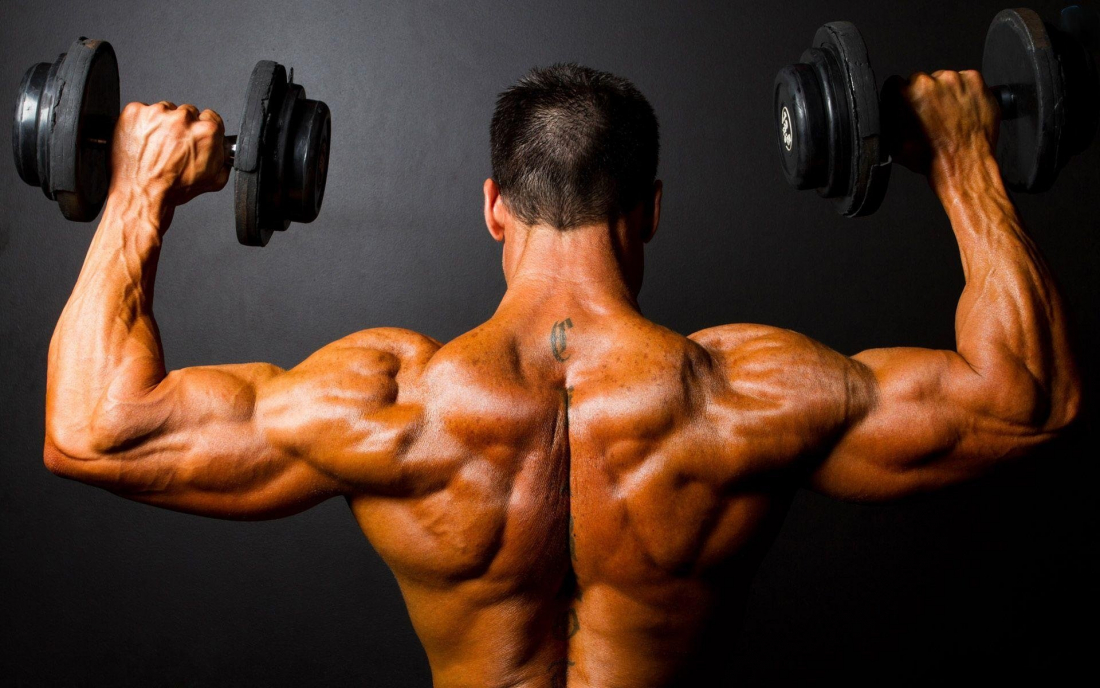
Many athletes refer to me as a shoulder specialist. This is probably because I have personally evaluated over 3000 shoulders. With that experience comes a lot of new expertise. Below, I'll present three examples of new things we're doing to keep shoulders healthy and high-performing.
1. Inverted kettlebell exercises are a great introductory exercise for returning to overhead presses.
My role as shoulder expert found me, so to speak, because my right shoulder is structurally insane. I've learned to work with it, and I've also trained a decent amount of strength for my size, with no noticeable problems, that is until I do something stupid - most often overhead or positively inclined pushes.
Overhead work is lacking for me though, so I play around and try what works. Ladmine press, for example, is an excellent transition exercise on the way between overhead presses to true horizontal presses.
If you think about the path of the arm, it's not much different than an overhead press. So how is it that overhead presses cause so many more shoulder problems for people than the landmine press. I suspect it's because the back being glued to the bench limits the ability of the shoulder blades to rotate upward; they're stuck in a downward rotation.
This year I've continued the theme of overhead pressing without true overhead pressing, and have experimented quite a bit with reverse kettlebell carries and presses. I like to start with the carry because it teaches people where the correct "end" position is, and then we can work backwards from there.
If you have successfully mastered the overhead carry, you can move on to the one-handed military press with an inverted kettlebell dumbbell:
Holding it inverted is more shoulder-friendly, as that unstable environment will focus more muscle work on joint stability than on actual force production. In this respect, it's very similar to doing push-ups on an unstable surface. So if you strongly insist on returning to overhead big-axis presses, test the waters on the inverted kettlebell version first.
2. Athletes have to earn their latissimus training.
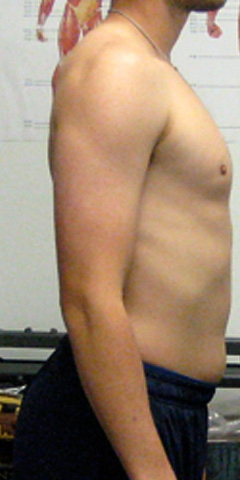 I really have a knife-edge relationship with lats. On the one hand, they're great because they make you look great and help with performance in many athletic events from sprinting to throwing speed. On the other hand, athletes use them too much for other activities like breathing and mid-body stability, and they shouldn't be doing as much work.
The result? A lot of atypical postures that look like this 
This guy uses his lats for absolutely everything. Notice how insanely arched his lower back is, and that his elbows are in a resting position about a foot behind his shoulders. In addition, most people who overuse lats will have their shoulder blades heavily tilted down (scapular depression) and limited shoulder flexion, which will be clearly visible when you test them on your back. To give you an idea,
the forearms in the picture below should actually be touching the table 
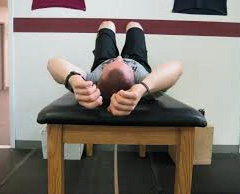
We currently spend a lot of time teaching athletes how not to engage the lats. However, it's clear to me that I'm not going to convince you to stop trying to create that V-shape in your torso by working for the lats. So what are the rules?
First of all, you can't do the push-ups or pulldowns until you pass the shoulder flexion test with your back against the wall. No exceptions allowed.
If you don't pass the test, make sure you roll on a foam roller regularly, stretch the lats, and practice this routine:
Then, if you find that your posture is similar to the one above, work daily to get out of that extension. In other words, you probably need to flex your pelvis more in the back and straighten your upper back - and try to stay that way during your exercises. Yes, it sounds funny, but you probably need to curl more and stop doing that arch in your back to improve your deadlift and squat technique.
Finally, make sure you add twice as many overhead arm raises to your workout to iron out that imbalance between the top and bottom of your shoulder girdle. Good additions to your program would be wall slide variations, overhead carries and push-ups, and overhead arm raises during warm-up exercises.
Let's say you're doing four sets of six push-ups with weights, for a total of 24 reps. How would you get 48 reps of overhead arm raises into your workout?
Warm-up:
- 1 Set ofDead Bugs- 8 reps/side
- 1 Set ofWall Slides with upward rotation- 8 reps
- 1 SeriesOverhead Lunge Walk - 4 reps/leg
- 1 SeriesAlternating Lateral Lunge Walk with Overhead Reach - 4 reps/foot
Training:
- 3 Series ofOverhead Lunge Exercise Variations- 3 x 6 reps = 18 reps
It's pretty simple, and you'll realize that getting your arms overhead more often - and with a neutral posture - can re-establish balance in your workout. Remember, though, that you have to earn the right to practice lats first!
3. Get rid of the YTLW series
You're probably familiar with those YTLW series that have gained popularity over the last decade or so. Especially then among strength and conditioning coaches who want to train several shoulder functions at once so they can get to the "proper" exercises. The way it works is that you take four exercises and do them unbroken for 8-12 reps.
The theories are delightful: healthy shoulders and economical training. The results, unfortunately, are not. I can responsibly say that I've never seen any athlete perform all four movements perfectly the first time - even worse is when one does it during the fatigue that such a long series induces.
Having said this, I love the Y; it's great for developing control of the lower trapezius, allowing you to properly control upward rotation with lots of posterior scapular tilt.
I also love the T; it helps engage both the mid-trapezius and the posterior rotator cuff and shoulder muscle - while ensuring the clob head doesn't slide forward in the hole.
The W is also a great exercise because it trains the ability to differentiate between the movement of the glenohumeral joint (head and dimple) and the clavicular joint (scapula to rib cage). You want the former, not the latter, and by making sure it happens correctly, you engage the rotator cuff without using lats.
Recommended
Intense Šortky GOLD Nebbia print 828
HMS Mechanický Eliptický Trenažér H 6512

Magnesium Malate 100cps 1+1

Czech Virus Joint MAX InflamaCare
To be honest, I don't really like L because it's too much about latecomers. Even if I did like it, it wouldn't do any good because most athletes are wiped out from the three previous exercises before they even get to it.
Besides the lack of leadership, the biggest problem is fatigue. Research clearly says that the best way to train the rotator cuff is with perfect technique without coming close to failure. Fatigue may be your friend when you're throwing down a set on your biceps or quadriceps, but it's your enemy if you're trying to build a strong and effective rotator cuff. The head of the joint simply bounces around the hole instead of staying nicely centered.
The solution is very simple: replace it all with individual parts spread out over the week. We can put Y (prone 1-arm trap raise) on Mondays and Thursdays with lower body, and T (prone horizontal abduction) and W (external rotation) on Tuesdays and Fridays with upper body.
The whole thing can be summed up as, "Do things right! It's better than doing a lot of things and getting tired of them."
Source: www.t-nation.com
Author: Eric Cressey
Translated by.
No posts have been made yet.








