





Crashed series - how to deal with them
 Author:
 What weight should you use for them?
 There is no longer any doubt that the best volume gains are made using multiple intense sets.
The problem is that at high intensity, the number of reps you can perform usually decreases with each set.
Take triple jumpers - once they don't rest for five minutes, they're done. In a study that subjected triathletes to a typical bodybuilding workout, quite a few of them got dizzy and wanted to throw up.
In short, it wasn't their typical workout. Bodybuilders were more resistant to fatigue because their muscles were accustomed to bodybuilding training (i.e., moderate to high repetitions and short breaks).5 This adaptation may include the development of a fast glycolytic energy system with increased activation of anaerobic enzymes (e.g., phosphorylase, phosphofrutokinase, and lactate dehydrogenase) that may delay lactate accumulation.
Previous research has shown that performance in terms of number of repetitions decreases markedly with minute and shorter breaks.1,2
 Squats are the worst at this in my experience; I remember nearly throwing up several times trying to keep up with the number of reps. In one study, researchers examined performance during four sets with a constant weight (8RM) and with one-minute breaks.
Subjects managed 7.9 percent of the reps in the first set, 5.9 percent in the second, 4.5 percent in the third, and 4.2 percent of the reps in the last set.2 Work capacity could not be maintained with a minute break.
Another study examined the decrease in performance in 5 sets of bench press performed with two intensity levels. ( 10RM and 5RM) and with 5 different break lengths ( 30 seconds, 1, 2, 3, 5 minutes). The weights were reduced by 2.3 to 6.9 kg when necessary to maintain the number of repetitions.
The results show that, regardless of intensity, at 30s and 1 minute breaks the weight decreased noticeably with each successive set. So if you have to drop weight, how much exactly should it be?
Recommended

Beauty Booster 100cps 1+1

Nebbia Kraťasy FIRST PICK 379

Nebbia Teplákové šortky 6” MUSCLE MOMMY 624

Nebbia Boxy fit košile s kapsami STREET ICON 599
Crashed series: pain is on the way!
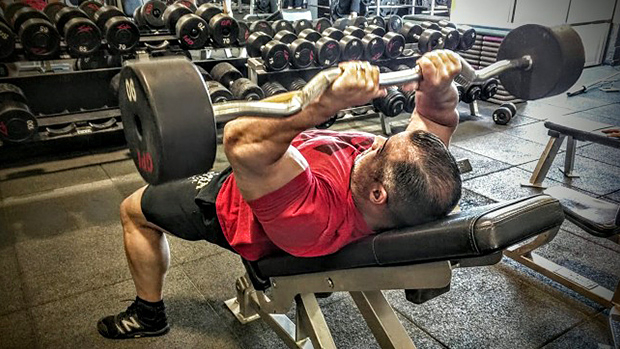 Bodybuilders use crash series routinely, especially afterwards before a competition when they are trying to remove fat and train intensely. A shredded series is shedding weight and continuing the series when you've already reached failure with a higher weight. It's very painful and the results are astounding - if you can take the pain that is.
I've always wondered what weight to actually cut. If you're doing five tens on the squat with 200 pounds and minute breaks, how much to drop to still get through 10 reps.
People around me do it completely randomly. Some lose a little weight, others lose a lot. Researchers at Eastern Illinois University decided to find out exactly how much weight you need to lose to maintain the volume of reps in a set.
The researchers had the subjects try a maximum of 10 reps in the squat rack. The subjects then returned for 4 more experiments.
- The same load for all sets
- A 5 percent reduction in weight with each set
- 10 percent reduction in weight with each set
- 15 percent weight reduction with each set
Subjects practiced the following exercises: back squats, lunges, and front squats. Subjects took breaks of 1 and 2 minutes between exercises.
15 percent rule
The researchers found that to maintain a constant number of repetitions and breaks of 1 minute long on both the back squat and the lunge, you need to lose 15% of the weight on each successive set.
Interestingly, there was no need to lose weight on the front squat, which was practiced last. Here the subjects were more resistant to fatigue. How is this possible when squats mainly use the quadriceps?
The researchers' hypothesis is that squats, as a complex exercise, use so many parts that some of them fatigued before the full potential of the quadriceps was used.4
Therefore, performance in the overhead kick remained unaffected. With squats, however, you will need to actually reduce the weight by 15% each set to achieve the same number of reps.
Sources:
1. Willardson, JM and Burkett, LN. The effect of rest interval length on the sustainability of squat and bench press repetitions. J Strength Cond Res, 20: 396-399, 2006.
2. Willardson, JM and Burkett, LN. A comparison of three different rest intervals on the exercise volume completed during a workout. J Strength Cond Res, 19: 23-26, 2005.
3. Ratamess, RA, Falvo, MJ, Mangine, GT, Hoffman, JR, Faigenbaum, AD, and Kang, J. The effect of rest interval length on metabolic responses to the bench press exercise. Eur J Appl Physiol, 100: 1-17, 2007.
4. Willardson JM, Kattenbraker MS, Khairallah M, Fontana FE. Research note: Effect of load reductions over consecutive sets on repetition performance. J Strength Cond Res, 2010 Mar;24(3):879-84.
5. Kraemer, WJ, Noble, BJ, Clark, MJ, and Culver, BW. Physiologic responses to heavy-resistance exercise with very short rest periods. Int J Sports Med, 8: 247-252, 1987.
Source: www.musculardevelopment.com
Author: Muscular Development Team
Translated by Vladimír Uhlíř
No posts have been made yet.








