





Chains, Bands and Force - Part 1
 Author:
 Every strength-training athlete will have noticed the difference in the weight of the dumbbell they are able to handle at the lowest phase of the exercise versus the weight at the highest phase of the exercise. For example, if he is able to perform a deep squat with 200 kg, he will be able to perform a quarter squat with a higher weight, say 270 kg. Similarly, if he can do a bench press with 160kg, he will be able to push a barbell of a higher weight, say around 200kg.
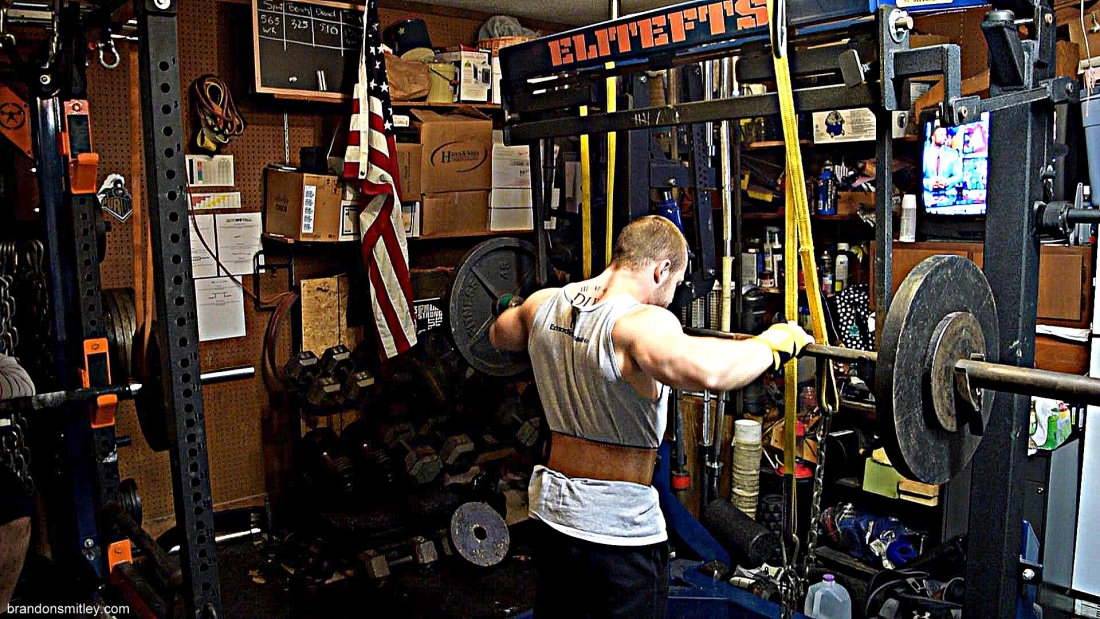
Training with an altered strength curve is still one of the most effective ways to improve strength for maximal loads.
The basic logical idea is to force the muscles to give the same intense power output in all phases of the movement during the exercise, and then move on to "normal execution" with these ingrained stereotypes. If we habituate the body to work at a given intensity throughout the entire stroke and then return to a "normal" drill without adaptive loading, we will reap a huge advantage from the previous training in terms of movement dynamics. We have the muscles accustomed to working at maximum throughout the entire path of the movement, so we will add much more acceleration to the barbell. Because of this, we will be able to overcome the weaker points of the lift better (faster) and be successful even with the previously limiting load. This is the reason why it is so widely used in lifter training around the world.
If we want to achieve the same stimulus throughout the entire movement path, we must use adaptive loads. The mechanism whereby the weight being overcome, or rather the resistance, increases towards the completion of the movement is the very essence of working on an altered force curve.
In practice, chains or elastic bands have become adaptive loads. In the case of attaching a heavy chain to a loaded barbell, we achieve the desired effect of decreasing and increasing weight on the barbell as the barbell moves down and up. A portion of the chain (half) is "deposited" on the floor as it drops, and as it moves upward, the chain is in turn pulled up from the ground, increasing its weight.
When elastic bands are used, the intensity of resistance increases as the bands are stretched. Depending on the strength of the bands used, we are able to control the load on the barbell. The advantage of the bands is the additional effect of pulling the barbell down, which to some extent forces us to prevent it by a much faster development of force.
The question is what weight of chains, or the difference between the bottom and top position, is good to use and when to use these recommended weights. There is a table of recommended weights.
- With barbell weights around 90-135 kg, the difference between the top and bottom position should be 9 kg. This is achieved by using a total of 18kg of chains. (half of which is placed on the ground in the down position)
- With dumbbell weights around 135-180kg, the difference between the top and bottom position should be 14kg. This is achieved by using 28kg of chains.
- For weights above 180 and 230 kg, the difference between the top and bottom position should be 20 kg. This is achieved by using 40 kg of chains.
Why these weights?
Let's start from the knowledge of your personal maximums for each phase of the lift. For example, when determining our strength curve for the bench press, we will first be interested in the maximum for the lying pressure achieved without the support of the triceps. Let's say it's 150kg. This means that we are able to push a 150kg load off our chest and no higher. We have thus established the lowest point of our strength curve. Next in the workout we use push-ups on different height boards. If we use both 1 and 2 and 3 boards, this gives us a more accurate idea of our strength capabilities over the next 5-20 cm above our chest. Usually the strength increases - in our case, for example, 155.0 kg; 162.5 kg and 172.5 kg. Finally, we could know the force of the push in the last 10-15 cm of the stroke. We know this force by using lockouts in training. In our particular case it would be 210 kg for 15 cm and up to 250 for the last 5-10 cm.
We can see that the curve grows gradually at first and only at a certain height above the chest does it dramatically flatten out. This is good to take into account, because the weight of the chain grows in gradual steps along the entire path of the curve and does not grow any differently in the last phase of the exercise. For us, the first 3/4 of the movement is important and the rest can be "underestimated" in terms of load. Therefore, we can add a probable weight of about 185.0 kg between the penultimate number and the power for 3 boards and count it as a breakpoint where the curve starts to get steeper.
We will therefore omit the penultimate and last numbers this time, as they are rather close to the ability to statically hold a certain load.
Anyway, in our case, using the maximum (100%) intensity we have a given difference and if we consider only the curve up to some 3/4 of the distance from the chest it is 35kg.
In case I decide to use adaptive loading for my dynamic training when using 50% load, I will want the difference between the top and bottom position of the dumbbell to be 17.5kg. The findings are similar to the above recommended table for adaptive load.
We have logically explained the origin of the recommended weights mentioned above. The recommended weights come from Westside Barbell and are WEIGHTS FOR DYNAMIC TRAINING using approximately 50% intensity! However, it also shows more about the use of training with chains and bands.
Next time, a description of the difference between the use of chains and bands when working on momentum and max.
No posts have been made yet.








