





Big benchpress WSB
 Author:
 The lying press is probably the most commonly used exercise in all the gyms I've ever visited. It has become a common indicator of strength among gym-goers. Even beginner adepts of the iron game somehow unconsciously gravitate towards the displays of strength of their more experienced colleagues.
The big push-up is the subject of much conversation, research and the uncovering of "secrets", especially if the person in question is trying to cross some "magic" threshold of their own in the push-up that they just can't and won't cross. They flip through bodybuilding magazines and train like bodybuilders. It's just that if they want to cross their limit, they have to think and train like a lifter.
It doesn't matter what the limit is. Because for everyone a big benchpress is something different, for someone it's over 100 kg, for someone it's 150 kg or 185 kg (400 pounds) or 200 and 225 kg (500 pounds) etc...
The following article is dedicated to the training methodology that leads to overcoming such limits.
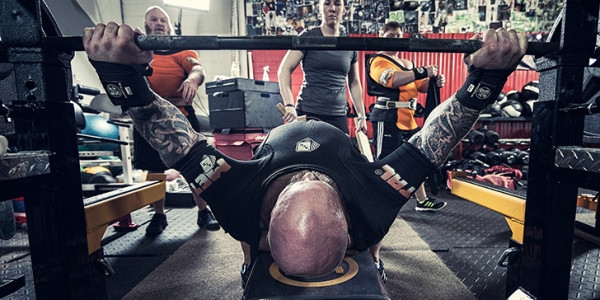
NEGATIVE SIDE EFFECTS
Once you enthusiastically surpass your first 8 week cycle, you may be horrified to discover that you have gained weight! Unfortunately, your body will defend itself by slapping some muscle mass on your sunken chest.
HOW TO BUILD A WORKOUT
The most important secret is simple. You need to build and strength the right muscles in the first place, which play a crucial role in the lying press. And that's the triceps, delts and the stabilising role of the lats is definitely important too! In no case do the pectoral muscles have priority! Surprise? There's another one coming.
It is not necessary to train the competitive bench press to the max to develop absolute strength! Instead, strengthen the muscles in your weakest pressing position so that this is where you achieve maximum contraction, and for a similar amount of time to the pressing position. So use the maximum effort method for an exercise with a similar movement pattern to the competition bench press. Yes these are different push-ups and special pressures at different parts of the barbell movement.
Third. Work on explosive power! You need to be able to engage as many neuromotor units in the push as possible in the shortest amount of time! No discussion.
AND WHAT A SET WORKOUT WILL LOOK LIKE
You will alternate a dynamic workout with about 55% load with a heavy workout where you will reach a personal best in pressure-like exercises, i.e. +100%. The layout of the exercises in the workout will be as follows:
- Main Exercise - Timed Bench Press Exercises - Maximum/Dynamics
- Triceps - auxiliary exercises for benchpress - the most important group for benching
- Front delts - support system for bench press progression
- Latissimus - support system for benchpress
- Biceps - support system and rehabilitation
- Delts - rear and middle - support system for benchpress and rehabilitation
In a classic schedule, maximum effort training is typically done on Wednesdays, dynamic training on Sundays. Monday and Friday are reserved for squats and deadlifts. If you use a different layout, make sure you have two days of recovery time before and after your workout for triceps and shoulders.
Maximum strength for the bench press - the main exercise
I've written that you'll be using exercises with a similar movement structure to the competitive bench press. Try to set a new record for 1 rep each workout! After warming up and warming down, work your way up for 3 sometimes 2 reps. Under no circumstances should you fail at this stage! Once you can't perform them in clean form move on to singles. The first should be at about 90% of max, the second just below max and the third should be a record attempt! Only the last single should be near or at failure and you need to have assistance.This will be extremely challenging, it will hurt and it will teach your CNS to work with maximal loads. Once again I remind you to allow plenty of time for recovery. That's also why you'll only do maximal strength training once a week.
The vital rule with such training is: alternate exercises every 2-3 weeks to avoid overtraining! This rule is easy to check in practice, just try to increase your max for the fourth time in a row and see what CNS tells you.
To overcome stagnation and increase strength, use additional load! Use chains or elastic straps. This will change the power curve of your performance. You'll be pushing against a higher load at the top than you were pushing at the bottom, giving you maximum momentum throughout the movement.
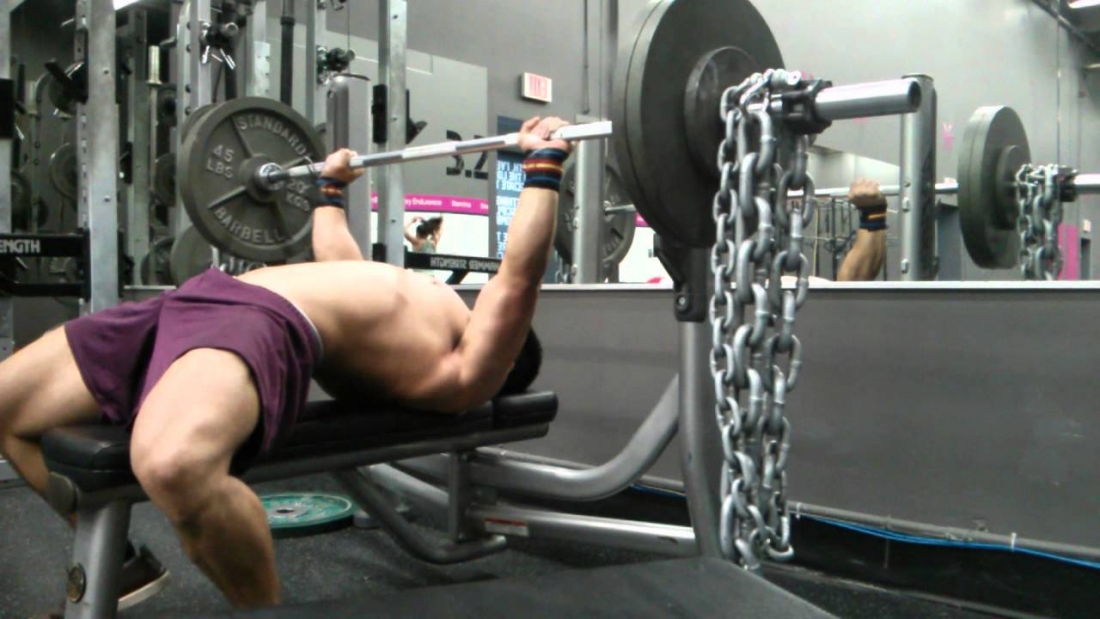
DESCRIPTION OF THE PRESSURE TRAINING WITH CHAINS
Working with chains has a similar effect to benching. The lowest resistance is in the down position, the highest is in the arm extension. You build starting speed, acceleration, and a strong top-end finish. After warming up, a strong 10-20kg chain is attached to the barbell with a weight of around 85%-90%. It attaches behind the discs to the dumbbell's axis using an auxiliary chain so that it is half on the ground. I gradually add weight using the chains (discs on the chain) until I am unable to perform the repetitions.
DESCRIPTION OF PRESSURE TRAINING WITH ELASTIC STRAPS
Three types of straps are used, from the softest to the hardest - pink for performances around 135kg, green for 135-205kg and blue for performances over 225kg without a shirt. One end is attached to the barbell (behind the discs) and the other to the bench structure. The strap will cause an increase in resistance for the max in the top position, but also tends to pull the dumbbell heavily against the chest. It is therefore necessary to exert such effort to overtake this tendency. You develop as much start as you do finish. From my own experience, I can confirm that training hurts a lot, really a lot.
A variation with boards (2x10cm pads) on the chest is also used. Because the strap would be tight, and it would be extremely difficult to get the barbell going, a cambered "cambered" axle is used.
The straps can of course be combined.
Use a narrower grip. By training, you build triceps strength and change the strength curve, so that you will find it easier to finish the push-up.
Recommended exercises for maximum strength
Remember to alternate every 2-3 weeks!
WORK ON THE BOTTOM PHASE OF THE BENCH (START)
Floor press - Lying on the floor
In the down position, rest your triceps up to your elbows on the floor, pause, and then push up into stretched arms. You are building explosive strength. The point is the same as the box squat - squat to seated. There is a disconnection of the mutually supporting transition of the muscles from braking to pushing, and you are building bottom strength as you take off.
The push from the chest rack
The axis of the dumbbell is placed on a stop about 5-10 cm from the chest. The dumbbell is pushed upwards. Use a narrower grip, or medium width.
WORK ON THE MIDDLE PHASE OF THE BENCH PRESS
A really important phase, especially if you are benching in a triceps. After the run-up, you come to the deadlift point and towards the end of the triceps support.
Board press - Pressure with chest pads
Use 2 or 3 boards about 5 cm thick. The barbell will push up when touched. You are stopping it at the point where the dead spot usually is and also where the support of the bench tee ends. When using 3 boards, use a narrow grip - index finger on the smooth part of the barbell in the middle, when using two boards, little fingers on the rings.
Pressure from the stops
Push from stops at different heights. Use a narrow grip. Lowest stopper about 10 cm above chest, highest 30 cm above chest. Lower the stoppers, but not the weight of the dumbbell! Instead of lowering the weight, use an assist. Can be varied with incline bench.
WORK ON THE UPPER PHASE OF THE BENCH
Lockout - Pushing off the bar
This is the movement in about the final 10-15 cm. Use a narrower than competition grip. Elbow extensions for heavy triceps presses and standing or standing back support presses can have a similar effect.
SUPPLEMENTARY EXERCISES TO THE MAIN EXERCISE
Standing push with back support
Use a narrow grip. Move the dumbbell from the chin to 15 cm above the head. After maxing out in singles, attempt a max for 5 reps.
Press in a seated position
Move the barbell from the chin to about 5-8 cm above the head. Alternate the width of your grip. Perform 7-10 repetitions of any of the above benches.
Lying press with one-armed record for 15 op
Perform a classic 1-2s single-arm press x record for 15op. Can be varied with incline bench.
TRICEPSY
You'll alternate extensions with small dumbbells, with a large dumbbell lying down to your neck, chin, forehead or temple, close-grip push-ups with a stop 5-10cm above your chest, and you can also use chains or elastic straps.
If you use one-armed pull-ups, do about 60 reps (6s x 10r)
If you use a large dumbbell, do about 40 reps (6s x 6-7r)
The last repetition should be performed with maximum effort! Finish your triceps training on the pulley until failure! You need to train with higher and higher weights, so change exercises after 2-4 weeks. Choose one of the following.
Triceps extensions lying on the ground 4-7s x 3-6 op
Use heavy weights. Alternate between the two variations. In the first, you must achieve complete triceps relaxation on each rep, so place the dumbbell on the floor behind your head. You will develop the explosive power required for the bench when starting after a pause on the chest. It is advisable to use a different size disc each time and thus start from different angles.
In the second variant, on the other hand, maintain a constant tension.
Triceps extensions with single reels 4-7s x 3-6 op
On the ground or on a bench. With palms facing each other, focus on building triceps over elbows, lower faster. Short rests between sets about 30 seconds.
J.M. triceps extensions
Similar to "French presses." The elbows are held at a 45-degree angle from the torso and the movement from the extended arms ends with the forearms resting on the biceps and back to the extended arms. Take care to isolate the triceps, there should be no rotation in the shoulders. Perform 3-5 s x 10 in the preparation period. Keep rep range between 2-4 before competition.
Presses lying down closely
55-60 reps = 6s x 10r or 7s x 8r
Barbell push-ups with weights
A range of motion of about 20 cm is sufficient. It is a push-up with maximum load. Unlike the bodybuilding version, you bend over, engage your chest and work on the push-up.
Push-ups with weight behind the body
Keep your hands behind your back in a narrow stance. You can place your heels on a higher bench.
FRONT DELTS
Alternate between different types of forearms - with one-arm dumbbells, with a large dumbbell, with a pulley, with a discus. Use the maximum load for the given number of reps! The last repetition should be performed with maximum effort.
UPPER BACK - LATISSIMUS
Rotate your grip every workout, alternate the exercise every 3 or so workouts. Use one-armed dumbbells, a large dumbbell or pulley for pull-ups and a pulley for pull-downs. Use enough weight so that the last repetition is performed with maximum effort.
BICEPS
Use free weights - single arms, large dumbbell. The rest is as for latissimos. Constantly alternate grips and execution.
DELTS - BACK AND MIDDLE
Alternate regularly. Perform briefly but to exhaustion. Special rehabilitation exercises for shoulder rotation may be included if necessary.
RECOMMENDED EXECUTION FOR THE DYNAMIC PHASE - MAIN EXERCISE
LYING PRESSURE WITH 55% OF MAXIMUM RAW
Swinging with 8-10s x 3r max explosively. Three reps is the max to keep the movement dynamic, anything over 3r is too slow and tired.
Push the barbell like it's loaded with your max!
It must be written in advance, if you don't perform the dynamic phase, don't expect progress! You need to learn to start the load with as much acceleration as possible. You are learning to push with as much force as possible in as little time as possible.
Important advice when doing dynamic training - don't pause at the bottom, lower quickly but in a controlled manner and then push on with maximum force!
Out of a total monthly volume of 200 reps, perform up to approximately 20 reps with 10-20kg extra so you can perform a few singles to a load not exceeding 90% of your RAW max. The condition is to maintain maximum dumbbell speed. Do not perform frequently!
Use narrower grips, occasionally up to super narrow around 30 cm.
DYNAMIC CHAIN TRAINING ON THE BARBELL WITH 55% OF THE RAW WEIGHT
A variation to the first exercise described.
Competitors with a max of around 115kg will use a chain weight of 10kg, as the chain is half on the ground in the highest phase of the exercise, increase the weight of the barbell by 5kg in the final phase.
For power over 160kg use 18kg = 9kg increase
When performing over 225kg, use 28kg = 14kg increase
For power over 270kg use 36kg = 18kg increase in dumbbell weight.
Second triceps exercise - Press closely with 30-40 cm grip 5x5
Lower 10cm above chest and after a pause, push out as explosively as possible.
Second triceps exercise - Variation after 2-3 weeks - Press ultra-wide grip
Grip about 5cm over the marks on the centerline. Elbows further away from the body. Perform 6 reps for a record. After 3 more weeks, perform singles for a record!
Rest of the workout similar to the above in the layout as previously mentioned:
- Main exercise - timed exercises for benchpress - see above
- Triceps - auxiliary exercises for benchpress - see above
- Front delts - support system for benchpress - as in max phase
- Latissimus - support system for benchpress - as in max phase
- Biceps - support system for benchpress and rehab - same as in max phase
- Delts - posterior and medial - support system for benchpress and rehabilitation - as in max phase
No posts have been made yet.








