





Annual strength plan
 Author:
 People often ask me how lifters should set up their year-round program.
Lifters often have their favorite, specific programs, but don't know how to put it all together from both a health and performance standpoint. This article is my answer to those questions.
Let's assume we have a typical lifter who has been training hard for a while. However, say 3 months, 6 months or more is more common. Let's also assume that this individual is not a beginner, but someone who has already built a decent level of strength.
To make the scenario complete, let's say our lifter has just finished a strength cut and is probably feeling fairly exhausted. For the lifter, this would be the period following the competition when most lifters are evaluating their training and planning for the next cycle.
I feel it is most effective to divide training into three phases, which is also the bulk of this article. Each phase will have a specific goal and recommended duration. When it comes to how long to train each of the phases, you will need to trust yourself and your body, however I believe that regularly skipping any of the phases will have a negative effect on your performance in the long run.
Phase 1 - fitness
Part of strength and muscularity is physical fitness. It's great to be strong, but if in addition to that you're also a fat guy who doesn't go two floors without a break, something is wrong.
As someone who teaches trainers who will eventually work with clients who want to improve their health, I can't ignore the value of health and fitness. Regular, intense strength training can create unwanted compensations and weaknesses. At some point, these issues simply need to be addressed.
If you can move decently but are weak as hell, no one cares what you can do in the gym, and a decent overhead squat performance is nothing worth bragging about - no one expects you to have any ailments if you can't squat number one with your bodyweight.
On the other hand, squatting 500 is great, but not being able to perform a decent lunge without a 20-minute warm-up isn't great. You need to have some sort of balance. Otherwise, you'll end up with an injury or performance limitation.
The goal of this training phase is to improve your overall health and fitness and work on your weaknesses. By weakness, I don't mean a lockout on the bench press or any other such specific problem; I mean how you move compared to how you should move.
Another goal of this training phase is to allow your central nervous system to recharge from the previous hard workout, which requires you to not train everything hard all the time. People may question the overtraining of the nervous system, but I'm convinced it happens (ever wonder why we sleep?) and I think it's more of a problem the stronger and more advanced you are.
Duration: this phase will usually last 2-8 weeks, 4-8 weeks is the most common.
Training Thoughts:
Get better at bodyweight exercises: push-ups, bar push-ups, sit-ups, lunges, lunges, planks, standing push-ups (remember, tools like rings and other unstable things, even a physioball can increase the difficulty of these exercises.)
If these exercises are too challenging for you, perform easier variations of them. If you're really bad at it, you can even work out on machines.
Do lots of unilateral exercises and work on solid symmetry in your strength. Ben Bruno has a bunch of articles with great unilateral exercises that are useful even for someone who is all about strength.
Don't do heavy (>75%1RM) squats, benches, deadlifts, and pushups. If you insist on complex lifts, train them at 40-60%1RM and for multiple reps. Five sets for 3-5 reps works well.
General rules:
- Higher reps (8+, even 15-20 or more is fine). 1-4 sets per exercise. Short breaks (under 2 minutes and ideally 1 minute). Keep workouts under 1 hour in length. Work extra on fitness 2-4 times and weekly.
- Practice "functional" exercises involving the whole body if possible.
- The frequency of stimulation of each area/movement tends to be higher (2 or more times per week), the volume of training is moderate and the intensity (%1RM) is low.
To summarize, if you like what I normally write, this style of training is probably not to your liking. Well, you might even make fun of it. But you shouldn't make fun of something you can't do. So use this simple rule: If you probably should be good at something, and you're not, work at it.
Phase 2 - Building Strength
The goal of this phase is probably what all readers of this site are looking for in a gym - building muscle, getting stronger, maintaining a high level of fitness, and keeping body fat under control. Good lifters often spend a significant portion of their careers in this phase.
Duration: commonly 4-16 weeks, most commonly 8-12 weeks.
Rules:
- Hard and consistent training of the main lifts using progressive overload. Training of smaller synergistic and antagonistic muscles that create muscle balance and symmetry.
- Increasing muscle size and overall net mass. Maintaining/increasing fitness. Frequency of stimulation of each area/movement is lower (1-2 x per week) to prioritize recovery and growth. Intensity is moderate (70-85%).
- The number of repetitions is usually low to moderate (3-12 repetitions, 5-10 most often).
- Breaks are common (2-5 minutes for strength, 1-2 minutes for size).
Stage 3 - specialize
The goal of Phase 3 is to become a beast at the specific exercises or skills you want to master. For a competitive powerlifter, this means preparing to attack new highs in the big three exercises, plus biceps raises if you're one of those hot dudes who practices them (I proudly do).
For the weekend exerciser, it may just mean improving benching to put your buddies to shame or finally reaching for a triple bodyweight deadlift. The goal, in short, is to sharpen strength in an exercise, even if it's at the expense of something else.
Specialization being for insects? Well, it's not easy to stand out in a crowd of seven billion people unless you specialize in something. A few generally capable people who aren't great at anything are pretty useless to the collective. The world is becoming more and more specialized, and if you want to shine, you have to accept that.
Duration: usually 4-12 weeks, most commonly 6-10 weeks.
Rules:
- Low repetitions in the exercises than you are focusing on. Long breaks, for performance support.
- Heavy weights (>85% of 1RM).
- Use a higher frequency on the main lifts when appropriate. High volume work when you can handle it. Isolated exercises and assistance exercises with no continuity should be minimized or omitted to improve recovery/energy conservation.
- Conditioning work is minimized or limited.
- Additional physical activity is eliminated (no soccer, etc.). Focus your energy on no more than 5 key exercises, the less the better.
Conclusion
I believe that a plan like this, can generate very noticeable results in the long run. I have used this type of program to increase my total from 1400, where it would have stuck for two years, to 1600 over the next two years.
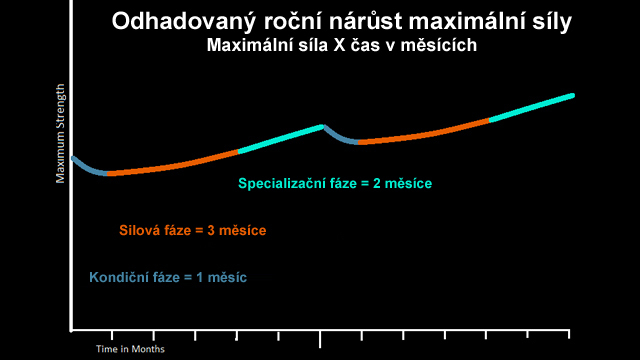
The chart shows you what your progress might look like.
Spend a month or so being healthy and fit and don't lift anything heavy. Dedicate three months to solid training where you build overall strength and add muscle mass. Dedicate two months to training for a competition or event. Repeat the whole cycle and it will put together a plan for the whole year.
Repeat the entire cycle several times and eventually your 10RM will surpass your former 1RM that you worked hard for.
I realize the chart shows that 2 months after the cut your strength is lower than where it was before. Don't worry, 4-6 months after that last cut, the new one will be noticeably higher in every way and hopefully you'll be more resilient and healthier.
These things go towards athletic longevity. Follow this yearly plan, and you will achieve what we all want: Lift long and well.
Written by Tim Henriques Translated by Jaromir Uhlir, taken from T-Nation
No posts have been made yet.








