





A comprehensive load for your chest
 Author:
 This new program takes a holistic approach and develops different physical skills at the same time. If your chest has been stuck in one place for a while, this program will help.
The skeleton of the program
The program is based on different types of exercises.
Heavy Weights: Simply put, I've never seen anyone with a chest like Kate Moss push 180 pounds of raw. While strength isn't always proportional to size, getting stronger is definitely a good idea for gaining muscle.
High reps: While the amount of tension (force applied) is crucial for muscle growth, the amount of time the muscles are under tension is also important.
Muscle tension lasting 40 to 60 seconds is very effective for muscle growth.
Training on unstable surfaces: I know what you're thinking. That this kind of training is for morons. It's for morons if it's done too often and wrong. But it can be profitable. I'll explain how in a minute.
The following paragraphs are from the book High-Threshold Muscle Building:
Another controversial topic is the use of exercises on unstable surfaces. Theoretically, they should have the potential to aid muscle activation through overall and joint stability (Lehman et al. 2006).
Therefore, in theory, this type of training could improve muscle activation as it increases the demands on the neuromuscular system which must provide stability. Therefore, theoretically, it could improve the capacity of the nervous system in muscle activation.
Push-ups on the Swiss ball increase triceps activation noticeably. (22% regular push-up, 43% on the swiss ball). Improvement in pectoral muscle activation also occurred, but not dramatically (21% vs. 26.6%). However, it is still a difference that speaks for exercises on unstable surfaces (Lehman et al. 2006).
However, when the feet were on the ball and not the hands, muscle activation did not change. Therefore, the unstable surface belongs under the hands. It also seems that the closer the muscle is to the source of instability, the greater the potential for muscle activation in the exercise.
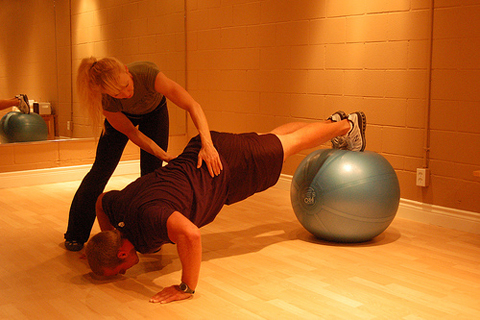
Less force production speaks against unstable surfaces compared to exercises with stable surfaces (Anderson and Behm, 2001). The force applied is one of the most important factors for engaging the maximum number of motor units. Thus, it is possible that techniques with less force potential reduce the effectiveness of a given exercise.
Training on unstable surfaces has been used very successfully in rehabilitation and injury prevention. Naughton and colleagues (2005) found this type of training to be effective in improving shoulder joint proprioception. However, the use of this type of training for muscle building is often misunderstood.
There seem to be two camps. One does almost everything on unstable surfaces and the other never does anything. Very few people choose the middle ground. And even fewer people use it logically.
 But back to the article.
I'll make it clear at the outset. Exercises performed on unstable surfaces will not lead to the same muscle growth as those performed on stable surfaces. The decrease in force production will prevent the maximum number of motor units from engaging. As a result, this use of an unstable surface does not make much sense.
The main purpose of training on an unstable surface is to activate the CNS. It will have to work harder to ensure stability during movement. So when you train on an unstable surface, you are actually giving your nervous system the potential to activate more motor units later, during the strength part of the workout.
So you need to do this training before similar exercises with a stable surface. (For example, push-ups with your hands on a Swiss ball and then push-ups with one-armed push-ups.)
Recommended
Nebbia Tričko THE BASE 377

Nebbia Bezešvé push-up legíny s vysokým pasem 303
Nebbia Washed crop top tričko GOLDEN AGE 782
You can do it as a superseries (stable exercise, unstable, break,...), you can alternate with a break after each exercise, or you can do each exercise separately.
In the last case, the exercise with unstable base should be put at the beginning of the workout. But for muscle growth it is better to put the exercises in a superseries or alternate them with breaks.
Exercises for maximum muscle tension: the goal of isolating a muscle is to maximize the work it does.
Strength is produced by three factors:
1. the muscle's own
2. 1.
3. The elastic part of the muscle and tendon
For maximum tension in the muscles, we need to reduce the rate at which both the stretch reflex and the elastic portion contribute. Floor exercises are good for this.
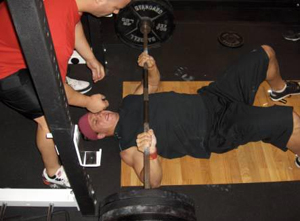
The stretch reflex is activated when there is a sudden change in the length of the muscle. When you start with one-arm floor exercises, there is no abrupt change in length (you are starting from a static position) and the muscle has to lift the weight with a much stronger contraction.
Complex program for the chest
A1) Main push exercise
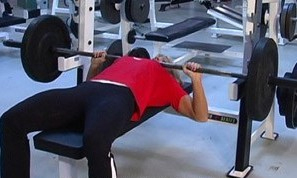
Week 1: Bench press (medium grip)
7/5/3/7/5/3
Week 2: Floor press
6/4/2/6/4/2
Week 3: Bench press (medium grip)
5/3/1/5/3/1
Week 4: Bench press (wide grip)
10/10/8/8
Take a 90 to 120 second break between exercises A1 and A2
Note: The remaining exercises are static. Which means they will be performed as described for the duration of the program. The first exercise is the only one where the repetition range varies
A2) Shrugs4-6 reps
If you can do more than 6, add weights. If less than 4, do negative reps
The shrugs in this program are not meant to improve your back and definitely don't count as a back workout. The goal is to take advantage of antagonistic training to add strength for the first antagonistic exercise.
Take a 45 to 60 second break between exercises A2 and A3
A3) Upper back stretch30-45 seconds
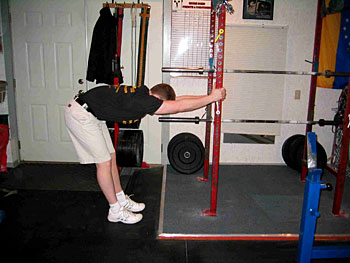
The goal of the stretch is to knock out the lower back. Stretching reduces the force capacity of the muscle. Weakening your back will help you push when you return to exercise A1.
After exercise A3, take a 90 to 120 second break and return to exercise A1.
B) One-arm push-ups at different angles
4 x 8-10/max/max
75-90 second breaks
Do 8 to 10 reps on a positively inclined bench. Without a break, lower the incline to negative and do as many reps as you can with the same weight. Again without a break, bring the bench to level and again do the maximum reps.
C1) Handles with blast straps
3 x maximum reps
30 second breaks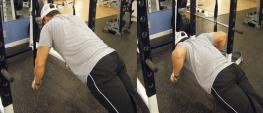
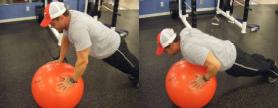
C2) Swiss ball push-ups
3 x max reps
30 second breaks
C3) Push-ups
3 x max reps
120 second breaks
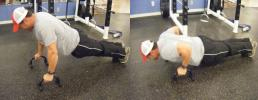
Note: The pedestals will reduce wrist pain.
D1) Blast straps
3 x maximum repetitions
without a break
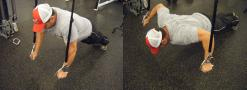
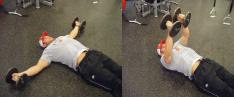
D2) Floor Straddle
3 x 8-10 reps
90-120 second breaks
Success guaranteed
If you've been on the spot for a while, try this program. It will hurt and it will grow!
Written by Christian Thibaudeau, translated by Jaromír Uhlíř
No posts have been made yet.








