





12 steps to great hamstrings
 Author:
 I avoid commercial gyms on principle. To keep my sanity.
And whenever that emergency occurs and I find myself in one of those black holes of fitness, I'm always amazed at the tragic leg workouts on display there.
Stumbling, over-kicking, leg presses and maybe the occasional squat that isn't even close to parallel. Maybe that's okay if you have no higher ambitions than to become that dude standing next to you checking his tan. But if you want some of that strength to go with that beautiful haircut, you need to train your hamstrings and your butt!
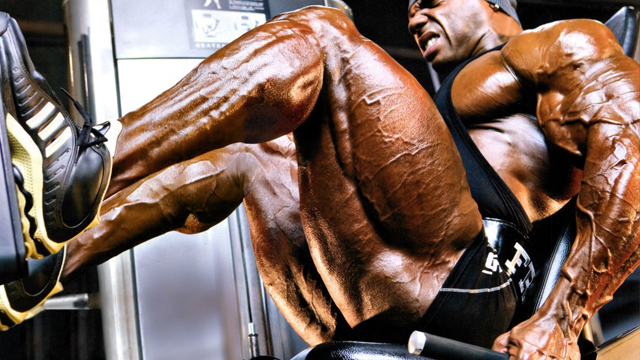
Butt dominants
Strong hamstrings, glutes and lower back are key to both speed and heavy deadlifts and squats. And guess what? A couple of tens on the stumbling machine won't help you do that! Hamstrings and glutes need to be trained intelligently and furiously.
Here are a few key points needed to create an intelligent program for your posterior:
- The back of the thighs (hamstrings) are made up of the biceps femoris, semitendinosus and semimembranosus. All need to be trained hard for maximum strength and speed.
- The hamstrings have two functions: knee flexion and hip flexion. Both of these movements must be trained.
- The hamstrings are largely made up of fast-twitch muscle fibers and therefore need to be trained hard. Do few reps - even 1's!
- Because the hamstrings are mainly made up of fast fibers, they have a good response to the eccentric part of the movement.
- If you've been neglecting them, you'll need to train the hamstrings more often before they match the quadriceps in strength.
12 steps
Each of the twelve exercises described below will give your hamstrings and butt a good workout. Choose one to three of them and add them after the main leg exercise (such as the deadlift or squat).
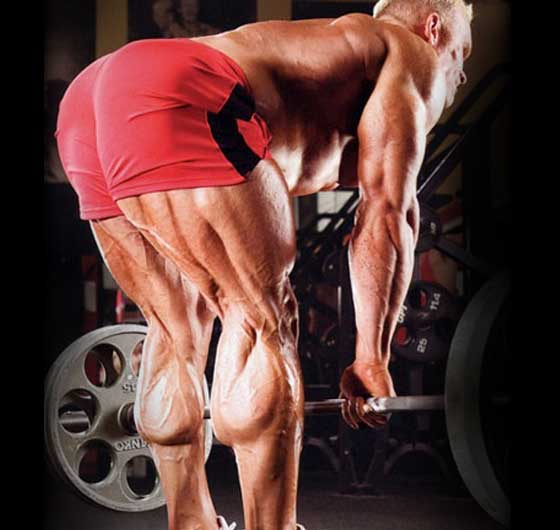
Romanian deadlifts
The Romanian deadlift is similar to the straight-legged deadlift, but instead of simply bending at the waist and pulling your axis up, your hips move backwards as you lean forward. It bears repeating: many people's deadlifts with legs extended neglect the hamstrings and favor the lower back. Especially those with short legs and a long torso.
The Romanian deadlift will probably give the hamstrings and butt more than any other exercise, besides the traditional deadlift. It's a much overlooked exercise. Both for athletic performance and for the butt, which doesn't go away when you turn sideways.
Keep your back straight. You can use both the overhand and the market grip. Definitely do low reps for this exercise.
Four sets of sixes will be good to start.
Glute-Ham Raises
You will need a special bench for this exercise. It looks similar to a hyperextension, only you bend at the knees and pull yourself up with your hamstrings, glutes, and calves. You push your legs into the mat and clench your hamstrings.
Glute ham raises can be put at the end of any workout. Start with your own weight and gradually add weight for sets with fewer reps.
Snatch Grip Deadlifts
Although I firmly believe that all variations of deadlifts should be practiced, I prefer this one for many reasons. The main one is that it forces you to go lower than a traditional deadlift, giving your hamstrings and butt even more work. Plus, it exercises the entire back of your body!
For deadlifts with a jerk grip, I would use jerks and not hold it crazy wide. I know weightlifters hold it to the edges, but it's just not necessary.
This exercise will teach you to actually sit back when pulling, which is an invaluable lesson for anyone looking to improve the deadlift.
Snatch Grip Deadlifts from a 10cm high box
Let's take a brutally effective exercise and make it even harder. Let's use a 10cm high box. This exercise will destroy your hamstrings and butt, plus engage your upper back and traps.
You'll notice this with both variations of the deadlift. Upper back and traps are pretty sore the next day. Whenever you have to hold a heavy axle and pull for reps, the traps and upper back have to do the work of stabilizing.
The box will extend the range of motion, but it's not so high that it noticeably changes the mechanics of the entire movement. If 10cm is going to mess up your technique, try a lower box or an aerobics box.
Sit back and let your hamstrings and butt do all the work. If I were to single out a common mistake, exercisers often start using their hands as the weight gets heavier - that's a recipe for disaster. When you find yourself pulling with your hands, take the weight off.
This exercise can be used either as a very heavy exercise or as a supplemental exercise for many reps.
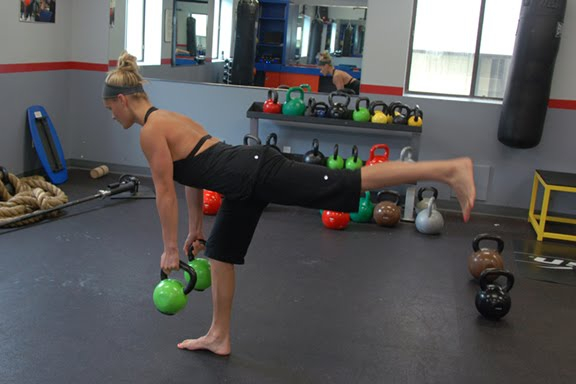
Deadlifts on one leg
I learned this gem from Paul Tsatsouline. Please ignore the circus-like appearance of this exercise - it's great! It can be done with one-armed dumbbells or kettlebells.
Place the one-handed kettlebells on the sides of the leg you are exercising. With a slight bend in your knee, bend forward and pick up the one-handed kettlebells. The non-working leg should be behind your body and not touching the floor.
Go as high as comfortable. Now, with your arms outstretched, pull the one-arms up to waist height while you pull the back leg forward. Continue until you are upright, on two legs and with the one-handed grip at your waist.
Stumbling with the band
For those familiar with the Westside Maximum Effort/ Dynamic Effort systems, this is a great way to train the hamstrings dynamically. The band will train the hamstrings to be strong throughout the range of motion as the exercise gets heavier towards the end.
Tie the band with one end to the cage, the other to your ankles, and sit on the bench. The band should have some tension even with your legs extended. Now bend your legs, do a quick, explosive kick.
Burying with the band can also be done with each leg separately, as shown in the video to the right.
Three sets of figure eights will do the trick.
Dynamic lunges
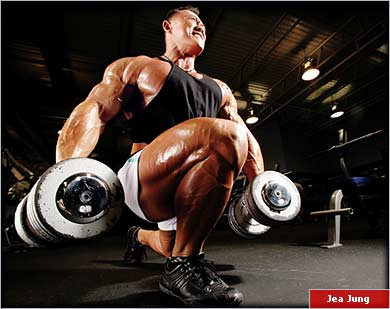
Lunges have a bad reputation because most nerds at gyms use those pink one-armed dumbbells and take five-inch steps when doing them. But if you do them with heavier weight and dynamically, lunges can be a great tool for strength training.
The lunge should be a very long stride. The return to the starting position is explosive.
Lunges performed in this way are effective because the athlete opens and closes their kinetic chain (= lower limbs - hips - trunk - back - shoulder - elbow - wrist, translator's note) during the movement, which helps the ability to safely keep a large portion of the body weight on one leg (as in running).
So they're functional and help you build a butt like granite -- I could do that!
Don't be afraid of heavy lunges. No one says you have to do fifteen reps of them.
Three to four sets of eight to ten reps will do the trick for your hamstrings and butt.
Dynamic stumbling with medicine ball
This exercise is great for the end of a workout and develops explosive lower body strength. Plus, it's a bunch of fun.
Start by lying on your stomach and putting your feet together. Your partner will roll the medicine ball down your legs. When you feel the medicine ball reach your ankles or shoes, stumble and throw the ball back to your partner.
It may take a few repetitions, but once you get the hang of it, the medicine ball will fly back to your partner, who should catch it at about waist height. This is a great dynamic hamstring workout.
Try this exercise if you suffer from frequent hamstring strains. Repetitions can go higher. I would recommend eights to tens.
Please make sure your training partner can catch the ball!
Stumbling with a towel
You may have noticed that I am not a fan of conventional tripping. Machines are simply limited. Both in movement and in the resistance they put up.
But I've included variations of tripping in this article. Why? Well, as I said at the beginning, you need to train flexion in both the knees and the hips. Except stumbling on the machine is for the lazy.
Both band and medicine ball stumbling are great exercises for hamstring dynamics, but their resistance is limited. Familiarize yourself with towel stumbling.
Lie on your stomach on a bench and let your legs hang over the edge. A partner will tie a towel around your ankles and you will perform the stumble.
This method is better than regular tripping for many reasons:
- Adjustable resistance. Your partner can add and subtract as needed.
- Increased resistance in the eccentric phase. The partner will simply pull more when lowering and you will struggle with more resistance.
- Adjustable designs. You can take it narrow, wide, single leg, or bipedal. Changing the design will do wonders for complete hamstring development.
Stumbling with a towel can be done in the medium range (four to eight) reps . Three to four sets towards the end of the workout.
Kettlebell Swings (Kettlebell Swings)
Kettlebell swings are one of the best, but least used, exercises for the back of the body. Most people perform the swing as a squatting movement. This style has been popularized by those who use them for fat loss. Which, with a high number of repetitions, is quite effective.
However, we are here for the growth of the hamstrings, so we will not be using this method of execution. The real swing, the one performed for strength, speed and muscle development, has a much greater range of motion and jerk at the bottom of the movement.
When the kettlebell is all the way back, jerk it forward. That sudden change of movement is the most important thing! If you swing slowly, you are swinging uselessly. Make sure to engage the hip area in the upward motion (snap - translator's note) so that the butt is engaged as well.
Don't be afraid of heavy weights. They're doing 50-pound kettlebells nowadays, so even the strongest should have something to do. If kettlebells aren't available, a one-arm kettlebell should do the trick.
I've found it to be a great warm-up exercise for heavy leg exercises. It's great to wake up the hamstrings and butt and alert them that they need to do some of that work.
The swings can also be used at the end of a workout. You should do three to four sets of four to six reps.
Recommended

Prom-in Pentha Pro Balance
Nebbia Sportovní podprsenka STRONG BEAUTY 424
Nebbia Push-up šortky se šněrováním STRONG BEAUTY 429
Nebbia Washed legíny s vysokým pasem LEGACY 777
UprightSled Walks
Anyone who saw T-nation's Christian Thibaudeau destroy Darryl Gee knows that pulling sleds and pushing prowlers are great for fitness. It can also serve as an alternative for leg development.
While most people pull and push at some angle, you need to pull upright, for focus on the hamstrings.
This is best achieved with a harness, but can also be achieved by attaching a rope to a belt. When you start pulling, keep your body as upright as possible and try to "pull" the base towards you instead of walking.
This can be observed while walking the dog. Dogs pull the substrate towards them. You can tell that you are doing it correctly by the intense tension in the hind legs.
Pulling can replace any of the aforementioned hamstring/back exercises. Start with three walks of thirty yards and try to work your way up to six. Add weight at that point.
Sprints
If there's anything that drives rabid exercisers madder than hearing that cardio is a waste of time, it's hearing that instead of running on the treadmill, they should get out and sprint!
Sprints are a long lost tool for fitness, reducing body fat and creating fabulous hamstrings. Even if you're not an athlete, sprinting is still a pretty good idea.
Actual sprinting puts huge demands on your hamstrings, butt and hip area. Just look at any sprinter or NFL player and it will be clear what sprinting will do to your legs.
You will be sprinting short distances to develop your hamstrings. We're not here for fitness -- that's in another article. If you haven't sprinted in a while, start slow. You may not feel much out there when you run, but sprinting can hurt pretty bad.
Think of sprints as upright pulling. They can be an alternative to any hamstring exercise, or they can be done on a separate day.
I find that most athletes like to sprint directly after a dynamic lower body workout. Some at the end of a heavy leg workout. Figure out for yourself what is best for you.
Start with four to five 30-meter sprints. Work your way up to eight. Then you can start playing with distance. Try thirty, forty, fifty meters, even sprinting backwards.
The grand finale
All right, fellas. This is the last warning. If I meet any of you at the gym and you're still working out your posterior like princesses, I'm going to pin this article to your flabby ass!
Getting a good butt doesn't have to be complicated. Just pick two or three of these exercises, add them to your program, and watch your hamstrings grow.
Steven Morris is a personal and strength trainer in the Philadelphia and South Jersey area and owner of the Explosive Football Training site.
No posts have been made yet.








