





The unrelenting panic around carbohydrate consumption
 Author:
 Carbohydrates. The demon of today's nutrition world. Modern nutritional strategies try to eliminate their intake ideally, because it is the consumption of carbohydrates that is supposedly the main cause of our fat stores, civilization diseases and lately it seems that carbohydrates are actually responsible for everything bad that happens to our bodies.
Yet carbohydrates, along with protein and fat, are among the essential macronutrients that should be balanced in a healthy diet. Carbohydrates are also considered to be the main source of energy, which we as athletes and active individuals should definitely not forget. They are divided into simple carbohydrates (this includes mono and disaccharides, often referred to as sugars) oligosaccharides and polysaccharides. Fibre is also classified as a carbohydrate .

Carbohydrates are now considered a major indicator of fat gain, and this is why modern strategies are moving towards restricting or eliminating them altogether. Let's pour ourselves a glass of clear wine. Weight gain is caused by CALORIC EXCESS, in other words, if you eat more than your body needs. If you are in caloric excess and eating carbs you will (probably) gain weight, if you are in caloric excess and not eating carbs you will (probably) gain pounds too. Whether you gain or lose weight is a question of CALORIC INTAKE, the balance between calorie intake and calorie expenditure, not whether you eat carbs or not. You can have a caloric surplus from any food in the world if you can't control the amount you take in.

It's quite simple. If you want to work with your body, whether to lose weight, gain weight, or shape up, you need to work with just the balance of calories in and out. If you want to lose weight, the total number of calories ingested must inevitably be less than the sum of those expended. If you want to keep your intake under control, there is nothing easier than to calculate your intake at least tentatively and to keep a food diary and count for some time. If you don't want to count, this can of course be achieved by so-called INTUITIVE eating. However, this approach requires perfect knowledge of your body, observing your intake reactions and adjusting your diet based on them. A state where you eat as much as you need for a given goal and don't have to weigh or think about the quantity is the pinnacle. When you get there, you can safely say that you really know your body and know how to work with it. Some people reach this state after years of trying XX diet approaches, others hit it in a few months and there are those who don't get there and need to think about their diet all the time. But that's getting way off topic.
A little bit of carbohydrate theory
For a balanced healthy diet, we should be in the 40-55% range of total energy intake in carbohydrate intake . Obviously, a higher proportion of carbohydrates in the diet is suitable for a part of the population with a normal weight and very active, or for individuals who play demanding sports. It is also necessary to differentiate the representation of each group of carbohydrates in their total sum. The type and form of carbohydrate intake largely influences satiety, and with it the total energy intake.

Polysaccharides, or complex carbohydrates, which are found in cereals, potatoes, legumes, etc., should make up the largest proportion of intake. Their digestion is slower and the insulin threshold fluctuations after ingestion are smaller. In contrast, simple sugars (sucrose, fructose, raffinose, milk sugar) stand out. The intake of simple carbohydrates should not exceed 60g per day in a healthy adult . Excessive intake of simple sugars is harmful and can lead to weight gain.
Carbohydrate foods should be part of every major daily meal, even if you are trying to reduce weight. In the context of weight loss, adequate carbohydrate intake prevents an unwanted drop in basal metabolic rate and improves the overall prospects for successful weight loss. You can moderate carbohydrates during the reduction period , but definitely do not strictly exclude them from your diet. If you set your carbohydrate intake excessively low for reduction, yes you will indeed lose weight, probably significantly and quickly, but what will you do when your body adapts to the intake and you need to adjust it further? It's better to choose a higher starting carbohydrate limit and gradually reduce it, than to set a significant restriction right from the start and then have nothing to lose. Combine carbohydrates with protein or a fibre-rich food in your diet to ensure optimal satiety time.

An important piece of information to mention about carbohydrate consumption is that carbohydrates are very essential for our brain and nervous system. The brain uses up a whopping 20% of the body's total energy, which is more than any other organ. This is also why we tend to get irritable and tired when we are deficient in carbohydrates.
Another common confusion around carbohydrates is their distribution throughout the day. For a long time, the strategy has been that carbohydrates must be consumed only up to a certain hour, and dinner and meals after dinner must be free of them, otherwise carbohydrates are stored as fat. Fortunately, this probably most widespread myth of healthy eating has been debunked by all modern studies and world experts. Studies show that evening carbohydrate consumption, on the contrary, is perhaps the best thing ever. Carbohydrates promote regenerative processes and, thanks to their "buffering" ability, help to fall asleep better. To reiterate, it doesn't matter what time of day you take in a given macronutrient, but your total caloric intake. A food intake has the same amount of carbohydrates in the morning, evening, summer and Thursday. The key is the daily calorie intake and the balance of calories in and calories out. Not whether you eat carbs at dinner or only eat them until 3pm.
And now for the important part... carbohydrates in an athlete's diet
There are many reasons why carbohydrates should not be missing from the diet of active individuals. When carbohydrates are digested, they are converted into glucose, which is the main source of energy for the body. The simpler the form of carbohydrates we ingest, the faster the source of energy they provide. Thus, complex carbohydrates are a source that provides energy for a longer period of time because they release sugar into the bloodstream more slowly. Yes, the body can of course use fats and proteins as energy as well, but carbohydrates have a slight advantage in terms of their ability to convert to ATP (energy source). Imagine you have a solar power station and a classically wired power station. The source is whatever there is more of at the time. Same goes for the body and the use of carbohydrates or fat as an energy source.

The issue of using carbohydrates or fat as an energy source is quite extensive, so we will deal with it very briefly. Time and intensity of exercise also play an important role. Carbohydrates are the only source that may or may not have oxygen for its activation. Protein and fat must have it. Hence, carbohydrates are used as an energy source during very intense workouts. In sports, we distinguish between anaerobic and aerobic activities (hence metabolism). Aerobic activities take longer to perform at a maximum of around 79% of maximum heart rate (65VO2max), and energy is mainly extracted from fat. Anaerobic activities are contrasted with anaerobic activities, where we get above the 79% TF limit (65% VO2 max)* and anaerobic metabolism uses mainly carbohydrates to produce ATP (see graph below). Carbohydrates should not be omitted from the diet of runners, sprinters, athletes, but also strength and other athletes.
*VO2 MAX = Indicator of maximum oxygen utilization or maximum aerobic activity. This is the amount of oxygen consumed in milliliters per kilogram of body weight per minute.
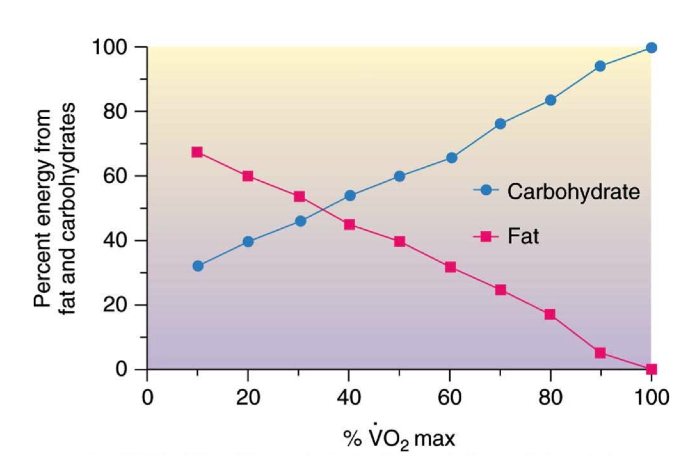 This graph shows the dependence of each substrate (fat x carbohydrate) on training intensity.
Let's briefly review the main benefits of consuming COMPLEX carbohydrates, not only for active individuals.
- They allow you to train at a higher intensity.
- They prevent muscle loss and promote better muscle recovery.
-They stabilize the level of hormones such as leptin, which is referred to as the "hunger hormone". This property is usually cited as a benefit for eating fat, but according to this study, carbohydrates have this ability much higher than fats. The hormonal benefits of carbohydrates don't end with leptin. Carbohydrates also suppress cortisol.
- They contain fiber, which makes us fuller.
- They are important for brain function.
- They help maintain stable cholesterol levels.
- Sensible consumption is also a prevention against diabetes, as complex carbohydrates do not cause blood sugar fluctuations.
What to take away from this?
Carbohydrates definitely have a place in every healthy person's diet, especially if they are active. Their consumption offers many benefits and they are an essential source of energy. There is no need to strictly exclude them from your diet. Carbohydrate consumption alone is not the key indicator of fat gain, it is the overall caloric surplus regardless of which macronutrients you eat. If you're an active person, you don't need to have any concerns about consuming them. However, keep in mind that there is no such thing as a carbohydrate and you can't compare cookies, sugary bakery products and other rather sugar bombs and complex carbohydrates.
Sources: examine.com, healthline.com, Pubmed
Recommended

GreenFood Chrom Lalmin
No posts have been made yet.








