





Is high-frequency eating really a key element in reducing?
 Author:
 If your goal is to lose weight, chances are you've come across advice like"if you want to lose weight, you need to eat 6 times a day". However, there are many people who, due to their jobs or time pressures, are unable to meet this number. Is high-frequency eating really a necessity to reduce and speed up metabolism?
The argument that eating more frequent meals makes our metabolism work faster sounds quite convincing, what are we going to say... However, studies that have looked at this issue have concluded that there is no difference between eating more small meals and eating fewer, more bulky meals.
Similarly, no link between high-frequency eating and greater fat burning has been shown. So the key to losing weight is not the number of meals into which you divide your daily intake, but just your daily intake. In other words, it doesn't matter too much whether you eat your daily intake in six meals or manage to consume only three large ones. The key to successful reduction is to create an inequality where intake < output.
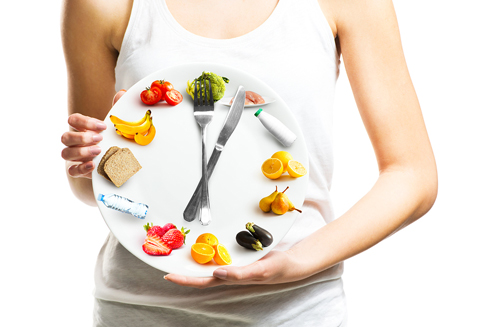
A greater frequency of meals is often associated with a greater so-called thermic effect. This could be simply explained as basically the amount of energy your body needs to digest and process the food. One study published in the International Journal of Obesity found that more frequent eating - six times a day to be specific - led to a greater thermic effect from food than "sporadic eating "*. However, there was nothing in the study to suggest that eating three, four or five meals was worse than six - it was just better than "sporadic" eating. Irregular eating habits are associated with a reduced thermic effect overall, regardless of their frequency.
By *sporadic eating is meant a type of eating where a person has absolutely no regularity in their eating habits.
The frequency of meals is a very common topic of conjecture and has been the subject of many studies. One American journal compared the results of 179 studies and came to a fairly clear conclusion - apart from individual changes in metabolic rate due to more or less frequent meals, there is no significant difference in metabolic rate (and overall weight loss) between high and low frequency eating groups.

However, a recent study was conducted comparing men consuming 3 meals per day versus those consuming 14 meals per day (this is really an extreme case, but for illustration). The results said that there was no significant difference observed in energy consumption, but the group consuming fewer meals showed a greater need for rest than the high frequency group.
But still... eating less frequently = fat gain, right?
So let's go over it again. It doesn't matter whether you eat your daily intake in three or six meals, because weight gain is caused by taking in more calories than your body needs, not by how many meals you divide them into. So don't stress if your job doesn't allow you to eat every two to three hours, as you can read in many "how to lose weight for sure" guides.
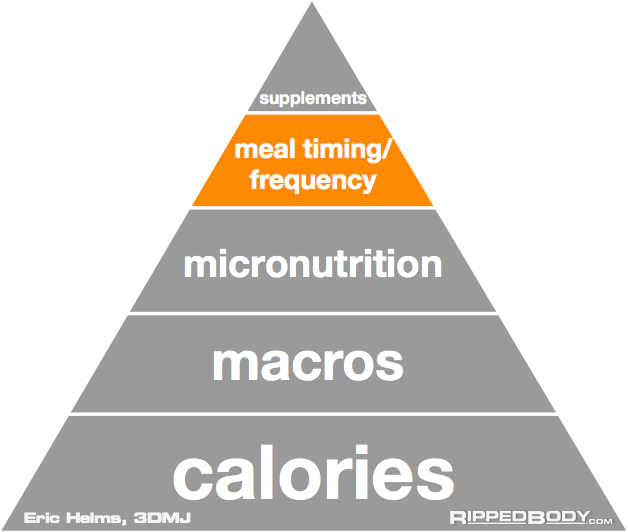
This is the pyramid of factors that are important when trying to lose weight. As you can see, the frequency of meals is only second from the end. Take a good look at this picture and remember that total intake is always the most important - it's what determines whether you lose or gain weight.
Even a lot of modern nutrition practices are based on the principle of lower frequency. Logically - we live in a time when everything is rushed and so many people are comfortable with IF (Intermittent fasting), which in simple terms works by having a time "window" in which you take in all your daily calories and then don't eat for the rest of the day. I am not a proponent of this principle, but it is one of many modern approaches and there are people who are fully comfortable with this way of eating and why not. Come to think of it, fasting is actually a thing of our ancestors and is also a key element of many religions.
But on the other hand - during a period of fasting, especially if it is longer, there is a reduction in the formation of new muscle proteins and rather a breakdown of muscle proteins. This is a perfectly normal progression, which is expressed by the well-known phrase
"when you eat too little, your body needs energy, so it starts burning your muscles and using them as energy."
Yes, this is indeed how it works, and if you get your intake wrong in your calorie intake time window, in the long run this way of eating may not give you good results. However, when set up correctly, it can instead be a very beneficial strategy for fat reduction. However, for building muscle mass this approach is not very suitable.
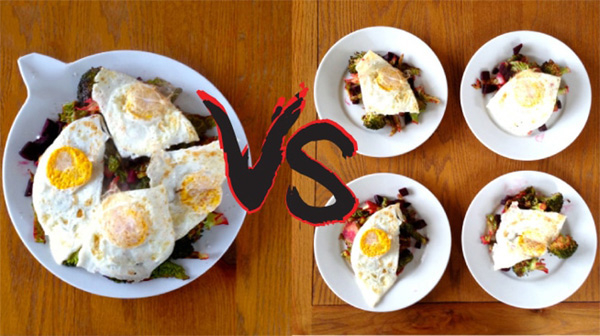
Meal frequency can also be a matter of simple math. If your total daily intake is, for example, 2500Kcal and you divide it into approximately equal parts, quite nice numbers come out even for higher frequency meals. On the other hand, if your intake is, say, 1600Kcal, then splitting it into 6 meals isn't exactly a calorie hit. Remember that the size of your portions must be directly proportional to their ability to fill you up. It doesn't make sense to eat completely small portions just to be able to fill the recommended six meals a day when you're hungry an hour after you eat. It is advisable to choose portions large enough to fill you up.
So what is the conclusion? The frequency of meals is a PURELY SUBJECTIVE matter. Small portions more often can offer the benefit of not feeling overfed and bloated. On the other hand, the downside is that you will feel hungry more often and in some situations there is simply no option to eat. Larger portions over longer time intervals, have these pros and cons exactly interchanged. What strategy you choose is purely your decision. Since the number of meals per day is pretty much a negligible factor in reducing, choose the frequency that best suits you and your time.
Sources:
https://www.ncbi.nlm.nih.gov/pubmed/26024494
https://www.health.harvard.edu/diet-and-weight-loss/eating-frequency-and...
https://examine.com/nutrition/do-i-need-to-eat-six-times-a-day-to-keep-m...
https://www.ncbi.nlm.nih.gov/pubmed/15806828
https://www.ncbi.nlm.nih.gov/pmc/articles/PMC4250148/
https://www.ncbi.nlm.nih.gov/pubmed/9155494
https://www.ncbi.nlm.nih.gov/pubmed/22719910
https://www.ncbi.nlm.nih.gov/pubmed/8383639
https://www.ncbi.nlm.nih.gov/pubmed/2405717
https://www.ncbi.nlm.nih.gov/pubmed/12081823
https://www.ncbi.nlm.nih.gov/pubmed/8383639
https://www.ncbi.nlm.nih.gov/pubmed/21123467
https://www.ncbi.nlm.nih.gov/pubmed/9155494
No posts have been made yet.








