





How often to take protein so that it really grows?
 Author: Šárka Randáčková
 There are a few things in bodybuilding that we just take as fact; they are not examined or thought about. We all KNOW that optimal mass gain is achieved by consuming adequate amounts of high quality protein. We all KNOW that large amounts of protein are best eaten in frequent small portions. This keeps amino acid levels consistently high, thus keeping us in a constant state of anabolism. We all know that eight meals a day is best for us. WE'RE ALL WRONG!
How often we should consume protein is just as important as the amount in each serving, because the sum of the anabolic response to each meal is not just about the height of the peak response, but also the duration of the response. In other words, once you trigger proteosynthesis with a protein-rich meal, how long will it last and when can you trigger it again? This will determine the optimal meal frequency for maximum anabolism.
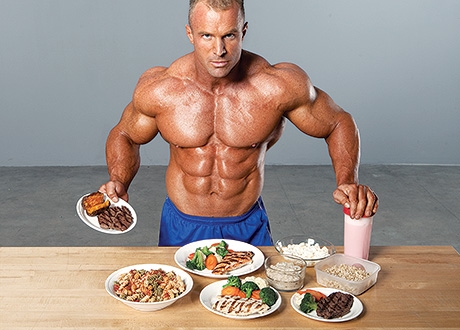
Our lab has shown that the anabolic response to a full meal containing protein, carbohydrate, and fat peaks after 90 minutes and returns to baseline after 3 hours.1 So it's easy, right? We should just eat every 3 hours. Before you run away with this information, read the rest of my text. What is REALLY interesting about our findings is that while proteosynthesis returned to baseline after 3 hours, plasma amino acids continued to be elevated above baseline and plasma leucine (the amino acid responsible for the increase in proteosynthesis) was elevated almost 3 times!
Similarly, mTOR signaling (mTOR activation triggers proteosynthesis) was still at a peak after 3 hours, while proteosynthesis had returned to baseline. However, the sustained increase in plasma leucine and mTOR signaling was not enough to sustain the increased proteosynthesis.
This suggests a problematic response of proteosynthesis to prolonged increases in plasma amino acid levels. Bohe et al. also showed a problematic response to a steady increase in amino acids during a 6-hour infusion of basic amino acids.2 The infusion arranged a constant increase in plasma amino acid levels; however, proteosynthesis lasted only 2 hours and could not be stimulated further for the remainder of that 6-hour period. It is unlikely that ingestion of another meal 2-3 hours after the first would have been sufficient to further increase proteosynthesis because amino acid levels are already elevated. To avoid a problematic response and maximize anabolism, it might be best to gradually increase protein doses and allow amino acid levels enough time (4-6 hours) to drop between meals.
I've probably shocked you so much that you've splashed the magazine with protein and are currently cursing me for 1) devaluing the latest issue of Muscle and Fitness and 2) telling you that the dietary protocol you've followed for so long may not be optimal for building mass. You've worked so hard and long to make sure you have a steady level of amino acids, and some problematic response will now tell you that it was useless! I apologize for the magazine, but I won't apologize for tearing down that old dogma - This is just what I do.
Recommended

Nebbia Washed-off bavlněné heavyweight tričko GRIND 370
Nutrend Delicious Bar

Nebbia Fitness bolero s dlouhým rukávem TRUE HERO 257

Intense Legíny GOLD Nebbia print 827
One possible mechanism that could explain the problematic response is that there is a membrane-bound stat protein, either intracellular or extracellular, that is sensitive to relative CHANGES in amino acid concentrations, rather than absolute concentrations. In such a case, a steady increase in blood plasma amino acids would lead to a problematic response because an unchanging increase in amino acid concentration would not lead to activation of the protein in question. One way around this would be to eat decent portions of free amino acids between meals, which would cause a rapid, supraphysiological increase in blood plasma amino acid levels that would subside just as quickly, and the whole system would become responsive again.
Another possible explanation for our problematic response could involve insulin. In our study, the movement of insulin in the blood plasma seemed to correspond with proteosynthesis.1 Bohe et al. also showed a similar pattern in their infusion study.2 Although an increase in insulin is not needed to kick-start proteosynthesis, it still maximizes the amino acid response.3,4 Perhaps an increase in plasma insulin is needed to MAINTAIN proteosynthesis after a meal. If this is true, it is likely that this mechanism is independent of the effect of insulin on mTOR signaling, because our laboratory has shown that this problematic response can occur even when mTOR signaling is still elevated.1 Although insulin is not required to kick-start proteosynthesis, it is known to stimulate peptide elongation (chain elongation of a growing protein as it is synthesized) in skeletal muscle.5 If a drop in plasma insulin levels reduces peptide elongation, it could well be knocking down proteosynthesis, and explain our problematic response.
Consistent with both of these theories, Paddon-Jones et al. took a group given three protein-rich meals 5 hours apart, with, or without supplementation with 15 grams of essential amino acids and 30 grams of carbohydrate, and measured the anabolic response. They found that over the course of the day, the group receiving the supplement had a higher anabolic response than the group not receiving it. Either the consumption of free amino acids and carbohydrates was probably enough of a stimulus to overcome that problematic response, or the supplement simply optimized the anabolic response to each of the meals. Either way, it seems that consuming higher doses of protein at greater (4-6) hour intervals and supplementing with free amino acids and carbohydrates between meals is an effective way to maximize proteosynthesis and probably overcome the problematic response to elevated amino acid levels.
Sources:
1. Norton LE, Layman DK, Garlick PJ, Brana DV, Anthony TG, Zhao L, Devkota S, and Walker DA. Translational controls of muscle protein synthesis are delayed and prolonged associated with ingestion of a complete meal. FASEB J, 2007 21: 694.6 [Meeting Abstract]
2. Bohe J, Low JF, Wolfe RR, Rennie MJ. Latency and duration of stimulation of human muscle protein synthesis during continuous infusion of amino acids. J Physiol, 2001 Apr 15;532(Pt 2):575-9.
3. Anthony JC, Lang CH, Crozier SJ, Anthony TG, MacLean DA, Kimball SR, Jefferson LS. Contribution of insulin to the translational control of protein synthesis in skeletal muscle by leucine. Am J Physiol Endocrinol Metab, 2002 May; 282(5):E1092-101.
4. Greiwe JS, Kwon G, McDaniel ML, Semenkovich CF. Leucine and insulin activate p70 S6 kinase through different pathways in human skeletal muscle. Am J Physiol Endocrinol Metab, 2001 Sep;281(3):E466-71.
5. Yoshizawa F, Tonouchi A, Miura Y, Yagasaki K, Funabiki R. Insulin-stimulated polypeptide chain elongation in the soleus muscle of mice. Biosci Biotechnol Biochem, 1995 Feb; 59(2):348-9.
6. Paddon-Jones D, Sheffield-Moore M, Aarsland A, Wolfe RR, Ferrando AA. Exogenous amino acids stimulate human muscle anabolism without interfering with the response to mixed meal ingestion. Am J Physiol Endocrinol Metab, 2005 Apr;288(4):E761-7. Epub 2004 Nov 30.
Author: Šárka Randáčková No posts have been made yet.








