





Do you drink coffee several times a day? Is coffee - evil or health in every cup?
 Author:
 Coffee in the morning for breakfast, in a cup on the way to work, with colleagues when they arrive at the office, after lunch, as a ritual when sitting with friends... In short, we all love coffee!
I'll be a bit ahead of the curve and say that the end result will please every consumer.
A little history (2):
Nobody knows exactly where and when coffee was discovered, but Ethiopian legend (2) says that the origins of coffee originated in Ethiopia, where a goat herder noticed that his herd behaved much more energetically after eating berries from a tree. So much so that it couldn't sleep at night! He passed this information on to the local abbot, who made a drink from the berries that allowed him to pray until the wee hours of the morning. Subsequently, the information began to spread throughout the region. The information spread to the Arabian Peninsula - people began to prepare coffee at socializing and public events. From there, coffee began to be imported to Europe in the 17th century! THANK YOU!
In our country it was even nicknamed "Satan's drink" for its stimulating effects.
Coffee gradually replaced the breakfast drinks that had been used up until then, which were beer and wine (that had something to it too...).
Coffee, of course, made its way to America, Thomas Jefferson even made a statement about it:
"Coffee - the favorite drink of the civilized world."
Now coffee is known to every educated and uneducated person and has become an integral part of our daily lives.

Present:
In the past years, I have come across dozens and hundreds of controversial claims.
On the one hand we could learn how drinking coffee is harmful, how coffee dehydrates us, that it causes cramps in the duodenum, impotence and how we should not drink it in any case. All of this is, of course, nonsense and now debunked myths.
As it happens, in recent years the complete opposite has been shown, and scientists have been coming up with new studies on the positive effects of coffee consumption.
For example, a study from Imperial College London (1) showed in a study lasting over 16 years that coffee drinkers live to a richer age! The results are based on an evaluation of health data of more than half a million people from ten European countries.
So what does it show:
Coffee contains large amounts of antioxidants that protect the DNA of human cells.
When comparing two groups, it even came out that the group consuming coffee had more antioxidants than the group consuming fruit and vegetables. It has been shown that there are 4-5 times more antioxidants in 600ml of coffee than in the same amount of fruit and vegetables. Of course, this doesn't mean you don't have to consume fruits and vegetables! There are still important vitamins, minerals and fibre.
Reducing the risk of dementia.
A 2010 Harvard study showed a 20% risk reduction in women consuming more than 4 cups a day.
Coffee consumers show increased longevity.
This claim is probably true for cardiovascular disease and diseases of the digestive system.
In Germany, life expectancy increased by 7% for women and even 12% for men!
This may be due, for example, to the fact that coffee (along with grapefruit and chicory) is the only bitter taste commonly consumed by society - bitter substances can result in the production of stomach and bile acids, thus promoting digestion.
Tip #1: consume coffee after meals!
Consuming coffee before a workout increases drive and motivation.
As is well known, caffeine boosts brain activity, shortens reaction time, improves motivation.
Even if these effects are only short-lived and after some time we become more and more resistant to them, we can benefit from this benefit.
Tip #2: my favorite Bulletproof Coffee before a workout!
What is it? It's a mix of coffee and saturated fat. The original recipe says you should mix coffee, 1-2 teaspoons of MCT fat (coconut oil) and 1-2 teaspoons of grass-fed butter or ghee, which is a trans-fat.
Pre-workout is recommended because saturated fat slows the absorption of caffeine, thus prolonging its effect!

When not to consume coffee, or at least limit it:
It is true that coffee can raise blood pressure. So if you suffer from high blood pressure and feel unwell after drinking coffee, skip it.
I do not recommend coffee during certain phases of an elimination diet, when the function of the adrenal glands is impaired and when you have problems with sleep, but this is subject to personal consultation and individual adjustment of individual programs.
Furthermore, coffee is not recommended for pregnant women as there is still not much evidence to rule out all possible negative effects.
Conclusion:
As with food, quality is very important with coffee! The ideal is to consume organic coffee and prepare it in a French press, for example (see the end of this article for how to do this).
Colombia, Brazil, Dominican Republic
If you have trouble sleeping, consume your last coffee no later than 16.00, as caffeine has quite a long half-life.
It is also said that the dose makes the poison. You can develop an addiction to coffee, so limit yourself to a maximum of 4-5 cups a day. What is harmful in large quantities can be beneficial in smaller amounts.
ATTENTION: All previous recommendations apply only to pure coffee without added sugar, milk and cream!! Because if you add 3 teaspoons of sugar and 2 tablespoons of full-fat cream to each coffee, instead of benefits you will only give yourself diabetes, other diseases and increase your body fat percentage! So once and for all, only pure coffee most of the time, or Bulletproof Coffee (see above).
Making coffee in a French press (3):
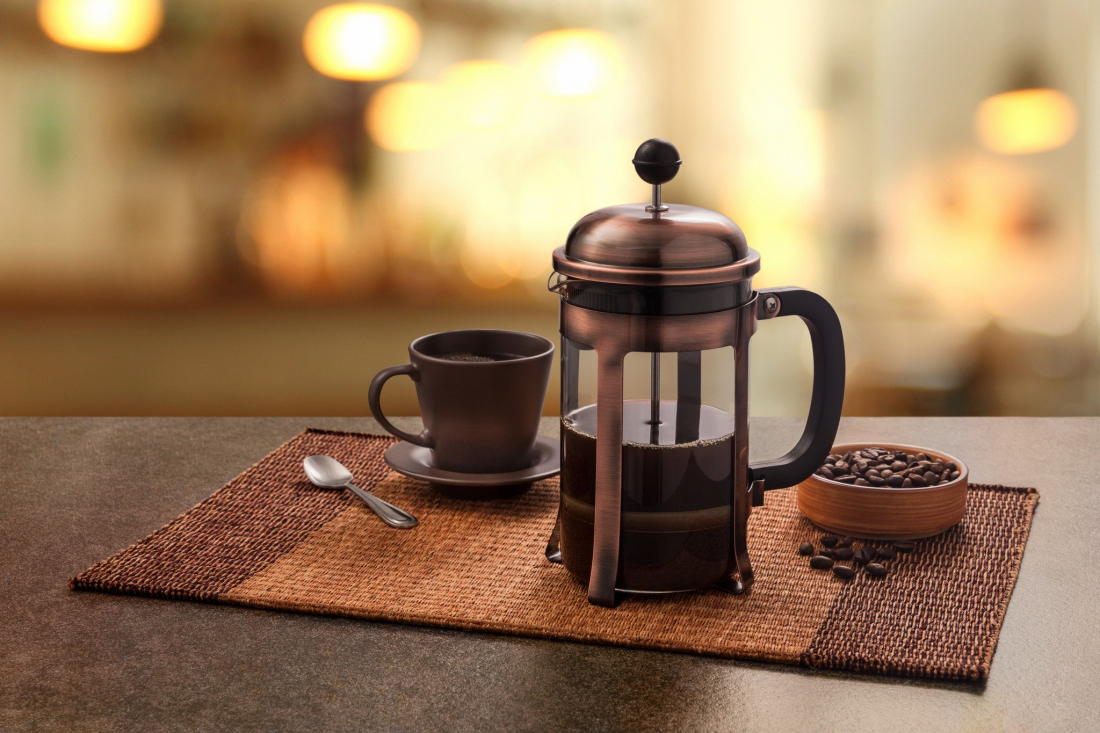
What is a French press? A French press is a coffee pot that uses a filter plunger to separate the brewed beverage from the coffee grounds, i.e. the logro. Most of the time, the container of the French press is made of glass and has plastic or metal handles, holders. The more unknown manufacturers of French presses are Bodum (Melior) and La Cafetière.
Now let's take a look at the preparation of coffee in a French press:
- Put water on to boil - the amount required to make the coffee, plus additional water of the volume of your French press.
- Prepare the desired amount of coffee, preferably freshly ground. 1 cup of coffee = one full scoop, which usually comes with the French press.
- Once the water starts to boil, turn it off. Fill the French press with water and let it warm up for a while, then pour out the water.
- Allow the remaining water to cool to about 90°C, which should take about 30 seconds at normal room temperature.
- Pour the coarsely ground coffee into the French press.
- Pour hot water over the coffee so that the water is just above the ground coffee - this will scald the coffee. Let the coffee "work" for a little while.
- Refill the French press with the desired amount of water and stir.
- Place the lid of the French press with the plunger pulled out to prevent heat from escaping. Do not press the plunger down yet.
- After 3-4 minutes, start to slowly press the plunger down. Press the plunger straight so that the strainer does not come away from the wall of the French press and the coffee does not leak upwards.
- Once the plunger has been pressed all the way down, you can pour the coffee, preferably into preheated cups.
Also, remember the following line:
If you need coffee to kick it, you don't actually need coffee, you need rest!
In case you like coffee and the article assures you that coffee is good for good health, SHARE the article!
Many pleasurable experiences while consuming coffee.
Sources:
1. http://annals.org/aim/article-abstract/2643435/coffee-drinking-mortality-10-european-countries-multinational-cohort-study?doi=10.7326%2fM16-2945
2. http://www.ncausa.org/About-Coffee/History-of-Coffee
3. http://www.cerstvakava.cz/clanky/jak-pripravit-kavu-ve-french-pressu/
Images:
1.http://somethingtodebate.blogspot.cz/
2. https://img.dietspotlight.com/
3. https://cdn.shopify.com/
No posts have been made yet.








