





For (complete) beginners
 Author:
 He is like an explorer on a journey to unexplored lands. He doesn't understand the language, he doesn't know the laws and he makes many logical mistakes. This article is for anyone who has ventured into the gym for the very first time. I won't give you a training plan or a diet, but hopefully I can help you get your bearings and understand which way to go.
The first step, of course, is the decision to join a gym. Everyone's reasons are different. Someone wants to lose weight, someone wants to gain weight, someone wants to feel good, someone wants to exercise for health and well-being, another has competitive ambitions. But before we go to the gym, we should prepare a plan in advance.
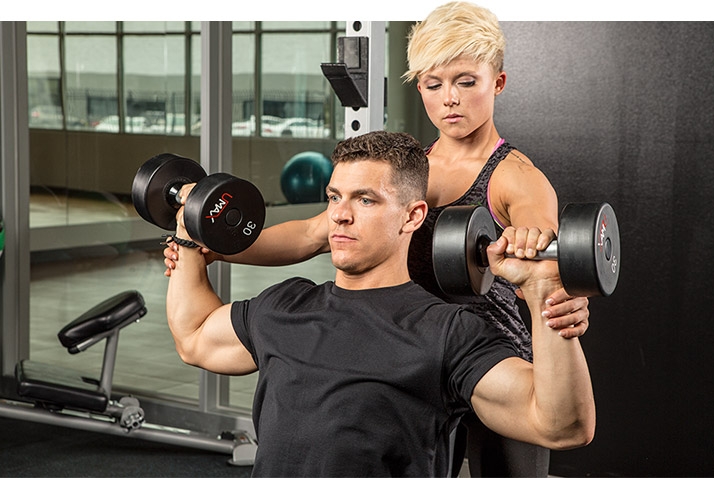
The first question is our health. Many magazines and experts advise to see a doctor before starting to exercise. Each of us has the opportunity to go for a general preventive check-up at least once a year. It will sound like a cliché, but not enough people know their true health status. If a beginner doesn't like doctors, they don't need to go for a check-up if they don't have racing ambitions (I would recommend this to potential racers anyway). Of course he must be aware that he is fully healthy. Exercise causes changes in blood pressure, IOP, heart rate, strain on tendons and muscles that cannot yet hold as much glycogen or recover it quickly as trained athlete muscles - the beginner must take this into account.
He needs to know what his blood pressure and heart rate are, whether his heart and blood vessels are in order, and for people with glasses I would recommend an intraocular pressure test or a consultation with an eye doctor (I have glasses myself and don't mind, but it is not recommended to exercise with contacts, for example). One also needs to know about his imbalances, which almost everyone has (at least minimal). A newcomer should know, for example, if he or she suffers from excessive lordosis or scoliosis, so that he or she can avoid exercises that might aggravate this condition, and instead include exercises that will help correct the defects.
If a person knows 100% that he or she has no defect or limitation, he or she can start thinking about exercise. Why do I say think and not exercise right away? I am sure you will agree with me that, for example, a painter who wants to paint a great painting must think about its composition. He must also be equipped with at least a basic knowledge of colors and the fundamentals of painting. Similarly, a beginner should devote at least a week or two to some preparation for practice. The first and most basic is just the analogy of composition - that is, to look realistically at oneself and clearly define what I want. Possibly write it down. Also take into account in the preparation whether I am already a trained athlete at least a little bit, or a couch potato type person who has never done anything before. Because a previous sport, meaning one that is done regularly and at a certain performance level, will after all pre-condition the body for the load. However, if a person has had a long break or has decided to join a gym as the very first sport in his/her life, he/she has to realize that it is necessary to focus a little on developing endurance and stabilizing muscles - i.e. muscles around the spine, abdomen, to partially prepare the tendons and joints for the load before the very beginning.
This means a minimum of 4-6 weeks of short training sessions (around 30-45 minutes) at low intensity, focusing specifically on the abdominals, mid-back and spine muscles. It used to be popular to give newcomers the basic exercises right away, but now this is being abandoned, with the idea that the basic exercises are for trainees who already have body stabilization built up and also mastered the movements.
When we have a goal and know where we stand in terms of performance, it is necessary to learn to know the "colours" - that is, to master the language of the gym. I recently came across somewhere readers lamenting that they don't know what a set, benchpress, hackendrepe..... Another time, a beginner at the gym explained to me that he was doing "that bar from the top on his chest - probably on his shoulders".I understand that a lot of terms will sound foreign to a newbie's ear, but the language of the gym is necessary to master, at least the basics. Sometimes older exercisers, wanting to shine in front of the new ones, are able to create sentences like, "Yesterday I threw two supers on the biceps with Ezeta and hammers and it was great...." Well, no wonder the newcomer feels like he is in China.... On the other hand, it's hard to explain everything in an article, because there would have to be a whole glossary...plus I'm not entirely sure that if I just describe benchpress, for example, as pressing a large dumbbell in a parallel grip with a wider grip over the chest while lying on a flat bench with your feet resting on the ground - everyone will understand.
Nothing like a visual explanation. It's absolutely best to go to a gym with someone who's been there longer, or find a trainer. However, some trainers don't explain and a newbie shouldn't be afraid to be curious - ask. A good trainer will always be happy to answer. I myself sometimes don't realise that a client doesn't understand me, but I'm happy to explain things to them so they know what's going on. As far as muscle groups are concerned, anyone who wants to go to the gym should know their body. Now I don't mean detailed anatomical knowledge, but when I say an exercise is good for the trapezius (or trapezius), a newbie shouldn't start looking for it on the abdomen.
Recommended
HMS Magnetický veslovací trenažér ZM1856
Nebbia Washed-off volné baggy tepláky s kapsami GYM BRO 373
As far as the nomenclature of the equipment in the gym is concerned, again the trainer should explain, or alternatively the newcomer should at least be guided and introduced to the equipment by the relevant staff. Feel free to bring a notebook to your first visit and take notes. You certainly won't learn to distinguish everything right the first time, and notes can help you remember names. The names of the exercises can be found in professional journals or publications, or remember the narrow booklets called "The Exercise Book" , which have the names with pictures.
Once upon a time, even as a bodybuilding rookie, I had a tiny little book called "Bodybuilding in your pocket", I don't even remember what edition. It was about 8cm high and 5cm wide and you could find basic exercises with descriptions. I also asked questions and wrote down verbally the execution of the exercises in my training diary. So I soon learned the names.
Then, among other concepts, it is necessary not to confuse the terms repetition and series or split.
Taking it from the biggest whole - beginners usually start doing full body workouts after the initial 4 weeks of firming up and getting familiar with the barbell - Mondays, Wednesdays and Fridays are usually ideal. When they progress a notch further, they can split the body up - maybe into top and bottom (simplified) and do these workouts like day 1 top - day 2 off - day 3 bottom - day 4 off and back to number one. From day 1 to day 4 it's one split. Split in AJ means to divide (split). When more advanced people train several days in a row non stop, the split is called for example 2+1, or 3+1 etc. This means that in the case of 2+1, for example, you train two days in a row and take a break on the third day. Then the split is repeated. Same for 3+1 three days training and one day off, 3+2 would be three days training and two days off (usually the first number indicates the number of days you train in a row and the second number the days off).
In split training, the body is always divided into training days, it is not trained in its entirety (training the whole body 3 days in a row without a break is pointless, due to lack of recovery, which is doubly important for beginners).
A training unit is actually the time of our training. Most of the time it is ideal to be within 45 -60 minutes, not longer, although beginners may take longer due to the longer recovery time needed between sets. And here we are at the series. And actually with reps - a rep is moving the barbell back and forth along its path (for example, with a biceps lift, one rep is when we lift the barbell up and drop it in a controlled manner). You might laugh because it seems obvious to you, but I've also seen people who confuse reps and sets with each other, or people who count each half-move.
A series is when we train a given exercise on a given muscle for a given number of reps. This means if I do a biceps lift with a barbell for say 10 reps (i.e. 10 up and down). After one set, there is one pause of duration for a novice, maybe even a minute or two, before he is able to do the next number of reps. So if I find in the training plan Biceps: biceps lift with a large barbell 3x10-12, biceps lift with single-arm dumbbells 2x10-12, it means,that first I start to train the lift with a large barbell ten to twelve repetitions. I do them, rest and do them a second time and the same a third time, after the third set I don't go back to the big dumbbell lift (at most I clean it up) and take the small dumbbells after the break.....
In the plans, usually trainers will standardly write the first number of sets and the second number of reps. If the plan says X-Z reps then usually X is the number we should be able to do at a minimum with some base weight and Z is the number we will gradually get to with that given weight (after a week of training, for example). Once we get to Z, we can add weights so that we can do X number of reps with the new weight.
Nutrition is also part of the workout. A complete beginner doesn't need to worry about diet at the beginning. He should just start paying more attention to what, when and how much he eats. And, as with training, pick up a "smart book" or trainer. Maybe he should start paying attention to the regularity of eating and drinking enough and regularly, and start getting more protein in his diet, which are the building blocks of muscle. As such, I would start to address diet with a complete novice after the introductory period. If a person is exercising just for fitness or just wants to lose a little weight, it is not advisable to put them on a bodybuilding diet right away.
Although some trainers - especially bodybuilders - sometimes tend to give such a diet to some slimming women, for example, the diet of fit people does not have to be so strict and should be varied and tasty. In particular, some principles should be followed - for example, eat smaller portions more often each day, do not be afraid to drink enough and also maintain even breaks between drinks, focus on increased protein intake, limit fats (even in the form of tarts, mayonnaise or sauces) , or when losing weight, follow the principle of simple sugars* in the morning and mid-morning, complex sugars (carbohydrates)* in the second half of the day.
Whether the beginner decides to use books, more experienced friends or the services of a trainer, he should realise that if he wants to achieve results, he must start from the beginning, build a plan and learn to speak the language of the gym. I'm sure he will learn it soon enough, and after a while maybe he himself will be explaining to a newcomer what the "hack squat" is.
Note: sugars - carbohydrates - simple: sugars with a short carbon chain (glucose, fructose, sucrose), because they are short, they break down faster and enter the circulation faster. Unfortunately, if they are not consumed immediately (e.g. after a morning when the body is in deficit) they are stored as fat. They are in sweets, biscuits, fruit, carbohydrate drinks, sweetened sodas, candy. -complex: have a longer carbon chain, often used to be called starches. For example, they are in potatoes, bread, rice, pasta and vegetables. They take longer to break down, so they last longer in the body and provide energy gradually over a longer period of time. Therefore, there is less risk of them being consumed and stored in fat.
Support your performance with quality supplementation!
In our shop you can choose from a lot of proteins, gainers, amino acids(bcaa, glutamine, ...), vitamins and minerals, creatines,fat burners and much more. So don't hesitate and step up a notch!
[Text.]
No posts have been made yet.








