





Can we be fat even if we only overeat now and then, even Christmas candy?
 Author: Šárka Randáčková
 Regular overeating will bring you piles of fat. However, if you overeat once, most of the weight gained will be water. Especially if you start with low glycogen levels.
Have you ever tried to weigh yourself after a big feast? Maybe after Christmas Eve dinner? How many of those extra pounds were fat? Very few!

A gram of fat has about 9 calories. So for every pound of fat you put on, you should theoretically eat about 4000 calories more than you burn.
So if you eat about 500 extra calories a day for a week, you could be a pound bigger at the end of it.
However, there is a limit to how much your body can process at one time. 3500 calories in one meal simply cannot be processed!
The body will try to cope with them differently. Burn them off (slightly raising the temperature) and eliminate them. You'll be pretty stuffed in the toilet. And the digestion itself also costs energy.
Thermogenesis
Some of the ingested calories are swallowed by the metabolism, others are converted to heat. This process is called thermogenesis, or the thermic effect of food, and costs about 10% of the caloric intake of a healthy adult eating a normal diet.
Your actual number will obviously have several components, including net mass and food composition. The thermic effect of nutrients can be expressed as the amount of energy they supply versus the amount of energy it takes to digest them:
- Fat gives us 9 calories per gram and its thermal effect is 0-3%.
- Carbohydrates give us 4 calories per gram and their thermal effect is 5-10%.
- Protein gives us 9 calories per gram and its thermal effect is 20-30%.
If you overeat, you may also feel restless. Restlessness is one of the inactive means of energy expenditure. In fact, all activity, except sleep, food and sports, counts towards these.
The value of inactive energy expenditure varies quite a bit between people. That is why, among other things, some individuals are fatter than others.
Glycogen
Our body stores carbohydrates in two ways. Either it converts them into fat, or it fills the glycogen stores in the liver and muscles.
Glycogen in the liver
The liver is used for short-term storage of glycogen. When you are fasting (most of us do this overnight), the brain first looks for glycogen in the liver. After 12-16 hours of fasting, a still-normal liver contains about 44 grams of glycogen per kilogram, meaning 25-50% has been depleted.
The maximum capacity of the average liver will therefore be about 60-90 g/kg.
Glycogen cannot be stored alone. It must be bound to water. There is about 2.4 g of water per gram of glycogen in the liver.
Weight and glycogen capacity of a healthy liver (g)
|
Liver |
Men |
Women |
|
|
Weight |
Normal range |
968-1860 |
603-1767 |
|
Average |
1414 |
1185 |
|
|
Glycogen in the average liver (full) |
Without water |
85-127 |
71-107 |
|
With water |
289-432 |
241-364 |
|
Glycogen in muscle
Amount of glycogen per kilogram of healthy muscle (g/kg)
|
Muscle |
Average |
Range |
|
Delta |
9,8 |
5,3-4,0 |
|
Quadriceps |
13,5 |
9,5-20,0 |
|
Both muscles |
11,7 |
5,3-20,0 |
The amount of muscle mass varies greatly, of course. In men (usually 22-40 kg,) and women (usually 15-30 kg). So the average man carries 256-466 g of glycogen in his muscles, and the average woman carries 175-350 g.
In the muscles, glycogen also binds to water, of course, up to 3 g of water for every 1 g of glycogen. But it can be as much as 17 g if you take a lot of carbohydrates and water after training in a dry environment.
So normally a man who has 31 kg of muscle stores 361 g of glycogen and 1083 g of water. And if he stuffs himself with lots of carbs and plenty of water (which is normal when feasting), it can be a lot more.
Glycogen depletion
Muscular people have more muscle, and they store glycogen better. One small study found that the capacity of three college athletes was 629-1,146 g, an average of 810 g. This is much higher than the average we found for the average male (341-593 g).
However, these athletes knocked out glycogen with a low-carbohydrate diet for three days; then for seven days they ate 3,500-5,000 calories a day, 80-90% of which came from carbohydrates (760-990 g). On the first day, all their energy went into rebuilding glycogen stores. They gained no fat. They gained only 30 g of fat on the second day and 45 g on the third day.
After a week of overeating, these athletes gained an average of 4.6 kg, with 1.1 kg being fat. Only half was made up from the huge amount of carbohydrate ingested; the other half was due to the small amount of fat eaten.
Fat formation from carbohydrates
As the study above showed, once glycogen stores are full, the carbohydrates eaten are stored as fat. This process is called lipogenesis.
It happens when you regularly eat more calories than you burn.
Lipogenesis is our body's preferred way of disposing of carbohydrates. Here's how the body does it. It prefers to burn carbohydrates as energy, store them as glycogen, or even burn them as heat.
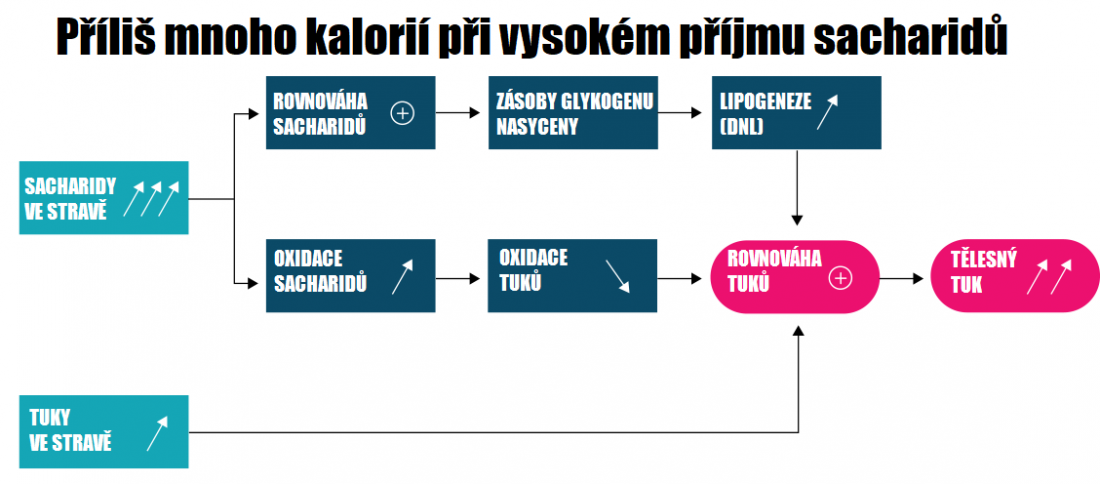
One study gave healthy men only one meal consisting of bread, jam and juice. It had 480 grams of carbohydrates (93% of the calories in this meal). The men lipogenically produced only 2 g of fat in the following 10 hours. Most of the carbohydrate was converted to glycogen (346 g) and the rest was burned straight (133 g). During the same 10 hours, 17 g of fat was burned as energy. There was 8 g of fat in the meal, and 2 g was formed from carbohydrates. So the men actually burned 7 grams of fat.
In another study, healthy adults ate 150% of their required daily caloric intake for five days. The extra calories were from carbohydrates only (they ate 684 grams of carbohydrates, or 2736 calories from carbohydrates per day). The resulting lipogenesis was ten times higher than on the maintenance diet. However, it was still only 5 g of fat produced per day. 5 g of fat per day will make 1825 g per year, which is relatively enough. However, the subjects were eating 50% above the maintenance calorie level. They were feasting every day.
Water excretion and retention
Glycogen binds to water, which means you carry a lot of water weight with it. Blood volume, total body water volume, it can all vary quite a bit between people. It depends on training, medication and diet. In addition to carbohydrates, sodium also has a big effect on it, which causes water retention.
Of course, there's also the contents of your bladder (a quarter of a kilo on average in the morning), and bowels (150g on average). And after the feast, of course, it's even more.
Conclusion
When you overeat properly, much of the weight gained will not be fat, but water. Especially if you overeat a bunch of carbs and salt.
If your glycogen levels are low, the weight consequences will be higher. On the other hand, such a state will ensure that you don't gain a dramatic amount of fat.
How much you can gain in one meal depends on many factors.
Many of the calories of a given meal will fall on digestion alone. In particular, it takes a lot of energy to digest protein. If you exercise regularly, maybe enough of that energy is used to build muscle.
An occasional feast won't make you fat!
That's a matter of long-term overeating and a combination of factors, often genetic.
Recommended
HMS Magnetický rotoped M8750
Czech Virus Supreme Maca

Nexgen 60 kapslí 2+1
HMS Elektrický běžecký pás BE 8535
By Alex Leaf
Translated by Jaromir Uhlir
Source: www.examine.com - Can one binge make you fat?
Author: Šárka Randáčková No posts have been made yet.








