L-Arginine and sports performance: what does the science say about supplementation?
 Author:
 In the world of sports nutrition and dietary supplements, there is a constant search for substances that could legally and safely push the boundaries of human performance. Among those often discussed is arginine, an amino acid known primarily as a precursor to nitric oxide (NO). It is this molecule, NO, that has been linked to a number of physiological processes that can theoretically lead to improved athletic performance. Arginine and dietary supplements similar to it, which are thought to increase NO production, are therefore popular ergogenic aids.
However, as is often the case in science, research results are not always clear-cut and often contradict each other. This ambiguity prompted the authors of the study from which we draw to conduct a systematic review and meta-analysis - that is, an attempt to summarize and statistically analyze the available data in order to gain a more comprehensive view of the effects of arginine supplementation on athletic performance, particularly in relation to energy metabolism. Let's take a closer look at what this extensive analysis revealed.
Article content:
- Mechanism of action: How does arginine help the body "Pedal"?
- What the Aggregate Data Says.
- Dosage and duration of use: timing is key?
Mechanism of Action: How does arginine help the body "Pedal"?
The potential benefits of arginine for athletes lie in several physiological and metabolic mechanisms. The most fundamental and most frequently mentioned is its role in the synthesis of the aforementioned nitric oxide (NO). NO is not just any molecule; it functions as an important cellular signaling agent with a number of physiologically relevant effects. Studies have shown that NO can:
- Increase blood flow: by dilating blood vessels (vasodilation), NO allows better blood flow to working muscles. This means a more efficient delivery of oxygen and nutrients, as well as faster flushing of metabolic wastes such as lactate.
- Improve muscle contraction: Optimized blood flow and energy delivery can contribute to more efficient muscle fiber work.
- Optimize gas exchange: Better blood flow can also promote more efficient oxygen and carbon dioxide exchange in the lungs and tissues.
- Improve oxygen kinetics: The body may be able to respond more quickly to changes in oxygen demand during exercise and use oxygen more efficiently.
- Promote mitochondrial biogenesis: NO can stimulate the formation of new mitochondria, the cell's "powerhouses", which in the long term increases the body's capacity to produce energy aerobically.
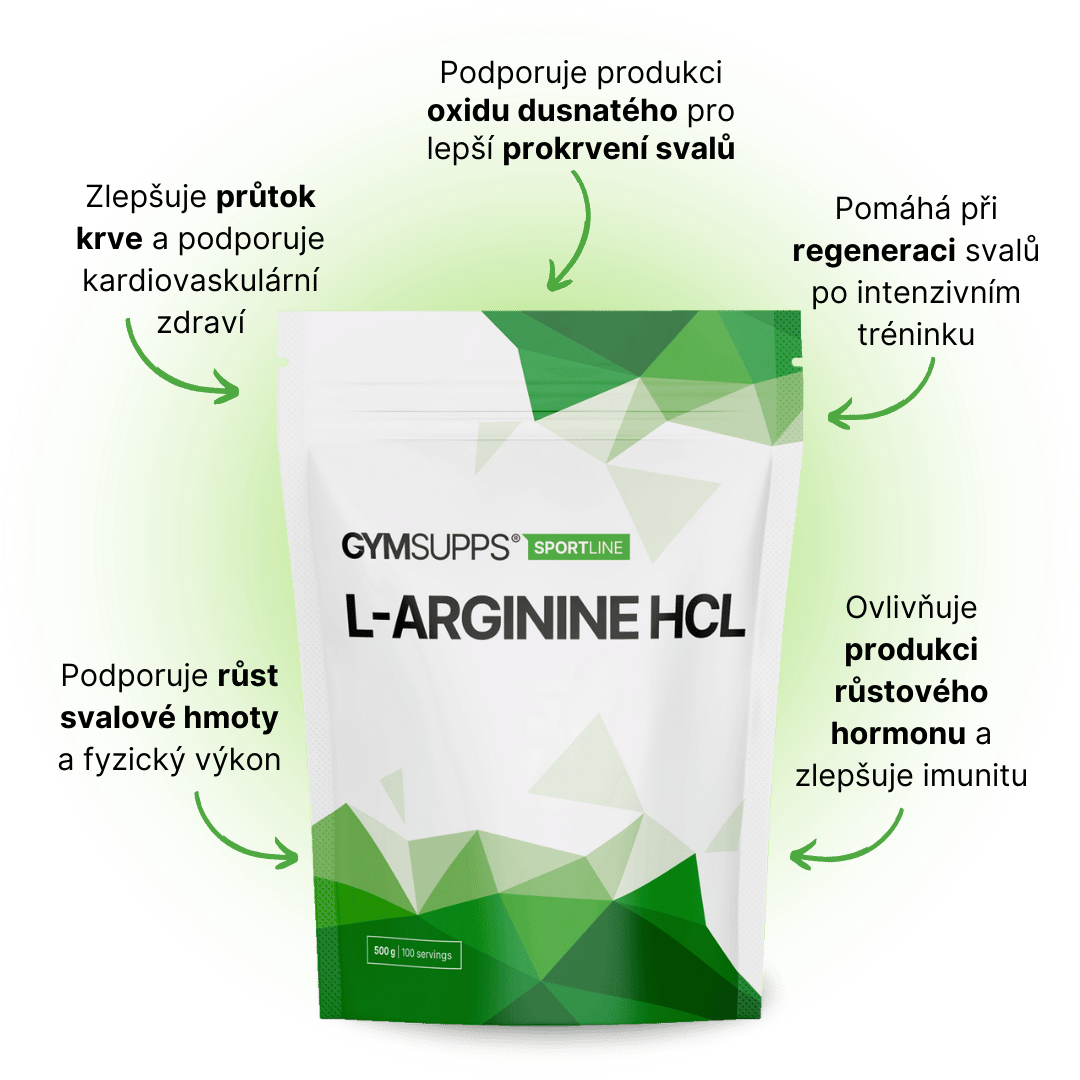
A second important mechanism by which arginine may influence performance is its ability to stimulate the release of growth hormone (GH) from the pituitary gland. Growth hormone plays a key role in:
- Supporting cell growth: which is essential for tissue regeneration and adaptation after training.
- Regulation of fuel mobilization in the body: GH influences fat and carbohydrate metabolism, ensuring the availability of energy for working muscles.
- Contributes to muscle mass growth and hypertrophy: Increased GH levels are associated with a better environment for muscle growth, which is the goal of many strength athletesʼ.
In addition to these two main pathways, other metabolic effects of arginine have been observed. For example, it has been found that after exercise, arginine can increase glycerol levels (which is related to fat release) while improving carbohydrate oxidation and oxygen utilization efficiency. These effects suggest potential benefits for endurance sports in particular.
Thus, arginine appears to have the potential to influence several different physiological and metabolic pathways that could lead to improvements in both endurance (aerobic) and strength or short-term high-intensity (anaerobic) athletic performance.

What the aggregate data says: The Meta-Analysis view
When the authors of the study statistically combined the results of the available relevant research, they came to some interesting conclusions. The meta-analysis showed that arginine supplementation can improve performance in both aerobic and anaerobic tests:
- Aerobic performance: here a statistically significant positive effect (p=0.02) was observed with an overall effect size (Standardized Mean Difference, SMD) of 0.84. This value is interpreted as a large effect size. However, it is important to note that there was a high degree of heterogeneity between the studies included in the analysis (I²=89%). This means that the results varied considerably between studies and therefore this pooled result should be interpreted with caution - not everyone and every study had the same effect.
- Anaerobic performance: here too a statistically significant positive effect was found (p=0.01), albeit with a smaller effect size (SMD 0.24), which is interpreted as a small effect. In contrast to the aerobic tests, the heterogeneity between studies was low here (I²=0%), suggesting more consistent results across the included studies.
Thus, these results suggest that while arginine may provide smaller but more consistent improvements in anaerobic exercise (e.g. sprints, strength training), in aerobic exercise (e.g. endurance running, cycling) the potential improvements may be greater, but the results are less predictable and may vary from study to study.
Dosage and duration of use: timing is key?
The meta-analysis also looked at how different supplementation protocols affect outcomes. It showed that positive effects can be observed with both short-term (acute) and long-term (chronic) use:
- Acute supplementation (< 7 days): doses in the range of 6-10 grams per day taken for less than a week have led to improvements in various physiological parameters and performance indices in some studies. Specifically, there was an increase in time to exhaustion, an increase in mean power output, and an improvement in capacity during exercise of moderate to submaximal intensity.
- Chronic supplementation (45-56 days). In these cases, improvements in performance were observed, for example, in the bench press maximal power test (1RM), in the Wingate test (a standardized test of anaerobic capacity and power), and in tests at intensities corresponding to VO2max.
Thus, it appears that arginine may work in different time horizons and dosing schemes, although the optimal protocol may depend on the specific goal and type of sporting activity.
Final thoughts
The systematic review and meta-analysis of the PMC7282262 study suggest that arginine supplementation has the potential to positively influence athletic performance, both aerobic and anaerobic. This occurs through several mechanisms, including the promotion of nitric oxide production, possible growth hormone stimulation, and other metabolic adjustments. Although statistically significant positive effects have been observed, it is important to recognize the persistent controversy and variability in outcomes, particularly in the area of aerobic performance.
Thus, arginine remains a substance of interest to athletes, but its effectiveness may be individual and dependent on many factors, including the type of exercise, dosage, duration of supplementation, and individual body response.
Recommended
GymSupps L-Arginine HCL
L-Arginine HCL 500g 1+1
Amix Arginine Pure amino Acid
Extrifit Arginine AKG 1000 mg
Source:
- 1) Rodríguez-Guerra, A., González-Gálvez, N., et al. (2020). Effects of Arginine Supplementation on Athletic Performance Based on Energy Metabolism: A Systematic Review and Meta-Analysis. Nutrients, 12(6), 1848.
No posts have been made yet.