





Improve your life with regular vitamin D supplementation!
 Author:
 Vitamin D, one of the most underrated vitamins, but one that has a bunch of very important benefits for our health. Why is it so neglected? The answer is simple. It's freely available, it doesn't cost us anything - in fact, it's produced when we're exposed to the sun, so there's an assumption that there's no need to focus on it. But not so long ago, there was media coverage of the fact that vitamin D deficiency is very common in the world, across all generations and nations.
Did you know that up to 90% of the American and over 40% of the European population is vitamin D deficient ? Yes, indeed. Worldwide, the number of people suffering from vitamin D deficiency, also known as the sunshine vitamin, is up to around one billion individuals. With that opening sentence, we actually found the simple answer to why they are deficient - staying out of the sun. We live in a time when young children prefer to sit at home all day in front of the computer and TV rather than run around outside, we adults are working more and more and so we have less and less time to spend in the sun.Unfortunately, research suggests that vitamin D deficiency is correlated with an increased risk of various cancers, autoimmune diseases, hypertension and other infectious diseases. Getting enough of it and getting enough of it offers a ton of positives, not only in terms of your health, but even your athletic performance.

A 2017 study showed that occupation may even play an important role in regards to low vitamin D levels . Shift workers, office workers, and healthcare workers are at a higher risk of developing a deficiency of this vitamin due to not getting enough fresh air and exposure to sunlight. Fortunately, there are ways we can naturally increase vitamin D levels and reduce the risk of adverse health conditions such as heart disease, cancer, diabetes and other symptoms of vitamin D deficiency.
Article Content:
- A theoretical window
- Vitamin D2 vs. vitamin D3
- Effects of vitamin D
- When to take a supplement and how to choose the right one?
- Beware of too high a dose
- What to take away from this article
A theoretical window
Vitamin D is a fat-soluble vitamin . It helps the absorption of calcium and phosphate from the digestive tract. This shows that it is important for strong bones, teeth and provides many other benefits, which we will get to later. However, in excessive doses it can also be toxic to the body. Vitamin D is made from chemicals in the skin when exposed to sunlight (hence the sunshine vitamin).
It is formed from the provitamin 7-dehydrocholesterol, which is a derivative of cholesterol, as its name implies. Vitamin D is a steroid hormone precursor. The vitamin D that is formed is accurately referred to as cholecalciferol or vitamin D3.
Vitamin D2 vs. vitamin D3
There are two types of vitamin D: vitamin D2 (ergocalciferol) and vitamin D3 (cholecalciferol). Vitamin D2 is a precursor to vitamin D, which is found in both plant and animal sources, but vitamin D3 is derived from animal products and is considered more absorbable and beneficial as a result. Why? The type that our body makes is cholecalciferol, or vitamin D3. The body is of course able to cover deficiencies in some part with the D2 form, but it can use and absorb the D3 form much more efficiently.
Unfortunately, it is true that most foods (e.g. yoghurt, etc.) that tempt us to add extra vitamin D contain the D2 form, which is cheaper and not nearly as useful to the body as the aforementioned cholecalciferol. Although there are not many foods from which it can be obtained, we can still find a few. Food sources include fattier fish such as salmon, sardines, mackerel, as well as shrimp, eggs and some dairy products. However, the most natural way to increase vitamin D levels is through ultraviolet B (UVB) radiation, or simply put - being in the sun.
At least 10 to 15 minutes a day is recommended (around 40 minutes for darker individuals). Cholesterol in the skin converts melanin into usable vitamin D, which is distributed throughout the body. D3 from animal products (more specifically from the cholesterol in these products) is the closest to how vitamin D is naturally produced by sunlight.
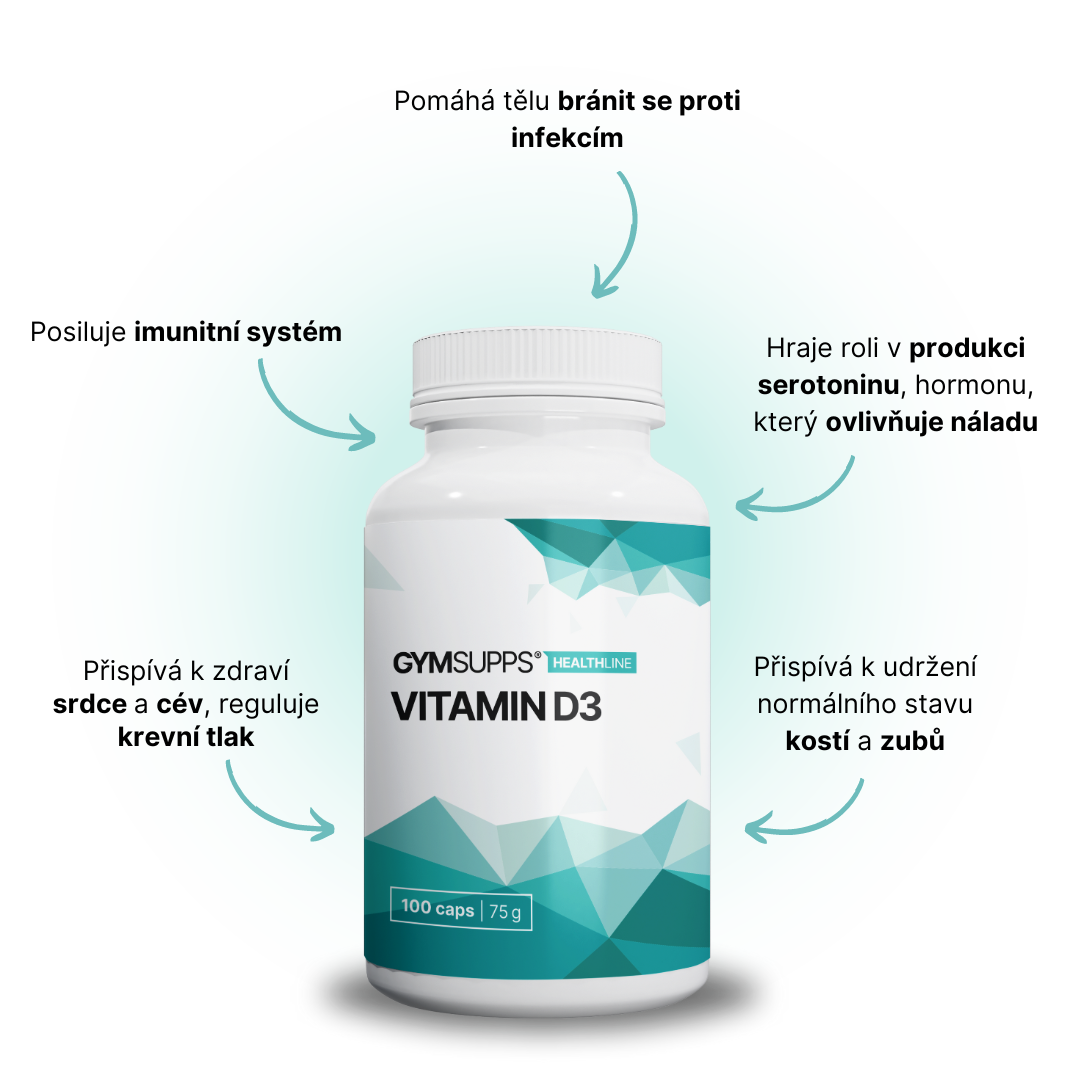
On sunny days, the body can produce enough, but especially in the winter, or if we spend really minimal time in the sun, it is advisable to supplement with additional vitamin D. The daily recommended dose of vitamin D for adults is at least 15 micrograms (or 600 IU).However, 600 IUs of vitamin D per day is not the amount that is optimal for everyone, as current research shows that the amount of vitamin D your body needs is largely dependent on your body weight and therefore, like most other nutritional requirements, the optimal vitamin D requirement is highly individual.To date, the upper limit of the amount that is "safe" is set at an intake of around 4000 UI, but no research has shown negative health effects at amounts up to 6000 UI for 12 weeks.
Vitamin D deficiency is most common in infants, the elderly, vegans, people living far from the equator, and people with darker skin types. Interestingly, studies have shown that people who have higher body fat and people who are obese also suffer from deficiency. And as the population of overweight adults and obese teens and children has been steadily increasing over the past few decades, the number of people with symptoms of vitamin D deficiency has unfortunately also been increasing.
The most common manifestations of vitamin D deficiency are:
- Bone thinning
- Fatigue and drowsiness
- Depression
- Sleep problems
- Weakened immunity
- Joint and back pain
- Hair fall
- Muscle pain
- Impaired healing
Effects of vitamin D
But let's also highlight some of the benefits of vitamin D.
Vitamin D for strong bones
When people talk about bones, calcium is probably the first thing that comes to mind, as it is a key player for healthy bones as it increases bone density, but we definitely shouldn't underestimate vitamin D. In fact, vitamin D has been shown to be a powerful stimulator for the deposition of calcium in the bones, making them healthier and stronger. If we don't get enough vitamin D, the body can slow down or even stop the deposition of calcium in the bones and from the bones back into the bloodstream. If the deficiency lasts for a long time, bones weaken and the risk of fractures increases.

Improves muscle function
Vitamin D has also been shown to have a positive effect on athletic performance. In addition, it can potentially increase the number of type II muscle fibres and thus also contribute to muscle mass formation. Vitamin D deficiency is quite common in athletes. It is associated with symptoms such as muscle weakness and type 2 muscle fibre atrophy.
Protection for our heart
In addition to aiding calcium absorption and keeping our bones healthy, one of the main functions of vitamin D for the body, it may not be such a surprise that it also has a protective effect for our hearts. It has been shown that people suffering from vitamin D deficiency may be at increased risk of high blood pressure, higher cholesterol levels, leading to heart disease, and in worse cases, heart failure. Research suggests that vitamin D has a positive effect on blood vessel elasticity, can help lower blood pressure and also improves glycemic control.
Reduces the risk of developing diabetes
Symptoms of diabetes result from insulin deficiency or inadequate insulin secretion following an increase in insulin resistance. Research has also shown that vitamin D has a demonstrable effect on reducing the risk of developing type 2 diabetes or developing it further. This is because it ensures improved beta cell function, less inflammation in the body and also improves insulin sensitivity.
Significantly reduces the risk of developing cancer
Vitamin D is indeed one of the most effective inhibitors of cancer cell growth. It improves calcium uptake and increases cell differentiation, which has been shown to have a proactive effect on the number of metastases. Prostate cancer, colon cancer, or genital cancer in both women and men. These are just a few of the types that vitamin D helps protect us against.
It helps with learning and ensures better concentration
Several studies have also shown that vitamin D also affects our ability to learn, concentrate, and retain information. It's no wonder, then, that people with lower vitamin D levels may have difficulty concentrating, learning, and maintaining attention. In addition, some research has shown a correlation between low vitamin D levels and an increased risk of developing schizophrenia and multiple sclerosis.
Other health benefits of vitamin D
- Helps harmonize hormone levels
- Helps against depression
- Important for proper development of children
- Affects mood
- Strengthens the immune system
When to take a supplement and how to choose the right one?
If you feel that you are not spending enough time in the sun, or not eating enough foods containing it, and could therefore be deficient in vitamin D, we recommend additional supplementation. The recommended dose is around 600 UI for adults, as mentioned in the previous paragraphs, but this is just some general recommended dose, your optimal dose should be determined individually ideally after consulting your doctor.Its intake is very important for children and the elderly. The best supplement is probably the sprays, as they are very easy to use and also the vitamin is best absorbed from them and the sprays do not burden the stomach unnecessarily. It is very important that the supplement contains the D3 form, which is optimally used and more effective. The use of the D2 form may be less effective and cheaper. Vitamin D is ideally supplemented together with a higher fat food to achieve the best absorption.
Recommended
Reflex Vitamin D3
Czech Virus Vitamin D3

GymSupps Vitamin D3
Vitamin D3 100cps 1+1
Beware of too high a dose
Vitamin D causes our liver to produce a chemical called 25(OH)D. When levels of 25(OH)D become elevated, calcium can build up in our bloodstream, potentially leading to kidney stones.Fortunately, the skin is able to regulate vitamin D conversion according to heat and other factors. It can store previtamin D for future use and "dispose" of amounts beyond what is needed. Vitamin D is a fat-soluble vitamin. This means that it is stored in body fat and can stay in the body for longer periods of time. If you choose to take vitamin D supplements, be sure to stick to a dose that is within the recommended range and don't overuse the supplement. However, it is true that vitamin D toxicity is rather rare and is less of a problem than vitamin D deficiency.
What to take away from the article
Vitamin D is a highly underrated component of micronutrients - after all, it is telling enough that up to 90% of Americans are deficient in this vitamin. Vitamin D is nicknamed the sunshine vitamin because the sun is its best source. However, due to the demands of today's times and lifestyle trends, children and adults often spend far less time in the sun than they actually need.
Vitamin D has many health benefits, from strengthening bones, positively affecting heart health, boosting the immune system, treating depression, and being a great cancer fighter and beyond. Its deficiency has serious consequences, which is why it is highly advisable to supplement. Ideally, of course, through exposure to the sun and fresh air, but if needed, reach for a supplement that contains a form of D3 that is more usable for humans.
Sources:
Vuolo L, Di Somma C, Faggiano A, Colao A. Vitamin D and cancer. Front Endocrinol (Lausanne). 2012;3:58. Published 2012 Apr 23. doi:10.3389/fendo.2012.00058
Schmid A, Walther B. Natural vitamin D content in animal products. Adv Nutr. 2013;4(4):453-462. Published 2013 Jul 1. doi:10.3945/an.113.003780
https://www.ncbi.nlm.nih.gov/pubmed/22536776
https://www.ncbi.nlm.nih.gov/pubmed/25495839
https://www.ncbi.nlm.nih.gov/pubmed/28341729
https://www.ncbi.nlm.nih.gov/pubmed/19663879
https://www.ncbi.nlm.nih.gov/pubmed/18400738
https://www.sciencedirect.com/science/article/abs/pii/S1064748112608902?via%3Dihub
https://www.ncbi.nlm.nih.gov/pubmed/23377209
Matyjaszek-Matuszek B, Lenart-Lipińska M, Woźniakowska E. Clinical implications of vitamin D deficiency. Prz Menopauzalny. 2015;14(2):75-81. doi:10.5114/pm.2015.52149
Larry Ke, Rebecca S. Mason, Louise A. Baur, Chris T. Cowell, Xiaoying Liu, Sarah P. Garnett and Kaye E. Brock, Vitamin D levels in childhood and adolescence and cardiovascular risk factors in a cohort of healthy Australian children, The Journal of Steroid Biochemistry and Molecular Biology, 10.1016/j.jsbmb.2017.07.010, 177, (270-277), (2018).
No posts have been made yet.








