




Workout Plan for Beginners (Week 2) – Add Reps, Not Ego
 Author:
Your muscle soreness has subsided, you’ve got your first numbers in your log, and an invitation to the first Christmas party just arrived in your inbox. Welcome to week two—the make-or-break week. That initial excitement about your new gym membership is starting to fade right now. The novelty has worn off, it’s dark outside, and online stores on every corner are screaming “Black Friday.” A lot of people quietly stop going to the gym at exactly this moment.
Not you. You’ve completed three workouts, you know how to do a goblet squat, and most importantly, you’ve written down the weights you started with. And that’s exactly the moment when “I’m trying to work out” becomes “I’m working out.”
In this episode, we’ll add a third set, and you’ll learn the one rule you’ll need at the gym for years to come: how to know when and by how much to increase the weight. No guessing, no “I’ll try something heavier today,” and no ego lifting. And since December is approaching, we’ll also talk about what to do if the hustle and bustle cuts a workout short.
If you haven’t read the first part, start there. You’ll find out how the plan works, how to choose your starting weight, and how to warm up before your workout. Without that, you’ll have a hard time finding your way around in the second week.
.jpg)
What’s Different from Week 1
- The order of the workouts rotates. This week, you’ll do B – A – B: Workout B on Monday and Friday, and Workout A on Wednesday. In two weeks, you’ll have completed each workout three times.
- You’re adding a third set. Instead of two working sets, you’ll do three for each exercise. This will increase the muscle load by about half without requiring you to use heavier weights.
- You’ll stillhave some room to spare. Continue to leave 3–4 reps in reserve for each set. We’re increasing volume, not intensity. Your body is still learning how to handle the load.
- You’ll start following the numbers. For the first time, you’ll put last week’s notes to use. Based on them, you’ll figure out where you can already increase the load.
Workout B (Monday and Friday)
| Exercise | Sets × Reps | Rest | What to Focus On |
|---|---|---|---|
| Leg press | 3 × 10–12 | 2 min | Feet hip-width apart, knees do not cave in |
| Seated one-arm overhead presses | 3 × 10–12 | 90 s | Backrest almost vertical, elbows slightly in front of the body |
| One-arm rows while leaning forward | 3 × 10–12 per arm | 90 s | Pull your elbow toward your side, not your shoulder toward your ear |
| Hip thrusts on a bench | 3 sets of 10–12 reps | 90 s | Chin to chest, push through your heels |
| Face pull on the pulley | 3 × 12–15 | 60 s | At the end of the movement, hands next to the ears |
| Dead bug | 3 × 8 per side | 60 s | Slowly, exhale as you extend |
Workout A (Wednesday)
| Exercise | Sets × Reps | Rest | What to Focus On |
|---|---|---|---|
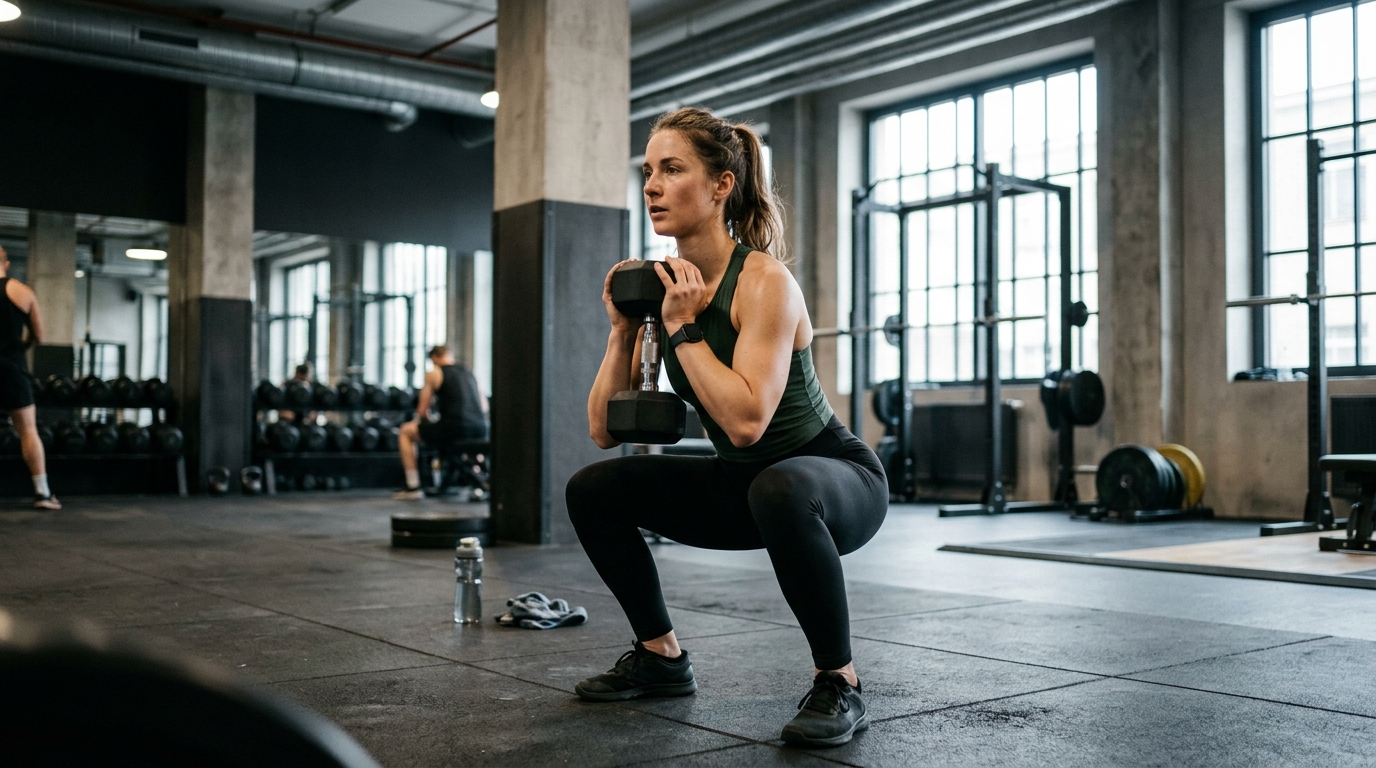
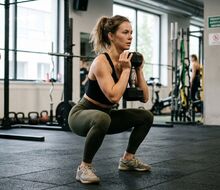
| Goblet Squat | 3 × 10–12 | 2 min | Elbows between your knees, go down as deep as you can while keeping your back straight |
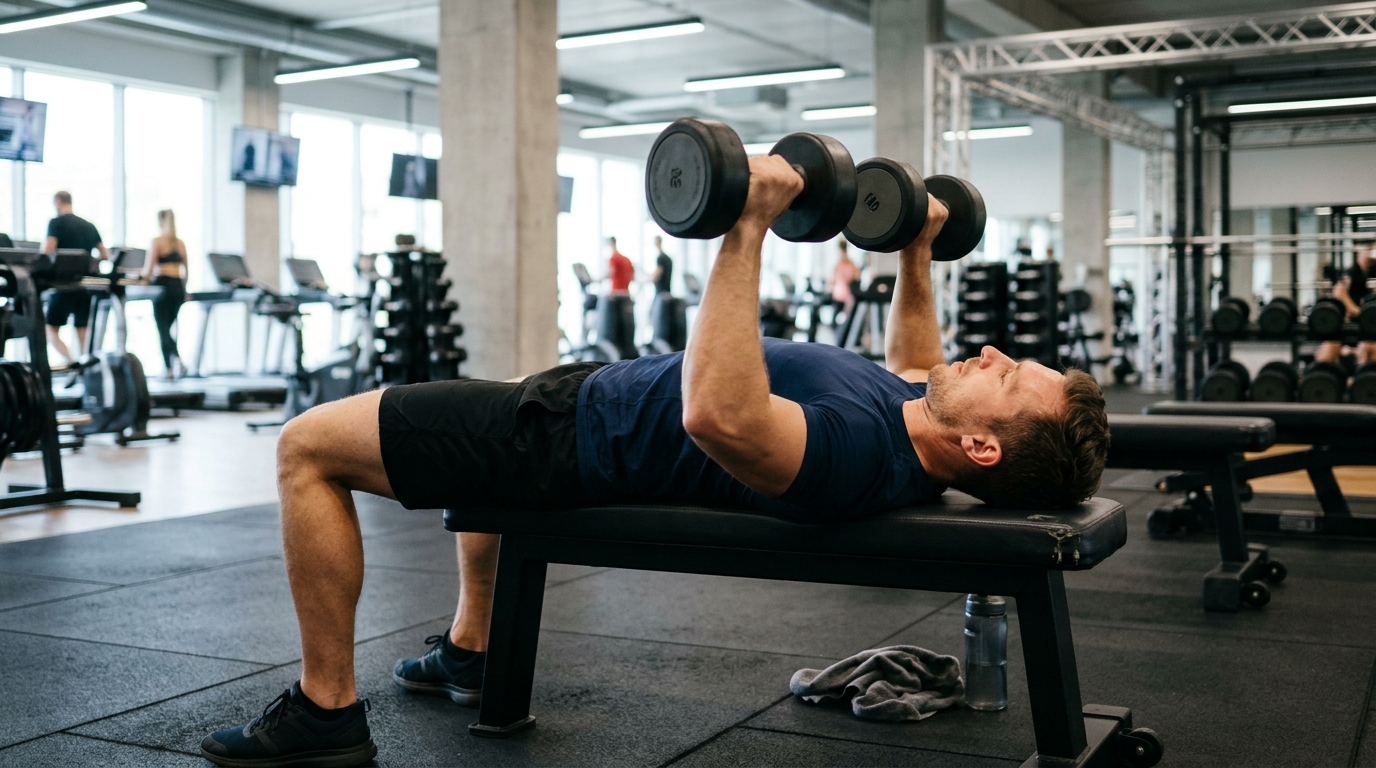
| One-arm press on a flat bench | 3 × 10–12 | 2 min | Lower the dumbbells toward your chest, not your shoulders |
| Upper pulley pull-downs | 3 × 10–12 | 90 s | Chest to the bar; at the top, don’t let your shoulders rise to your ears |
| Romanian deadlift with dumbbells | 3 × 10–12 | 2 min | Keep the dumbbells close to your thighs |
| Plank | 3 × 25–35 s | 60 s | Try to do it for 5 seconds longer than last week |
In the last column, you’ll find a new technical detail for each exercise. Last week you learned the movement; now you’re refining it. If you felt your joints rather than your muscles during any exercise last week, reduce the weight and focus specifically on that point.
Double Progression: The Only Rule You Need
Muscles grow when they’re gradually given a greater load. This is called progressive overload, and it’s the foundation of every effective training plan. The question is how to increase the load so it’s neither too fast nor too slow. For beginners, the best answer is double progression.
It works in two steps:
- First, you add repetitions. Your range is 10–12 reps. Using the same weight, you try to do one more rep from workout to workout.
- Then you add weight. Once you can do 12 reps in all three sets and still have some energy left, add the smallest possible amount of weight next time. With that, you’ll drop back down to 10 reps, and the whole cycle starts over.
Here’s how it works in practice with the goblet squat:
| Workout | Weight | Set 1 | Set 2 | Set 3 | What's Next |
|---|---|---|---|---|---|
| 1 | 12 kg | 11 | 10 | 10 | Maintain your weight |
| 2 | 12 kg | 12 | 12 | 11 | Maintain your weight |
| 3 | 12 kg | 12 | 12 | 12 | Next time, add |
| 4 | 14 kg | 10 | 10 | 10 | Start counting reps again |
With dumbbells, the smallest increment is usually 2 kg; on the pulley machine and leg press, it’s one weight plate. At first glance, it seems slow, but if you add weight this way once every two weeks for each exercise, in a few months you’ll be lifting completely different numbers.
Why not add more weight faster?
You’ll improve quickly in the first few weeks, making it all the more tempting to jump up by 5 or 10 kg right away. However, much of this initial improvement comes mainly from your nervous system: you’re learning to engage your muscles more effectively. Tendons, ligaments, and joints adapt to the load more slowly than muscles. If you add weight too soon, your form will break down, the load will shift from the muscles to the joints, and you’ll be setting yourself up for injury.
Furthermore, research shows that muscles respond similarly to both lighter and heavier weights, as long as you push each set close enough to failure. So heavier weight alone doesn’t mean more muscle. So leave your ego in the locker room—in this plan, the winner is whoever is still working out in eight weeks, not whoever lifts the most in the second week.
The third set is the hardest, and that’s okay
You’ll probably find that you do one or two fewer reps in the third set than in the first. That’s completely normal, and you can see it clearly in the double progression log. Fatigue builds up during the workout, so don’t expect all sets to be the same.
A few tips for getting through the third set:
- Take your rest breaks. Two minutes for compound exercises really means two minutes—not thirty seconds while scrolling on your phone.
- Drink some water between sets and breathe deeply—it helps you recover faster.
- Don’t compromise on quality. If your form starts to break down in the third set, end it one rep early. Better to do 10 good reps than 12 half-hearted ones.
.jpg)
What if you miss a workout?
The end of November can be hectic: end-of-year work, the first Christmas parties, shopping. You might miss a workout. It’s no big deal—just follow a few rules:
- Don’t cram two workouts into one day. Instead, shift your entire schedule back a day—for example, to Tuesday–Thursday–Saturday.
- Don’t try to make up for the missed session with extra workouts. If you miss one session, just move on to the next one in the schedule.
- Don’t throw the whole week away. Two workouts a week are still much better than none. The main thing is to get back on track on Monday.
If you know you have a busy week ahead, schedule your workouts in your calendar just like you would an appointment. What’s in the calendar usually gets done.
Nutrition and Recovery: Support in Week 2
As you move into the third set, the amount of damage your body needs to repair after a workout also increases. Now is the right time to make sure it has the resources it needs.
- Creatine —the most extensively researched supplement of all. It helps you squeeze out one or two more reps per set, which, with double progression, will directly show up in your workout logs. Just 3–5 g a day, anytime during the day.
- Protein bars —in the pre-Christmas rush, it’s easy to skip a meal. Having a bar in your bag will save you from having to catch up on protein in the evening—or not at all.
Recommended
Prom-in Essential Pure Bar
Creatine Monohydrate 500g 1+1
GymSupps Creatine HCL
What's in Store for You Next Week
In Week 3, we’ll explore why full-body workouts three times a week work—even from a recovery perspective. You’ll find out how much rest your muscles really need between workouts and how to tell when you’re ready for your next workout. We’ll also ramp up the intensity slightly: your margin in each set will drop to 2–3 reps.
Week 2 Summary:
- 3 workouts in the order B – A – B
- 3 sets for each exercise, still with 3–4 reps in reserve
- Double progression: reps first, then weight
- 12 reps in all sets = next time, add the smallest possible weight
- If you miss a workout, reschedule it; don’t try to make it up
See also
- Workout Plan for Beginners (Week 1) – Less Is More: Your First Week Without Soreness
- Put your ego aside—you’ll save your joints! Science has finally settled the debate on heavy vs. light weights
- 8 vs. 20 Reps: Science Debunks the Biggest Myth About Muscle Growth!
Recommended

XGen 90cps + Omega 3 90cps

No posts have been made yet.