





The forgotten old-school trick that will blow your biceps off
 Author:
 Do you feel your arms getting stagnant? Trying dozens of variations of biceps lifts, pumping blood into your muscles, but those damn sleeves are still just as loose? Maybe it's time to stop looking for novelties and look to the arsenal of bodybuilders from the golden era.
For there is a principle that many of today's exercisers have forgotten. It's not about exotic exercises or super-sets. It's about understanding how a muscle really grows. And this trick, backed by modern science, can give you results you've only dreamed of until now.
The problem with your current biceps training
Most people at the gym do biceps lifts with a large barbell or one-arm standing. And that's fine. The problem is that the greatest tension in this exercise is about halfway through the movement. At the beginning (when the arm is extended) and at the end (when the muscle is fully contracted), the load is much less.
But this misses a key stimulus for growth: overloading the muscle at its most stretched position.
New studies show that training that puts the most emphasis on the muscle when it is fully stretched triggers much more pronounced muscle hypertrophy (growth). And this is exactly what fighters like Arnold and Larry Scott knew fifty years ago.

Secret revealed: the Scott bench is not just for decoration
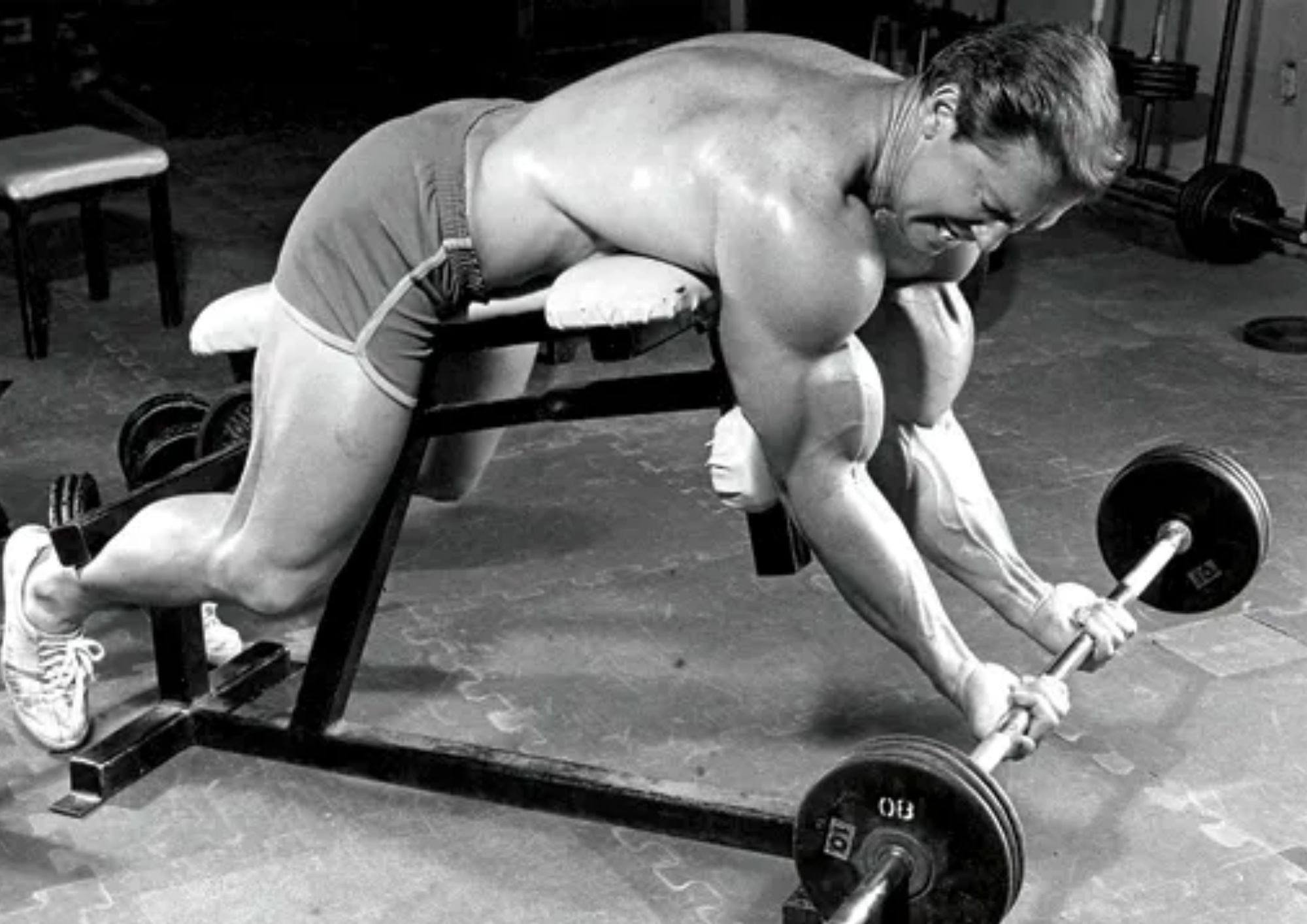
The forgotten trick is the targeted and brutal biceps overload in the lower, extended phase of the movement. And there's no better tool to achieve this than the Scott bench (Preacher Curl).
Why is it so effective?
- Isolation: the bar completely prevents any cheating by the shoulder or back. The biceps have to do all the work.
- Maximum tension in the stretch. Your biceps are literally screaming for help in a position that you hardly load during a normal lift.
- Safety.
How to do it right for maximum results:
Forget the ego. You'll need to use much less weight on the Scott bench than you're used to. And that's okay.
- Sit down and adjust your height: Your backrest should end just below your armpits. Your arm should rest firmly and comfortably against it along its entire length.
- The most important part of the exercise is the negative (eccentric) phase. Lower the dumbbell slowly, in a controlled manner, for 3-4 seconds. Feel the bicep stretch and fight gravity.
- Full extension, but not extension: In the bottom position, extend the arm almost fully to feel the maximum stretch of the biceps. But never extend the elbow all the way to the top to prevent injury.
- Explosive upward movement: Without jerking, lift the dumbbell up with a smooth, powerful biceps curl. Clench the muscle at the top for a second.
- No resting at the top: There is minimal tension at the top. Do not rest here. After a brief clench, immediately begin the slow negative phase of the next rep.
Pro tip: Try using an EZ dumbbell or one-arm dumbbells. When moving up, try to pull your pinky towards the ceiling (called supination). This will activate the top of your biceps even more.
Incorporate into your workout:
Replace one of your existing biceps exercises with just Scott's Bench Raises. Include them as the first or second exercise in your workout when you have the most strength.
-
Example: 3-4 sets of 8-12 reps with perfect technique.
Stop just mindlessly swinging the dumbbells. Go back to the basics that built the physiques of champions. Focus on stretching, slow down the negative phase and you'll see that this "forgotten" trick can do absolute wonders for your arms.
Recommended

Czech Virus Super Greens Pro V2.0
Nebbia Cyklistické šortky s vysokým pasem ICONIC 238

Source: Moro, Tatiana, et al. "Effects of 6 Weeks of Traditional Resistance Training or High Intensity Interval Resistance Training on Body Composition, Aerobic Power and Strength in Healthy Young Subjects: A Randomized Parallel Trial." International Journal of Environmental Research and Public Health 17.11 (2020): 4093.
No posts have been made yet.








