




Supersets vs. Classic Sets: Can You Train for a Shorter Time and Build the Same Muscles?
 Author:
You walk into the gym, do a set of bench presses, and then take a three-minute break. Then another set, another break, and the whole process repeats. By the time you get to the last exercise, you may have already spent nearly two hours working out. But what if there were a way to significantly shorten the entire process without necessarily reducing the amount of work you do?
This is precisely the question that researchers focused on when they compared traditional strength training with supersets. Their findings challenge the notion that a high-quality workout automatically means spending long hours at the gym.
Supersets vs. Traditional Sets: What Did the Researchers Find?
In 2025, a systematic review and meta-analysis was published in the journal *Sports Medicine*, which included a total of 19 studies and 313 participants.
Researchers led by Xing Zhang compared two approaches to strength training:
- Classic sets: You complete a set of one exercise, rest, and then continue with the next set.
- Supersets: You perform two exercises without a significant break between them. You rest only after completing both exercises.
The goal was to determine whether shortening rest periods and combining exercises affects training performance, fatigue, strength development, or muscle growth.
The results were surprising.
Supersets made it possible to significantly shorten training time, while the total number of repetitions performed and the training volume remained, on average, comparable to those of classic sets. And what about muscle growth itself? In studies that tracked long-term training adaptations, no statistically significant difference in hypertrophy or maximum strength development was found between the two approaches.
However, this does not mean that the methods are equivalent in all circumstances. Most of the included studies evaluated immediate responses to training, and only two studies directly monitored long-term muscle growth. The results are therefore promising but still require some caution.
Why can supersets save time without reducing muscle growth?
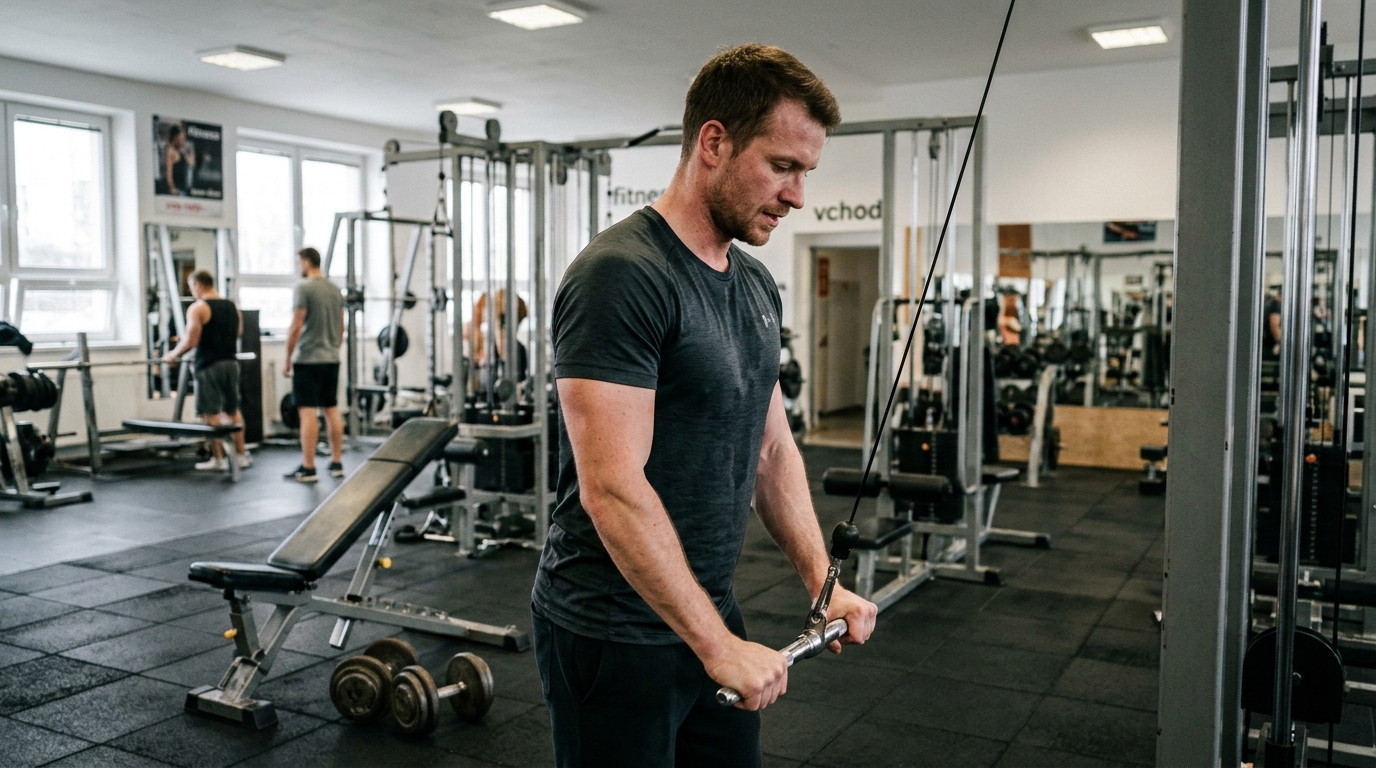
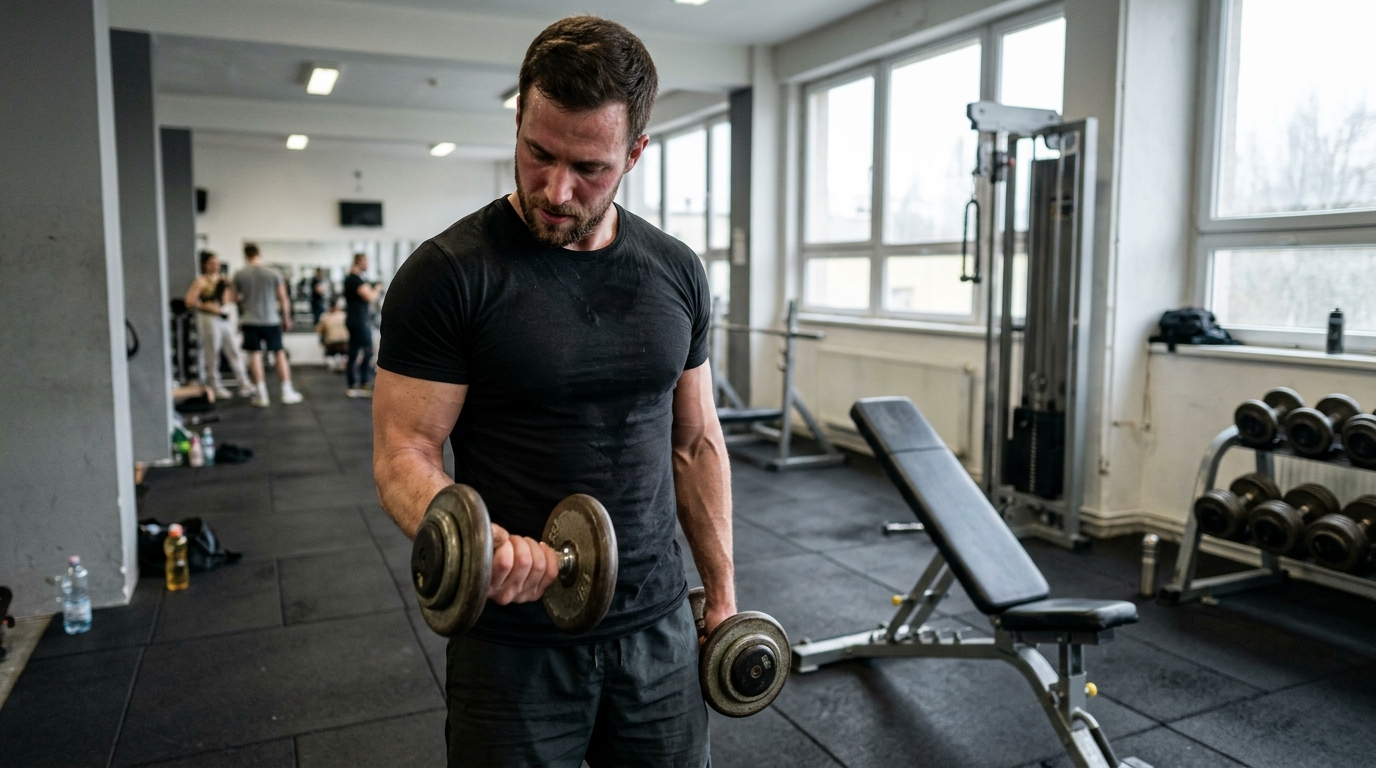
Imagine you’re doing bicep curls and tricep pulldowns in your workout. In a traditional workout, you’d first complete all your bicep sets—including rest periods—and then move on to the triceps. In a superset, however, you can combine both exercises. First, you do the bicep curls, and without a long wait, you continue with the tricep pulldowns. Then you rest and repeat the entire sequence.
While one muscle group is working, the other has time to partially recover.
This is precisely one of the reasons why supersets of opposing muscle groups can be a practical solution. Muscle growth isn’t determined by the length of the workout alone, but primarily by sufficient mechanical stimulus, an appropriately set training volume, and long-term progression.
If you can perform a comparable amount of high-quality work during a shorter workout, the shorter duration doesn’t automatically mean worse results.
But greater fatigue doesn’t necessarily mean bigger muscles
There is, however, one important caveat. Researchers found that supersets led, on average, to higher blood lactate levels, greater energy expenditure, and a higher subjective perception of exertion. Simply put: The workout may be shorter in duration, but it may also feel more demanding.
People who have ever combined two exercises into a single superset know this all too well. Your heart rate goes up, your breathing quickens, and your muscles may start to burn intensely. But this is precisely where it’s important not to confuse fatigue with effectiveness . Just because a workout exhausts you more doesn’t automatically mean your muscles will grow faster.
For example, if you combine two heavy exercises that place significant strain on the same muscle groups, fatigue may manifest as a drop in performance in subsequent sets. A meta-analysis has indeed suggested that supersets of exercises with similar biomechanical demands may result in a lower total training volume than traditional sets.
Therefore, it’s not just whether you use supersets that matters, but above all, which exercises you include in them.
How to Properly Combine Exercises into Supersets?
If you want to start with supersets, you don’t have to immediately combine the two most demanding exercises in your workout. On the contrary, it may be more beneficial to combine muscle groups that do not directly overlap during individual movements. The combinations listed are practical examples, not a direct ranking of effectiveness verified by a meta-analysis.
For most exercisers, I’d recommend starting with a combination of opposing muscle groups, such as biceps and triceps or chest and back. This allows you to save time without unnecessarily accumulating fatigue in a single muscle group.
| SUPERSET TYPE | EXAMPLE COMBINATION | PRACTICAL APPLICATION |
|---|---|---|
| Opposing Muscles | Bicep curls + tricep extensions | A good choice for saving time during arm workouts. |
| Chest and Back | Bench press + machine rows | Allows you to alternate between pushing and pulling movements. |
| Upper and Lower Body | Shoulder presses + leg curls | Distributes the workload among different muscle groups. |
| Same muscle group | Chest presses + flys | A significantly more demanding combination with greater local fatigue. |
* The combinations listed are practical examples. The suitability of supersets depends on exercise selection, fitness level, intensity, and recovery capacity. Source: Zhang et al., Sports Medicine (2025).
Example of a Simple Superset
Try the following routine, for example:
- One-arm bicep curls—10 to 12 repetitions.
- Without a long pause, move on to pulldown – 10 to 12 repetitions.
- Rest for approximately 90 to 120 seconds.
- Repeat the entire combination three times.
The recommended rest time is a guideline. Adjust it based on whether you can maintain proper form and the desired intensity in subsequent sets.
You can then apply this approach to other suitable exercise combinations.
A shorter workout doesn’t mean you can neglect recovery
Shortening your time at the gym is one thing. But managing your training load over the long term is another. Supersets can be a practical solution for people who want to complete a high-quality strength training session within a limited time. However, this higher training density can also lead to greater subjective fatigue.
That’s why it’s important to monitor not only the length of your workout but also your total energy intake, adequate protein intake, sleep, and your ability to recover between sessions. If you have trouble meeting your protein needs through your regular diet, GymSupps XWhey Protein can be a practical option. It’s a multi-ingredient whey protein that can help supplement your daily protein intake. Protein contributes to the growth and maintenance of muscle mass.
For athletes who regularly engage in intense strength training, GymSupps Creatine Monohydrate may also be a suitable supplement. When taken daily at a dose of 3 grams, creatine enhances physical performance during consecutive short-duration intervals of high-intensity exercise. However, neither protein nor creatine can replace a well-planned training regimen, a high-quality diet, and proper recovery.
Recommended
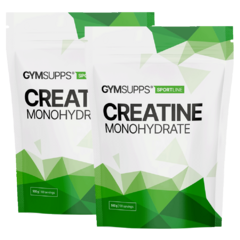
Creatine Monohydrate 500g 1+1

GymSupps XWhey Protein
So are classic sets unnecessary?
Absolutely not. Classic sets have their place, especially when you want to focus as much as possible on your performance in a specific exercise. For example, if you’re working on maximum strength in the heavy squat, deadlift, or bench press, it may be better to take longer rest periods and not combine these exercises with other demanding activities. Supersets, on the other hand, can be very practical for supplementary exercises, training smaller muscle groups, or on days when you have less time at the gym.
So there’s no reason to stick to just one method. For example, you can start your workout with heavy, traditional sets and then switch to supersets for supplementary exercises. This approach allows you to combine a focus on your main performance goals with time efficiency.
.jpg)
Do you have to spend two hours at the gym for your muscles to grow?
Perhaps the most interesting conclusion of the entire meta-analysis isn’t that supersets are better than classic sets. It lies elsewhere.
A long workout isn’t automatically a better workout.
If you can combine exercises effectively, maintain sufficient volume, and gradually increase the intensity over time, you can accomplish a large portion of your workout in less time. Of course, this doesn’t mean that every bodybuilder should immediately stop resting between sets. It simply means that the time spent in the gym isn’t, in and of itself, a measure of muscle growth.
And that may be interesting news for anyone who wants to balance strength training with work, family, and everyday life. Because at the end of the day, it may not be how long you were in the gym that matters.
Rather, it’s how effectively you actually used the time you spent there.
Recommended

New 100% Whey Protein 800g 1+1

XGen 90cps + Omega 3 90cps
References:
- Zhang, X., Weakley, J., Li, H., et al. (2025).
- Iversen, V. M., Norum, M., Schoenfeld, B. J., Fimland, M. S. (2021).
No posts have been made yet.