





Pull-ups vs. Cable Pull-downs: What Does EMG Reveal About Muscle Activation?
 Author:
 EMG studies show that grip variations matter less for the latissimus dorsi than most people think. Find out how to choose the right vertical pull-ups for your back, biceps, and pain-free shoulders.
Most exercisers overthink vertical pull-ups and their grip widths. Available research based on EMG (electromyography) does not support the idea that a super-wide grip on pulldowns automatically builds a wider back, or that switching from pulldowns to pull-ups completely changes the muscle engagement of the entire back. The conclusion is much narrower: pull-ups (both overhand and underhand) and pulldowns train the vertical pulling pattern. However, grip, body position, and whether the body or the bar moves can shift the load more toward the latissimus dorsi, biceps, lower trapezius, rear deltoids, and shoulder stabilizers.
If your goal is back size, use a grip that allows you to lift heavy weights, control your shoulder blades, and progressively increase the load without putting strain on your joints. If your goal is to improve your bodyweight pull-ups, train pull-ups directly. If you want to isolate the latissimus dorsi with less demand on the rest of the body, the pulldown is a more easily adjustable exercise.
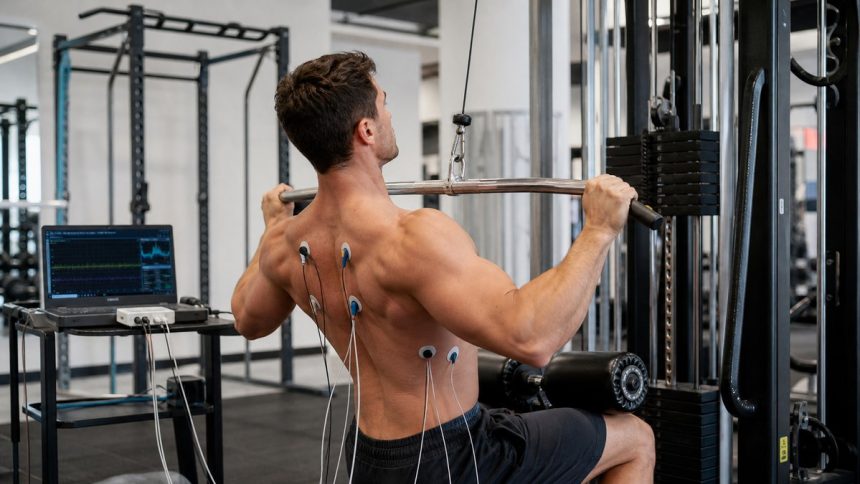
What EMG Can Tell Us About Pull-Ups
Electromyography (EMG) measures electrical activity in a muscle during exercise. It’s useful for comparing how hard a muscle is working under controlled conditions, but it doesn’t directly demonstrate long-term muscle growth. Hypertrophy still depends on load, range of motion, proximity to failure, training volume, recovery, and the ability to consistently repeat the movement.
This distinction is crucial for pull-ups and lat pulldowns. While a study may show that two grip widths produce similar activation of the latissimus dorsi, the structure of your shoulders, arm length, training history, and pain tolerance may make one grip a much better choice. EMG should help narrow down the decision, not replace the coach’s judgment.
Pulley Grip: Wider Doesn’t Automatically Mean Better
An old bodybuilding adage says that pulling a pulley with a wide grip builds a wider back. However, the research isn’t quite that dramatic. A 2014 study involving 15 trained men found that narrow, medium, and wide overhand grips produced very similar activation of the latissimus dorsi, trapezius, and infraspinatus. Furthermore, the narrow and medium grips allowed for slightly heavier loads (at the six-rep max) than the wide grip.
A more recent study from 2025 tested seven variations of the pulldown exercise and found that grip type and forearm orientation do not significantly alter the recruitment of the latissimus dorsi. The lats remained the primary target for all variations, while the assisting muscles (rear deltoids, middle trapezius, biceps) were engaged differently depending on body angle and hand position.
Tip: For most exercisers, this leads to a simple rule: Choose a grip that you can fully control through a deep stretch, a strong downward pull of the elbows, and a clean pull to the upper chest.

Pull-ups and pulley rows are not the same thing
A pull-up is an exercise performed in a so-called closed kinetic chain: your hands remain fixed while your body moves. The pulldown is performed in an open kinetic chain: your body remains stationary while the pulley moves. This changes the demands on stability and overall body tension.
With pull-ups, you must control your ribs, pelvis, shoulder blades, grip, and body weight all at the same time. The pulldown allows you to sit down, brace your thighs, and focus solely on an isolated pull and a precisely selected weight. Therefore, the decision between these two exercises shouldn’t be reduced to “which one activates the back more.” Pull-ups are better for building strength and athletic skills, while the pulley machine is excellent for hypertrophy and targeted muscle growth.
The behind-the-neck pulldown is a poor compromise
The behind-the-neck pulldown appears in old bodybuilding routines, but it’s rarely worth taking the risks associated with it. Research has shown no clear benefit for building back muscles that would justify forcing the shoulders into a more vulnerable externally rotated position and extending the neck.
Front pull-downs, neutral-grip (parallel) pull-downs, one-arm pull-downs, or controlled pull-ups provide a much safer setup without putting your cervical spine and shoulders at risk.
How to Improve Your Pulldown Technique
- Secure your thighs firmly under the pads: A loose setup forces you to lean back too far at the end of the rep.
- Initiate the movement with your shoulder blades: Think “shoulders away from your ears,” then pull your elbows down.
- Pull toward the upper chest, not the abdomen: Leaning back too far changes the angle of the pull and turns the exercise into a sort of hybrid seated row.
- Control the extension: Let your arms fully extend upward without losing rib cage engagement or aggressively shrugging your shoulders toward your ears.
- Use straps wisely: If your forearms fail before your back does (especially during higher rep counts), straps will help maintain tension on your back muscles.
Common Mistakes to Avoid
Many exercisers blame their grip when the problem actually lies in the execution of the rep itself:
- Starting the movement by bending the elbows: If the elbows bend before the shoulder blades move, the biceps will take over a large portion of the work.
- Leaning back too far with each rep: A slight angle in the torso is fine, but if you’re almost lying down, it’s now a horizontal pull.
- Shortening the range of motion in the top position: Full extension with your arms overhead is one of the main reasons to do these exercises in the first place.
How to Incorporate Both Exercises into Your Workout
You don’t have to stick to just one exercise forever. A quality back workout often uses both: pull-ups to build foundational strength and skill, and pulldowns for extra volume and easier fatigue management. Here are three practical approaches:
- Strength-Focused Back: Start with weighted (or assisted) pull-ups for 3–5 sets of 3–8 reps. Follow with cable rows for 2–4 sets of 8–15 reps.
- Back Focused on Hypertrophy (Muscle Growth): Start with pulldowns for 3–4 heavy sets of 8–12 reps. Then add controlled pull-ups or resistance band pull-ups as long as you have energy.
- For Beginners: Use pulldowns to build foundational strength, and then, as you improve, add negative pull-ups and resistance band pull-ups.
Conclusion
Use insights from EMG studies to debunk myths about grip widths, but don’t overcomplicate your training. A wide grip isn’t a magic solution for back width. Underhand pull-ups effectively combine back and bicep training. Pull-ups are a great choice, but they aren’t automatically the best option for every trainee.
The best choice for vertical pull-ups is the one that aligns with your goal, allows you to progressively add weight, and keeps your shoulders and elbows healthy. For most people, this means a moderately wide overhand grip or a neutral grip for repeatable volume on a pulley machine, and classic pull-ups or underhand pull-ups for a strength foundation.
Recommended
Nebbia Intense Legíny GOLD Mesh 829
Nebbia Washed sportovní podprsenka LEGACY 779

Czech Virus Supreme Maca

Nutrend Magneslife instant drink powder
No posts have been made yet.








