





Is poor sleep ruining your workouts and your fitness?
 Author:
 You know the feeling. You barely slept four hours because you were staring at your phone late into the night or finishing up a work project. In the morning, you down a double espresso, scoop out a serving of pre-workout, and somehow drag yourself to the gym. The barbell is loaded the same as last week, but even during the warm-up, those few kilos are crushing you to the ground. The scale hasn’t changed. You have. If you think you can simply make up for sleep debt with brute force and sheer willpower, you’re setting yourself up for a real problem.
New research shows that poor sleep isn’t just about feeling tired. It literally rewrites how your body burns fuel during training, how your nervous system responds, and what hormones are circulating in your veins. As a result, your workout not only feels harder but is also much more damaging physiologically.
Article Contents:
- The “fat-burning” trap you don’t want to fall into
- Your Central Nervous System (CNS) on Fire
- What Can You Take Away From This in Practice?
The “fat-burning” trap you don’t want to fall into
Researchers recently took a group of fit men and women and had them go through three sleep scenarios: a luxurious 8 hours, a grueling 4 hours, and finally, no sleep at all. Everyone went through all three phases to ensure the comparison was completely accurate. The next day, they put them through a workout and measured in detail where the body was getting its energy from.
The finding? After just one night of reduced sleep , your body panics and switches to a mode where it burns a higher percentage of fat during exercise.
Now you might be thinking:
“Awesome! So if I don’t sleep, I’ll burn more fat and get ripped faster!” Hold on.
It doesn’t work that way at all. From an overall perspective, the total number of calories burned hasn’t changed at all. If you burn a slightly higher percentage of fat during a single workout but your total energy expenditure remains the same (or even decreases because you’re weak and slack off during the workout), that’s no magic formula for getting ripped.
It’s exactly the opposite. It’s a sign of extreme stress.

But how do you break out of this vicious cycle of stress?
Knowing that you should get 8 hours of sleep and avoid stress sounds great in theory. But the reality of everyday life is often different. When you’ve had a demanding day, followed by a tough evening workout, and your blood is coursing with liters of stress-induced cortisol, your overloaded central nervous system (CNS) simply won’t let you just “switch off.” So you end up staring at the ceiling, tossing and turning, and the frustration that tomorrow’s workout will be another ordeal only makes the whole situation worse.
If your body can’t naturally switch from “fight-or-flight” mode to “recovery” mode, you need to help it with targeted nutrition. The absolute foundation for calming the nervous system, lowering cortisol, and inducing deep sleep is high-quality magnesium in the highly absorbable form of bisglycinate. If you also add a comprehensive sleep supplement with herbal extracts, your brain will receive a clear signal to relax, you’ll minimize the time it takes to fall asleep, and in the morning you’ll finally wake up 100% ready to break records.
Recommended

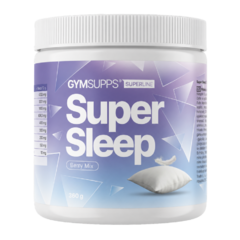
GymSupps Super Sleep
Your Central Nervous System (CNS) on Fire
Why does your body suddenly start drawing more on fat reserves? Because lack of sleep switches it into "fight-or-flight" mode. Your adrenal glands start pumping out cortisol, a stress hormone designed to prepare you for a fight for survival. This stress response releases more fat into your bloodstream as quick energy reserves, so while you burn more of it, the toll is enormous.
The same mechanism causes your resting heart rate to spike and raises your blood pressure. Your mood plummets, your focus is nonexistent, and the same effort feels much more painful. Your central nervous system is overloaded, and your muscles aren’t receiving the right signals to contract strongly.
What does this mean in practice?
Don’t treat sleep as just “something that happens between workouts.” Consider it the most important anabolic phase of the day. If you’ve neglected it, try to minimize the damage with these steps:
- Put your ego aside and scale back the intensity: When you’ve had a lousy night’s sleep, it’s much wiser to take it easy. Don’t chase personal records (PRs) and don’t train to failure. By “pushing through” on sheer willpower, you won’t burn more fat or create a better muscle stimulus. You’ll just set your recovery back for the next three days. Do a light pump session or incorporate active recovery.
- Cool down for better deep sleep: Deep sleep (the phase when growth hormone is released and muscles recover) only occurs when your body temperature drops. If you sleep in an overheated room, your sleep quality goes out the window. Lower the temperature to 18°C or take a hot shower before bed—your body will start dissipating heat faster afterward and cool down.
- Optimize your pre-sleep supplementation: Instead of focusing only on pre-workout supplements, also address post-workout recovery. High-quality magnesium bisglycinate or zinc will help calm your nervous system and get you into deeper stages of sleep more quickly.

No posts have been made yet.








