





The best sources of plant-derived omega-3
 Author:
 In recent years, omega-3 fatty acids have become almost synonymous with a healthy lifestyle. They are talked about in relation to heart health, a clear mind and the suppression of inflammation in the body. For meat eaters, and especially fish eaters, the path to getting enough of them seems fairly straightforward. But what about those who opt for a plant-based diet? Vegetarians and vegans often confidently reach for flaxseeds, chia seeds and walnuts, thinking that this will fully meet their omega-3 needs. But as scientific research shows, the reality is much more complex.
Article content:
- Introducing Omega-3s: They're not all the same
- The Great Conversion Conundrum: The Problem with ALA
- The Solution from the Deep: Microalgae as a Direct Source
- A Practical Guide for Everyday Life and Conclusion
Introducing Omega-3: They're Not All the Same
Before going into deeper analysis, it is absolutely essential to understand that under the umbrella name "omega-3" there are different types of fatty acids with different functions and sources. Three are most relevant to our topic:
-
Alpha-linolenic acid (ALA): this is the form of omega-3 found exclusively in plant sources. It is considered "essential," meaning that our bodies cannot make it on their own and we must necessarily take it from our diet. Rich sources are the aforementioned flaxseeds, chia seeds, walnuts, hemp seeds and their oils.
-
Eicosapentaenoic acid (EPA): This fatty acid plays a key role in regulating inflammatory processes in the body. It is known for its benefits to heart and vascular health.
-
Docosahexaenoic acid (DHA): It can be described, without exaggeration, as the building block of the brain and the retina. It forms a significant part of the structural mass of these organs and is indispensable for their proper function, cognitive ability, memory and healthy vision.
While ALA is purely of plant origin, EPA and DHA are found in abundance in fatty marine fish such as salmon, mackerel and sardines. And here lies the crux of the problem for vegans and vegetarians. Our bodies primarily need and directly use EPA and DHA. Proponents of a plant-based diet argue that the body can make these two key acids from plant-based ALA. Technically, they are correct, but the practical implementation of this process is, as we shall see, very inefficient.
The great conversion conundrum: The problem with ALA
Imagine you want to build a complex model of a spaceship (DHA) out of LEGO bricks. However, you are only given basic red bricks (ALA) by nature. Theoretically, you can use them to build simpler parts (EPA) and, with a lot of effort and a lot of loss, a final model of the ship. But the process is extremely slow, inefficient and the result is uncertain. This is exactly how the conversion of ALA to EPA and DHA works in our bodies.
The scientific literature confirms this fact. A review study published in Critical Reviews in Food Science and Nutrition in 2014 analyzed in detail the bioavailability and utilization of vegetarian sources of omega-3. The authors concluded that the rate of conversion of ALA to EPA is very low, and conversion to structurally key DHA is even significantly lower, often almost negligible. The efficiency of this process varies between individuals but is generally in the order of one percent. What is even more striking, however, is the finding that ALA from some sources, such as nuts and seeds, has not been converted to DHA at all in many studies.¹
So what does this mean in practice? A person can consume a tablespoon of flaxseed oil and a handful of walnuts each day to ensure they get enough ALA, which has its own health benefits. However, relying on this to also ensure optimal levels of DHA for the brain and eyesight is a very uncertain strategy. It is a metabolically demanding and inefficient task for the body that may not lead to the desired goal.
Solution from the deep: Microalgae as a direct source
So where to look for solutions? The answer is fascinating and logical at the same time. We need to go to the roots, or in this case, rather to the source of the food chain. Many people believe that fish are the primary producers of EPA and DHA. However, this is a mistake. Fish do not produce these valuable fats themselves - they accumulate them from the food they eat. And in the marine world, that food is microscopic algae.
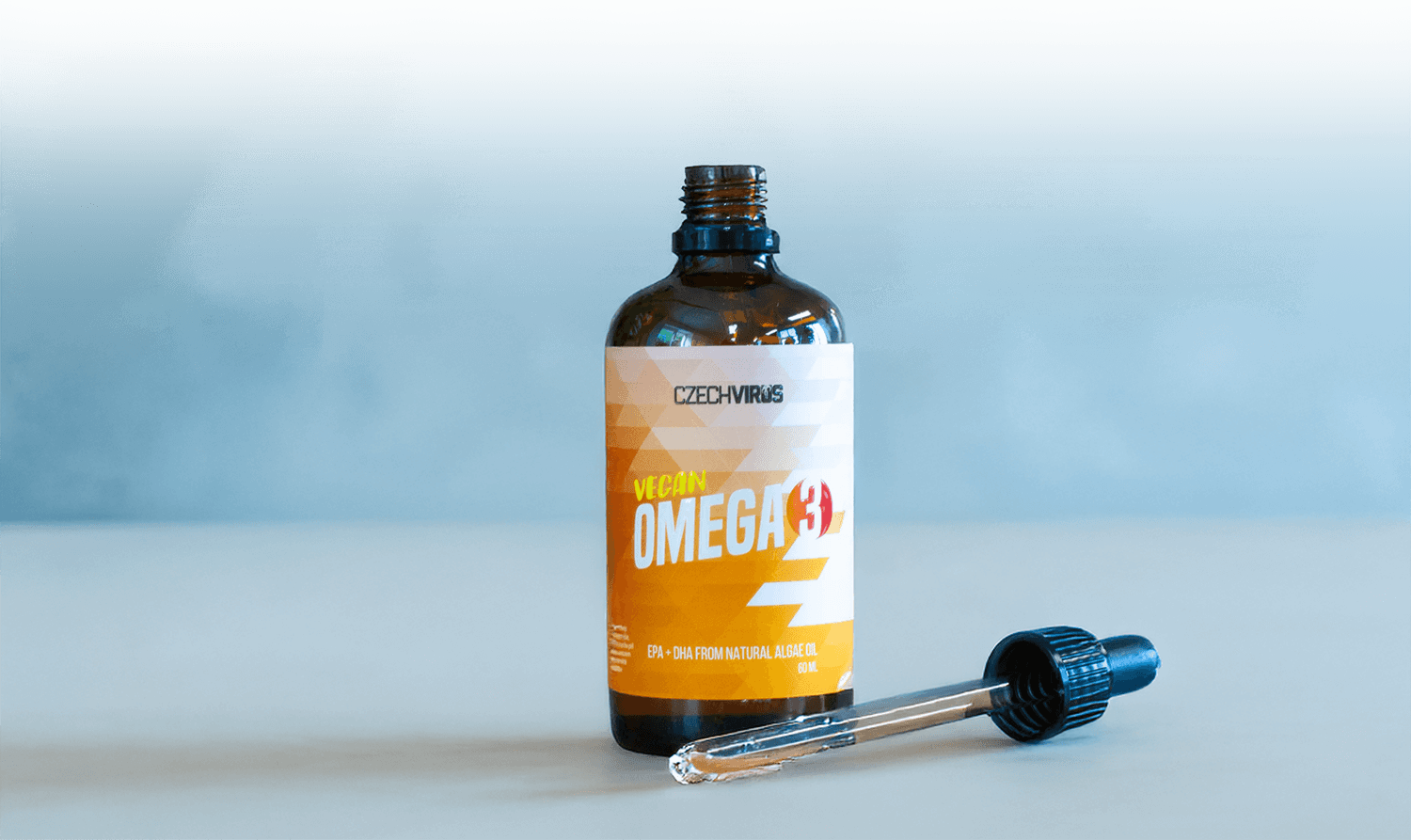
Marine microalgae are the original "factories" for the production of EPA and DHA. They are a direct, native and purely plant-based source of these vital fatty acids. This finding is a revolution for anyone looking for a reliable plant source of omega-3s.
This fact is confirmed by a more recent review study from 2022, also published in Critical Reviews in Food Science and Nutrition. The aim of this paper was to specifically update supplementation options for vegetarians and vegans. The study came to a clear conclusion: microalgae oil is a highly bioavailable source of DHA and its consumption leads to a significant and reliable increase in blood DHA levels in people on a plant-based diet.² This completely circumvents the problematic and inefficient conversion from ALA. Instead of supplying the basic building blocks (ALA) and relying on uncertain construction, we supply the body directly with the finished product (DHA).

A practical guide for everyday life and conclusion
What can we take away from these scientific findings for everyday life? Should we reject flaxseeds and walnuts? Absolutely not. ALA sources are still an extremely valuable part of a healthy diet. They provide fiber, vitamins, minerals, and ALA itself has proven health benefits. However, they should not be considered the only and sufficient source to meet the need for EPA and especially DHA.
Based on the available scientific data, a combination approach seems to be the most sensible strategy for vegetarians, vegans and people who do not consume fish in general:
-
Continue to consume sources of ALA: Regularly include ground flaxseeds, chia seeds, walnuts and hemp seeds in the diet for their overall health benefits.
-
Consider supplementing with microalgae oil: To ensure a reliable and adequate intake of key DHA (and often EPA), supplementing your diet with seaweed oil is the most effective and scientifically sound choice.
In conclusion, the world of plant-based omega-3s is more complex than it first appears. Relying solely on the conversion of plant ALA to DHA is inefficient and uncertain for the body. However, nature offers us an elegant solution in the form of microalgae, the original producers of these essential fats. An informed and conscious approach that combines traditional plant sources with modern and direct supplementation from algae is the best way to ensure optimal brain, vision and whole-body health for anyone who chooses to go the plant-based route.
Recommended
Amix ProVegan Omega 3-6-9
Czech Virus Vegan Omega 3
Sources:
- ¹ Lane K, Derbyshire E, Li W, Brennan C. Bioavailability and potential uses of vegetarian sources of omega-3 fatty acids: a review of the literature. Crit Rev Food Sci Nutr. 2014;54(5):572-9. doi: 10.1080/10408398.2011.596292.
- ² Gallego-Narbón A, Zapatera B, Barrios L, Vaquero MP. Bioavailability and conversion of plant based sources of omega-3 fatty acids - a scoping review to update supplementation options for vegetarians and vegans. Crit Rev Food Sci Nutr. 2022;62(24):6785-6796. doi: 10.1080/10408398.2021.1880364.
No posts have been made yet.








