





How to Get the Most Out of Protein? A Simple Guide Where Timing Really Matters
 Author:
 You know that feeling all too well. You finish your last, exhausting set of squats, put the barbell back on the rack with a huge sense of relief, and instead of taking a moment to catch your breath, you immediately rush to your locker. There, with a hint of panic in your eyes, you frantically shake your shaker bottle. All because you’re convinced that if you don’t manage to drink your dream protein shake within the magical thirty minutes after your workout ends, the so-called “anabolic window” will slam shut, and all your hard work at the gym today will be for nothing.
Don’t despair—take a moment to calm down, and above all, stop stressing out while staring at your watch. Protein is a fantastic ally, one of the most thoroughly researched dietary supplements, and an absolute cornerstone of muscle recovery. The problem, however, is that aggressive marketing of dietary supplements has led us to believe the myth of the 30-minute clock. The body is an incredibly complex and intelligent mechanism, and its recovery certainly doesn’t end at the 30-minute mark after a workout. Muscles don’t grow just in the gym locker room—they grow in the hours and days that follow. All you need to do is understand a few basic rules about how our bodies process protein and when timing really matters. Your body (and your mind) will thank you.
Article Contents:
- The anabolic window is a myth; total daily intake is king
- When Does the Clock Really Start Ticking?
- Three specific situations where timing matters a great deal
- How big should a single serving be?
- 5 Simple Steps to Maximize Results
The anabolic window is a myth; total daily intake is king
A common and very fundamental misunderstanding is the focus on perfect post-workout timing while overlooking the absolute foundation of nutrition. To understand why, we need to look at the numbers and how muscle protein synthesis (the process of building new muscle protein) works. A perfectly timed shake with 25 grams of top-quality whey isolate won’t save you if, at the end of the day, you’re still 70 grams short of meeting your daily goal.
Your muscles don’t close their “gates” after a workout. In fact, they remain extremely responsive to nutrient intake for 24 to 48 hours after a strength-training stimulus. If you had a sufficiently nutritious meal a few hours before your workout, your body still has enough amino acids in your bloodstream to begin repairs immediately after you finish exercising.
The biggest and most important factor for preserving and building muscle mass is your total daily intake. For people who exercise, this should range from 1.6 to 2.2 grams per kilogram of body weight. For an 80-kilogram man, this means roughly 130 to 175 grams of protein per day. As long as you don’t meet this absolutely basic rule, it makes no difference at all in terms of muscle growth whether you drink your protein shake at 4:15 p.m. or as late as 5:30 p.m. at home with dinner.
When Does the Clock Really Start Ticking?
Does this mean that timing is completely irrelevant? Not at all. Many professional athletes, coaches, and nutrition specialists today realize what regular gym-goers often overlook: timing shouldn’t be a dogma that causes us stress, but a smart tool for solving a real problem in our daily routine.
You may have the best supplement on the market, but debating whether to take it before or after a workout only makes sense if there’s a huge gap in your diet or if your body has nothing to draw from.
How to Meaningfully Replenish Building Blocks
Improving your diet sounds great on paper, but if you’ve been training hard for a long time and your body is running on empty, you won’t be able to replenish your protein just by having an egg for breakfast every now and then. Until you choose the right approach and strategy, your muscles will remain hungry.
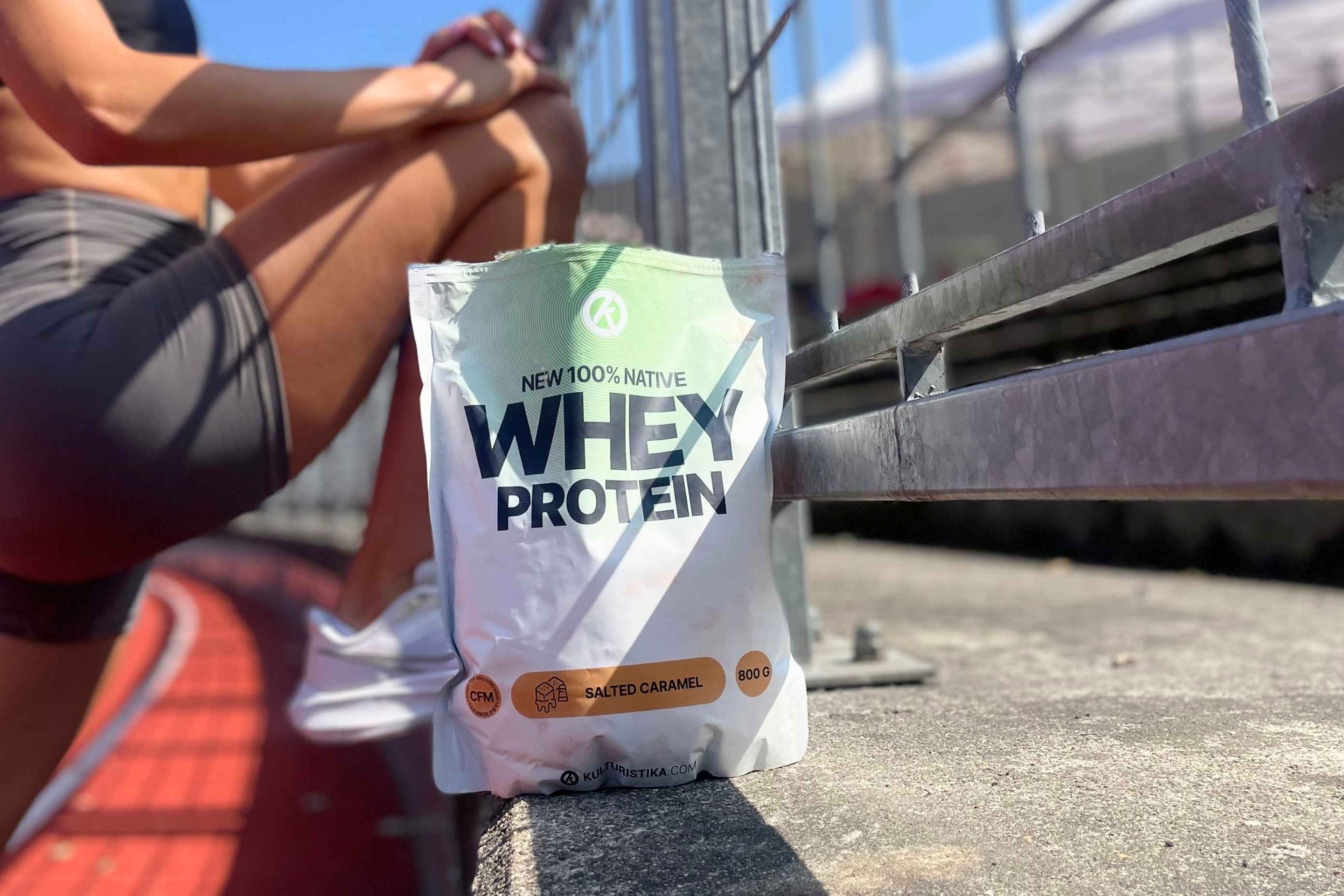
Don’t look for esoteric shortcuts—start with what’s on your plate. Include a hearty slice of turkey in your diet (one 200-gram piece will cover almost half your daily intake!), along with eggs, cottage cheese, and lentils. But if you’re struggling with a chronic time crunch and long gaps between meals, you need to bring in some heavy-hitting outside help. Avoid cheap junk from the supermarket—low-quality protein packed with sugar is barely absorbed; it’ll just burden your digestion and act as an expensive laxative. Opt for highly absorbable forms. Choose GymSupps XWhey Protein, which will flood your bloodstream with amino acids in a flash after your workout, or go for New 100% Whey Protein, an absolute Czech classic with a pure formula for maximum recovery support.
Recommended

New 100% Whey Protein 800g 1+1
GymSupps XWhey Protein
Three Specific Situations Where Timing Matters Extremely
Try this scientifically backed approach. Only take out your stopwatch and precise minute-by-minute plan in these three specific cases:
1. Working out after a long overnight fast (morning workout on an empty stomach)
If you’re an early bird who lifts weights at 6:00 a.m. and your last meal was a light dinner at 7:00 p.m. the previous day, you’re in a very specific situation. Your body has gone 11 hours without a supply of fresh amino acids. Insulin levels are low, and your body is in a catabolic (breakdown) state. At this point, immediate protein intake makes perfect sense. If you can’t eat anything before your morning workout, consume 25–40 g of high-quality protein as soon as possible after your workout. Fast-acting whey protein is ideal because it doesn’t burden digestion and reaches your muscles in a flash.
2. Too Long a Break Between Meals (The 5-Hour Rule)
Imagine a typical workday: you have lunch at 12:00 p.m., go straight from work to the gym at 4:00 p.m., your workout takes an hour and a half, then a shower, the trip home... and you don’t have dinner until 8:00 PM. That’s a whopping eight hours without protein! The golden rule of nutrition for muscle growth is this: the meals surrounding your workout shouldn’t be more than 4 to 5 hours apart. If you know there’s going to be a gap between lunch and dinner, this is exactly where a smartly timed protein shake or protein bar comes in—either about an hour before your workout or immediately after, to bridge that huge gap.
3. A Chronic Problem with Meeting Your Daily Goal
If you regularly find yourself panicking at 9:00 p.m. because you’re 60 grams short of your daily protein goal (which is the equivalent of 300 grams of chicken breast), your problem isn’t with absorption—it’s with planning. Use timing to create what are called “protein anchors.” Divide your daily goal into 3 to 5 fixed meals. If your goal is 160 grams, don’t try to make up for it with a massive dinner. Spread it out over 4 meals of 40 grams each (Breakfast 40g, Lunch 40g, Post-Workout Meal/Shake 40g, Dinner 40g). This way, your body will have a steady supply of nutrients throughout the day, and you’ll avoid overeating in the evening.
.jpg)
How big should a single serving be?
Another common myth is that the body can’t absorb more than 30 grams of protein in a single meal. That’s nonsense—the body can absorb and utilize much larger amounts; digestion simply slows down. However, for optimal stimulation of muscle growth , roughly 0.4 grams of protein per kilogram of body weight in a single meal is recommended as an ideal starting point. For a 75-kg person, that means a serving of about 30 grams; for a 100-kg man, it’s 40 grams per serving. You’ll achieve the best results by spreading these amounts across several meals throughout the day.
5 Simple Steps to Maximum Results
Save yourself weeks of frustration, slow progress, and the stress of constantly watching the clock. Try these essential adjustments that will make your supplementation make real, scientifically backed sense:
- Make it your top priority: First, calculate your daily goal (1.6–2.2 g per kg of body weight). Until you’re hitting this specific number every day, there’s absolutely no point in worrying about what time you drink your shake. Total volume always trumps perfect timing.
- Keep an eye on your five-hour window: Check the typical time interval between your pre-workout and post-workout meals. If it’s longer than 4 to 5 hours, that’s a sign you should add a quick source of protein (a protein shake, Greek yogurt, or skyr) during that window.
- Early birds need fuel: If you like to work out on an empty stomach right after waking up, don’t unnecessarily extend your overnight fast for additional hours after your workout. This is where a quick post-workout protein shake or a very hearty, protein-rich breakfast really pays off and helps preserve your muscle mass.
- Don’t skip solid food in favor of powder: Protein powder is great for convenience, speed, and taste. But it should never make up the majority of your intake. A wholesome meal (meat, eggs, legumes) will also provide you with iron, zinc, calcium, B vitamins, fiber, and other micronutrients that you simply won’t find in a scoop of instant powder.
- Sometimes less is more: Most large clinical studies clearly show that whether you consume protein 30 minutes before or 30 minutes after a workout, the results are exactly the same in terms of long-term muscle growth. Choose whatever agrees with your digestion and fits better into your daily schedule. Don’t work out on a full stomach if it makes you feel sick, and conversely, don’t wait to eat if you’re starving.
Protein powder is a great, safe, and extremely practical dietary supplement that can significantly help you build strength, muscle mass, and support overall recovery. You just need to use it the right way. Stop thinking of it as an emergency brake you have to pull exactly 30 minutes after your last rep. Instead, start using it as a strategic tool to supplement your day, bridge long gaps between meals, and meet your total daily intake. Try this simple mindset shift, and you’ll see how your body will gradually reward you with great results and workouts you’ll enjoy without unnecessary dietary stress.
Recommended
Prom-in CFM Pure Performance
No posts have been made yet.








