





Where does fat get lost during weight loss?
 Author: Šárka Randáčková
 We will explain why the answer to this question may not be what you expect.
Abstract
Given the rates of overweight and obesity and the strong interest in the topic, there is a surprising ignorance among the general public and health professionals regarding the weight loss process. We have encountered a variety of misconceptions about how people lose fat among general practitioners, dietitians, and personal trainers (Figure 1).
Most people believed that fat is converted to energy or heat, which violates the law of conservation of mass. We believe that this misconception has been extended by the mantra of "energy received/expended" and the focus of university biochemistry, which is on energy production.
Other fallacies have been that fat metabolites are excreted in feces or converted to muscle. We will present an unusual calculation of how we "lose weight."
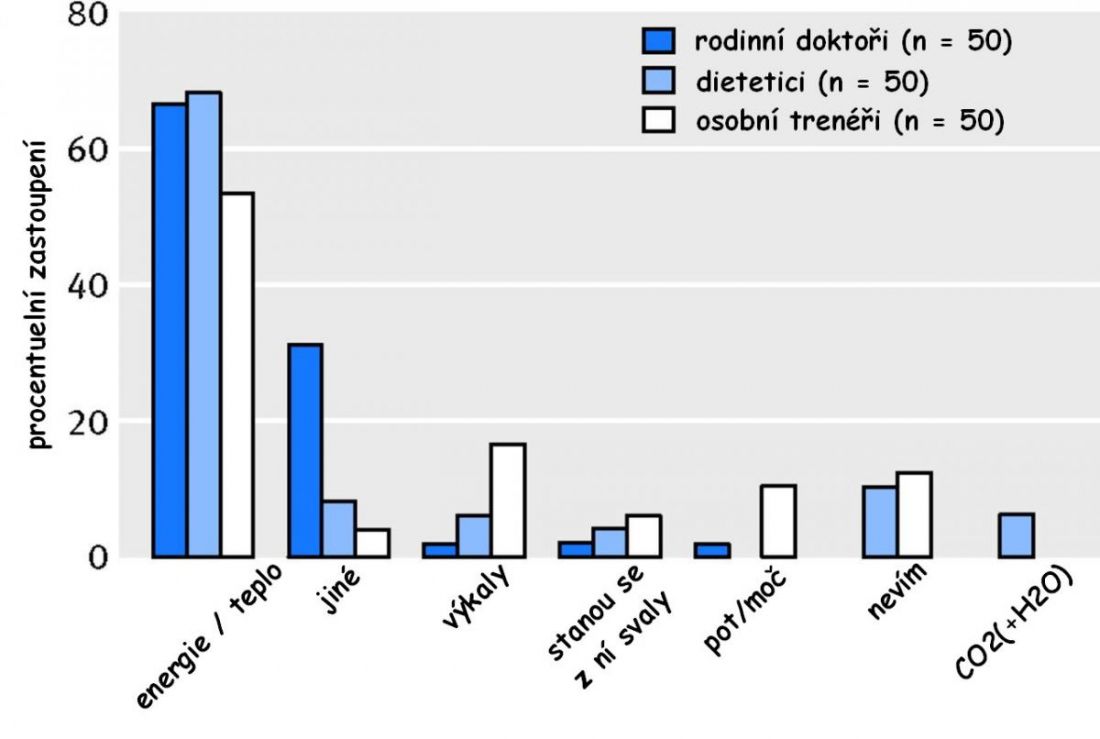
Fig. 1 Responses of a sample of doctors, dietitians, and personal trainers to the question: "When someone loses weight, what happens to that lost weight?" (The correct answer is CO2)
The weight we want to lose
Excess carbohydrates or proteins in the diet are converted to triglycerides and stored in fat cells. Excess fat in the diet needs no conversion other than lipolysis and re-esterification.
People who wish to lose weight while maintaining their lean mass are, biochemically speaking, attempting to metabolize the triglycerides stored in their fat cells.
The chemical formula of the average triglyceride molecule can be deduced from studies of fatty acid composition. In 1960, Hirsch et al. published data that gave rise to an "average fatty acid" with the formula C17.4H33.1O2.1
This 50-year result is in striking agreement with more recent data.2 Three "average fatty acids" esterified to the glycerol backbone (+3C, +6H) give us an "average triglyceride" with formula C54.8H104.4O6. The three most common fatty acids stored in human adipose tissue are oleic (C18H34O2), palmitic (C16H32O2), and linoleic (C18H32O2),1, 2 which esterify to give C55H104O6.
The complete oxidation of a single triglyceride molecule involves many enzymes and biochemical steps, but the entire process can be summarized as:
C55H104O6 + 78O2 → 55CO2 + 52H2O + energy
Stoichiometry shows that the total oxidation of 10 kg of human fat requires 29 kg of inspired oxygen, which produces 28 kg of CO2 and 11 kg of H2O.
This shows us the metabolic fate of fat, but is silent on the proportions of the mass stored in these 10 kg of fat, which is rejected as carbon dioxide or water during weight loss. To get these values, we have traced the path of every atom out of the body. The carbon and hydrogen atoms, of course, leave the body as CO2 and H2O, respectively.
The fate of the six oxygen atoms of triglyceride is a mystery solved in 1949 by Lifson et al.3 They used labeled heavy oxygen (O18) to show that the oxygen atoms of body water and respiratory carbon dioxide are rapidly exchanged through the formation of carbonic acid (H2CO3).
The six oxygen atoms will thus be divided between CO2 and H2O in the same ratio, 2:1, in which oxygen exists in all substances. In other words, four will exhale and two will form water.
An unusual calculation
The fraction of the molecular weight of triglyceride exhaled in CO2 is the fraction of its molecular weight (daltons) contributed by its 55 carbon atoms and four oxygen atoms:
(661 Da (C55)+64 Da (O4))/(861 Da (C55H104O6))×100=84%
The fraction of matter that becomes water is:
(105 Da (H104)+32 Da (O2))/(861 Da (C55H104O6))×100=16%
These results show that the lung is the primary excretory organ for weight loss (Figure 2). The water produced can be excreted in urine, faeces, sweat, breath, tears or other body fluids.
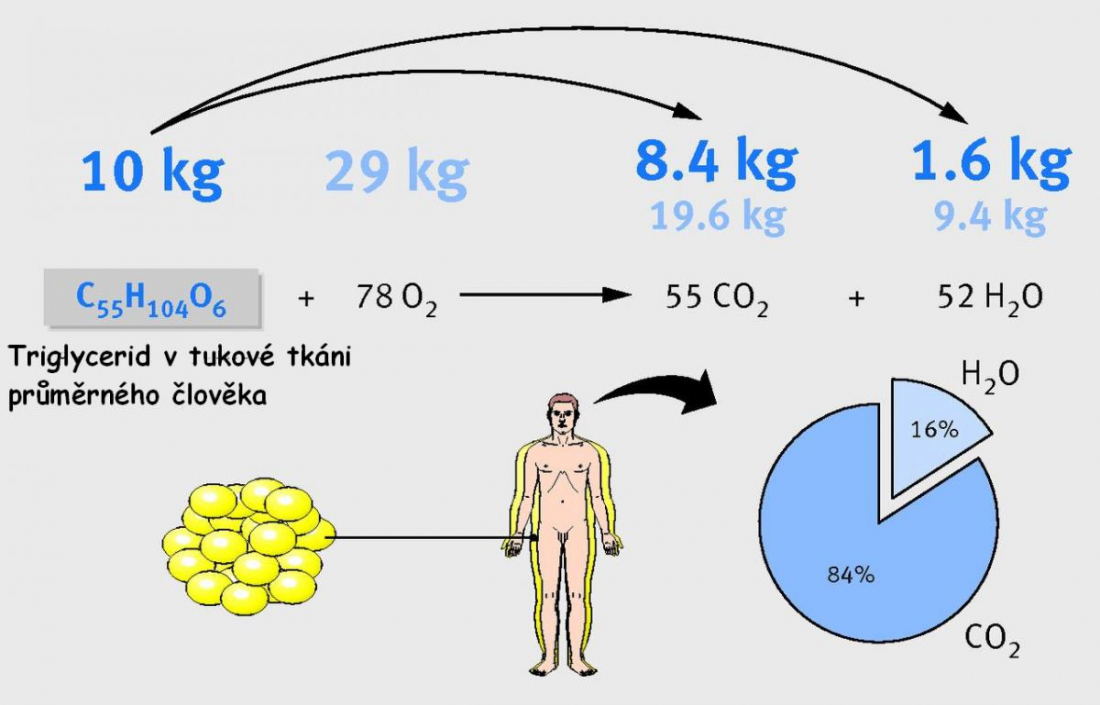
Fig. 2 When someone loses 10 kg of fat (triglyceride), 8.4 is exhaled as CO2. The rest of the total 28 kg of CO2 produced is contributed by inhaled oxygen. The lungs are therefore the primary excretory organ for weight loss. (This calculation ignores fat, which can be excreted as ketone bodies under the proper (patho)physiological conditions, or small amounts of pure muscle mass, from which nitrogen can be excreted as urea.)
Detection of fat loss
At rest, the average 70 kg person consuming a mixed diet (respiratory quotient 0.8) exhales approximately 200 ml of CO2 in 12 breaths per minute.4 Each of these breaths therefore expels 33 mg of CO2, of which 8.9 mg is carbon.
In a day spent sleeping and doing light activities that double resting metabolic rate, this person inhales 0.74 kg of CO2 every 8 hours, removing 203 g of carbon from the body. By comparison, 500 g of sucrose) will provide 8400 kJ (2000 kcal) and contains 210 g of carbon.
Replacing an hour of rest with a workout that can raise the metabolic rate by up to seven times compared to rest, such as jogging, removes an additional 39 g of carbon from the body, increasing the total amount by about 20% to 240 g. By comparison, a single 100g muffin represents about 20% of the average person's total daily energy needs.
Physical activity for weight loss is therefore relatively easy to outweigh with excess food.
Our calculations show that the primary excretory organ for fat loss is the lungs. Weight loss requires the release of carbon stored in fat cells, which brings us back to the tired song about moving more and eating less.
We recommend incorporating these concepts into the higher education curriculum to correct the widespread misconceptions about fat loss.
Sources:
1. Hirsch J, Farquhar JW, Ahrens EH, Jr, Peterson ML, Stoffel W. Studies of adipose tissue in man. A microtechnique for sampling and analysis. Am J Clin Nutr1960;8:499-511.
2. Hodson L, Skeaff CM, Fielding BA. Fatty acid composition of adipose tissue and blood in humans and its use as a biomarker of dietary intake. Prog Lipid Res2008;47:348-80.
3. Lifson N, Gordon GB, Visscher MB, Nier AO. The fate of utilized molecular oxygen and the source of the oxygen of respiratory carbon dioxide, studied with the aid of heavy oxygen. J Biol Chem1949;180:803-11.
4. Ainsworth BE, Haskell WL, Herrmann SD, Meckes N, Bassett DR, Jr, Tudor-Locke C, et al. 2011 Compendium of physical activities: a second update of codes and MET values. Med Sci Sports Exerc2011;43:1575-81.
Author: Šárka Randáčková No posts have been made yet.








