




Do muscles grow better when you think about them?
 Author:
Imagine two men standing side by side at the gym. Both are holding dumbbells of the same weight. Both are doing bicep curls, and both have similar form. The first one focuses primarily on lifting the dumbbell from the bottom position to the top. The second one tries to consciously feel his biceps working. He focuses on their contraction, controls the movement, and thinks about how the muscle is working with each repetition.
At first glance, their sets may look almost identical. But their attention is focused in different directions. And it is precisely this difference that has piqued the interest of scientists studying the relationship between the nervous system, muscle activation, and hypertrophy.
Could it be that it depends not only on how we exercise, but also on what we think about while exercising?
Article Contents:
- What Is the Mind-Muscle Connection?
- What the research showed: Can muscles grow faster?
- Does greater muscle activation automatically mean greater growth?
- Why can concentration be especially helpful during isolation exercises?
- How can you use the mind-muscle connection during your workout?
- It’s not just what you think about that matters
What Is the Mind-Muscle Connection?
The term “mind-muscle connection” refers to the ability to consciously focus your attention on the muscle that is working during a specific exercise. In the scientific literature, this is referred to as“internal focusof attention.” For example, during a bicep curl, we focus on the contraction of the biceps.
During a fly, we focus on the work of the pectoral muscles. And during a leg extension, we focus on engaging the quadriceps. In contrast,“external focus” means that we think primarily about the result of the movement. For example, on the movement of the dumbbell, reaching a certain point, or lifting the weight. Both types of focus can have their place in training.
What’s interesting, however, is that they can influence different aspects of muscle activity and athletic performance.
What the Research Showed: Can Muscles Grow Faster?
One of the most interesting studies on this topic was published in 2018 by Brad Schoenfeld and his colleagues. The researchers followed 30 untrained men who completed an eight-week strength training program. The participants were divided into two groups.
The first group was instructed to focus on the target muscle during the exercises. The second group focused on the outcome of the movement—that is, the actual lifting of the weight. Both groups performed bicep curls and leg extensions.
The results were interesting. For the biceps, the group with an internal focus of attention recorded an average increase in muscle thickness of approximately 12.4%, while the second group saw an increase of 6.9%. The difference between the groups was statistically significant. However, no similar benefit was demonstrated for the quadriceps.
The study thus suggested that consciously focusing on a muscle may, under certain conditions, promote its growth. However, it did not prove that this approach works the same way for all muscle groups and all athletes.
Furthermore, this was a relatively small study conducted on untrained men. The results therefore cannot be automatically applied to experienced bodybuilders.
.jpg)
Want bigger muscles? Focus alone isn’t enough
The mind-muscle connection can be a useful part of your workout, but muscle growth depends primarily on sufficient training load, quality nutrition, and recovery. Even a perfectly focused set cannot replace a properly structured long-term training program.
When building muscle mass, it’s important to ensure adequate protein intake. Whey protein can be a practical aid, making it easier to incorporate protein into your diet. Creatine monohydrate is also among the most well-researched sports supplements; it supports performance during repeated, short-term, high-intensity efforts.
Recommended

New 100% Whey Protein 800g 1+1

Creatine Monohydrate 500g 1+1

Does greater muscle activation automatically lead to greater growth?
Here, it’s important to distinguish between two things. Some experiments have shown that when a person consciously focuses on a specific muscle, its electrical activity—as measured by electromyography (EMG)—can change. However, this alone does not mean that the muscle will necessarily grow faster over the long term.
EMG captures the electrical signals of muscle activity. It is not a direct measure of mechanical tension or future hypertrophy. For muscle growth, a sufficient training stimulus, appropriately adjusted volume, progressive overload, and recovery remain essential.
Focusing on the working muscle can thus be a useful tool, but not a substitute for quality training.
Why can concentration be particularly useful for isolation exercises?
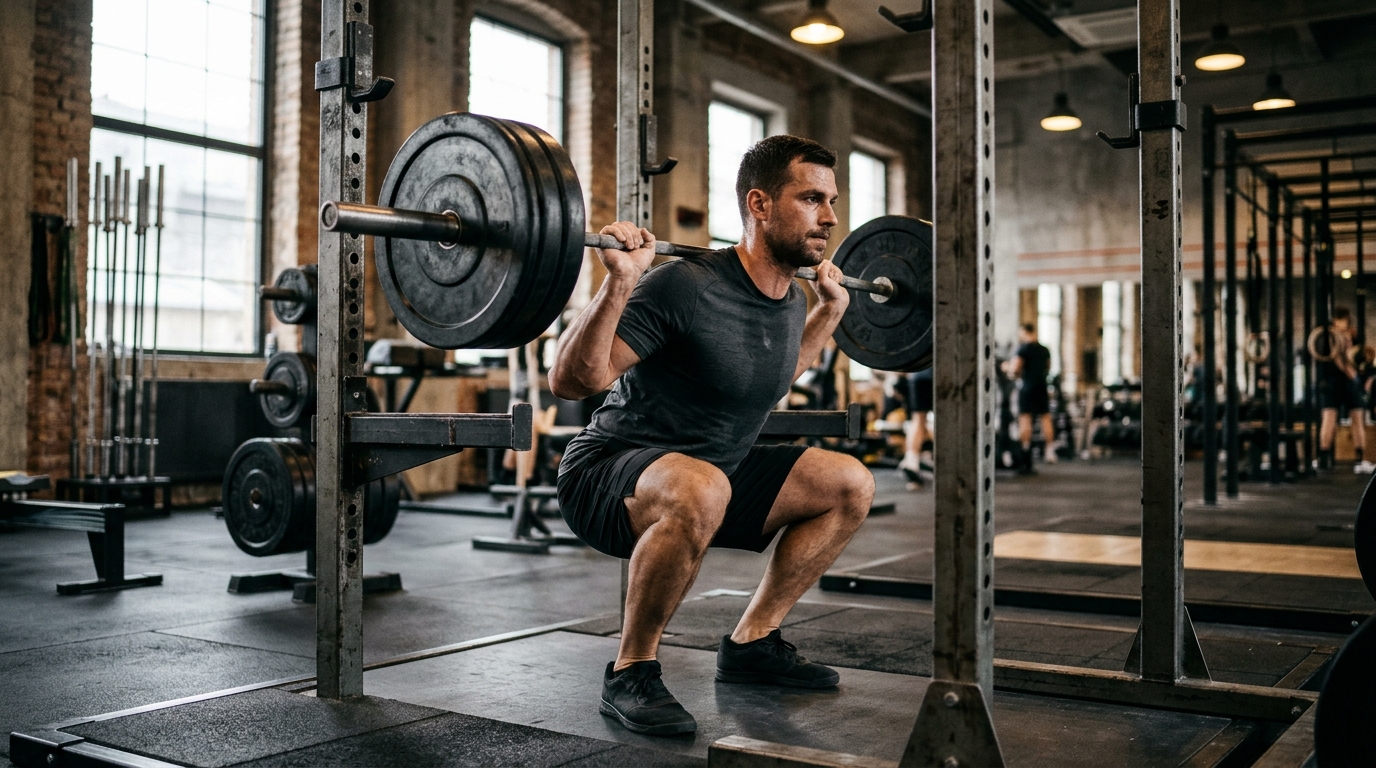
Imagine the difference between a bicep curl and a heavy squat. With a bicep curl, it’s relatively easy to focus your attention on a single specific muscle. With a heavy squat, however, the nervous system must coordinate the work of many muscle groups simultaneously. And this is precisely where the way you focus your attention can have a different significance.
Research on motor learning and athletic performance often shows that external focus can be beneficial for movement efficiency and performance. Therefore, it’s not accurate to say that we should think exclusively about the contraction of individual muscles during every exercise. For isolated exercises aimed at hypertrophy, consciously focusing on the target muscle can be a practical aid.
Conversely, for heavy compound exercises, it may be more useful to focus on stability, technique, and movement execution.
| Exercise | Recommended Focus | Practical Tip |
|---|---|---|
| Bicep Curl | Inner | Focus on contracting your biceps. |
| Triceps on the pulley | Inner | Feel the triceps working as you extend your elbow. |
| Leg Curls | Inner or outer | Focus on the quadriceps or the controlled movement of the weight. |
| Bench press | Depending on your goal | For power, focus on the barbell’s path; during lighter sets, try to feel your chest muscles. |
| Squat | More on the outer muscles | Focus on stability and controlled movement. |
| Deadlift | More of an outer exercise | Focus on the correct barbell path and a solid starting position. |
How can you use the mind-muscle connection during your workout?
If you want to try this principle, start with simple isolation exercises. For example, bicep curls, tricep pulldowns, or leg extensions. Choose a weight that allows you to perform controlled repetitions without significant momentum. During the set, try to consciously focus on engaging the target muscle.
You don’t need to slow the movement down excessively or force a burning sensation at all costs. The important thing is to maintain proper form and ensure the workout provides a sufficiently challenging stimulus. If you find that focusing helps you control the movement better, you can incorporate it as part of your routine.
However, if it disrupts your coordination or reduces your performance during heavier exercises, there’s no reason to stick with it.
.jpg)
It’s Not Just About What You’re Thinking About
The connection between the mind and muscles represents an interesting intersection of sports psychology and physiology. It shows that our attention isn’t merely a passive observer during exercise. It can influence the way we perform movements and how our muscles engage during them.
At the same time, however, we must not overestimate the results of individual studies. We do not have enough evidence to claim that consciously focusing on a muscle always leads to significantly greater hypertrophy.
If you want to build muscle mass, the foundation remains high-quality training, gradually increasing intensity, adequate protein intake, and recovery. The mind-muscle connection can be a useful supplement that helps you work more effectively with your own body.
Muscles grow outside the gym, too
Consciously focusing on a muscle can help you better control your movements, but real progress also requires adequate recovery. That’s why you shouldn’t forget about quality sleep, an appropriate training volume, and a varied diet. Magnesium, for example, plays an important role in the proper functioning of muscles and the nervous system. Supplementing with magnesium may be particularly beneficial if your intake from your regular diet is insufficient. Remember that a quality workout isn’t just about how intensely you can feel the burn in your muscles. What matters most is how you’re able to improve over the long term.
Recommended

No posts have been made yet.