




It's not your strength that holds you back, but something else entirely—why is it that sometimes the very thing you're worst at is what makes the difference?
 Author:
Imagine an athlete who has almost everything: exceptional strength, great stamina, perfect discipline, and years of experience. At first glance, these seem like the ideal prerequisites for success. But then the decisive moment comes, and everything goes wrong. Not because he isn’t strong enough or prepared enough. It’s because a single skill—the one that matters most at that moment—fails him.
We’ve all seen similar situations at the gym. You can lift heavy weights, but your grip always lets you down during deadlifts. You have well-developed muscles, but you lack the endurance needed for more demanding workouts. Or you have a perfectly structured plan, but you consistently underestimate the importance of sleep.
And this is where we come to an interesting paradox. Sometimes, our performance isn’t determined by what we’re best at, but by what limits us the most.
Article Contents:
- Why Might Your Strongest Asset Not Be Enough?
- Science shows that just training more isn’t enough
- The biggest mistake? Trying to eliminate every single weakness
- What if it’s not your training that’s holding you back, but your recovery?
- If you want to improve your performance, start with the basics
- How can you tell what’s really holding you back?
- Sometimes it’s not more strength that moves you forward, but removing a single obstacle
Why might your strongest asset not be enough?
In sports psychology and training practice, the analogy of a chain is often used. A chain may have ten exceptionally strong links, but if one cannot withstand the load, the entire chain fails. Human performance works similarly in some situations. It isn’t the result of a single isolated ability, but rather a combination of strength, technique, endurance, coordination, mental preparedness, and recovery.
Imagine, for example, a bodybuilder who has exceptionally well-developed pectoral muscles but is limited in the bench press by weak core stability and poor technique. Further increasing the strength of his pectoral muscles may not bring the expected progress until he improves these specific areas.
This doesn’t mean that the weakest ability always automatically determines the outcome. What matters is whether a specific deficiency actually limits your performance in what you’re trying to achieve.

Science shows that simply training more isn’t enough
Research on athletic performance suggests that the quality and focus of training are just as important as the sheer volume of work done. For example, a meta-analysis published in 2016 in the journal *Perspectives on Psychological Science* examined the relationship between targeted training and athletic performance. The researchers found that differences in the amount of targeted training accounted for approximately 18% of the differences in performance among athletes. The result shows that training plays an important role, but it is not the only factor in success.
What you focus on during training is also crucial. For example, if you lack stability or proper form when doing squats, adding more weight may not be the best solution. Sometimes it’s much more helpful to reduce the load, improve your technique, and only then continue building strength.
After all, more effort doesn’t automatically mean better results. It’s important to focus your effort on what will actually help you progress.
The biggest mistake? Trying to eliminate every single weakness
You might be thinking right now that you should start focusing on everything you’re not good enough at. But that’s where another problem arises. Every person has certain natural predispositions, abilities, and limits. Some people are better at developing maximum strength, while others excel at endurance or coordination. Trying to be the best at absolutely everything is not only unrealistic but often unnecessary.
It’s important to distinguish between a weakness that truly holds you back and one that isn’t critical to your specific goal. For example, if you’re training primarily for muscle hypertrophy, you don’t need to achieve top results in a 10-kilometer run. However, if your lack of fitness limits you to the point where you can’t handle the required training volume, improving it may make sense.
So the goal isn’t to eliminate all weaknesses. The goal is to identify the ones that stand between you and your results.
What if it’s not your training that’s holding you back, but your recovery?
Even more interesting is the situation where the problem has nothing to do with what you’re doing in the gym. You may have a perfectly designed training plan, with sufficient intensity and consistency. But if you consistently neglect sleep, you may be unnecessarily hindering your progress.
A 2025 meta-analysis published in the journal *Frontiers in Physiology* showed that sleep deprivation can negatively affect various components of athletic performance, including maximum strength, explosiveness, speed, and technical skills.
In such cases, the solution may not be another training session or a more intense set. It may make much more sense to adjust your sleep schedule and overall recovery.

If you want to improve your performance, start with the basics
Pushing your limits isn’t just about adding more exercises or increasing intensity. It’s equally important to provide your body with the conditions it needs to respond appropriately to training. This includes adequate energy intake, a high-quality diet, rest, and appropriately chosen supplementation.
If you’re focusing on strength performance, GymSupps Creatine Monohydrate can be a practical supplement. It contains pure creatine monohydrate, which, when taken at a daily dose of 3 grams, enhances physical performance during repeated short-term intervals of high-intensity exercise. This can be particularly useful during demanding strength training.
If, on the other hand, you’re concerned about getting enough minerals, GymSupps Magnesium Chelate Bisglycinate is a good option. Magnesium contributes to normal muscle and nervous system function and helps reduce fatigue and exhaustion. However, supplementation alone cannot replace quality sleep or fix a poorly designed training program.
The goal isn’t to find a miracle product, but to gradually remove real obstacles and create the conditions for long-term progress.
Recommended


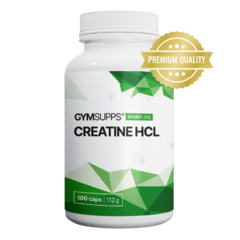
GymSupps Creatine HCL
How can you figure out what’s really holding you back?
Try looking at your training a little differently. Instead of asking how to get even stronger or train even harder, ask yourself three simple questions:
- In what areas have I not been making progress over the long term? Identify a specific problem, not just a general feeling of stagnation.
- What’s really limiting my performance? It could be technique, strength, conditioning, recovery, or a lack of consistency.
- What will happen if I improve this weakness? If addressing it can significantly contribute to your goal, it’s probably worth your attention.
That said, you don’t necessarily have to eliminate every weakness. Sometimes you can compensate for it by changing your training, using appropriate equipment, or redistributing the workload.
| WHAT’S HOLDING YOU BACK | HOW TO RECOGNIZE IT | WHAT TO DO ABOUT IT |
|---|---|---|
| Weak grip Strength limit |
During deadlifts or pull-ups, your hands give out before the target muscles do. | Strengthen your grip: Incorporate farmer’s walks, hanging holds, or, depending on your goal, use grip strengtheners. |
| Poor Technique Limited range of motion |
You lose control of the movement, and your form deteriorates significantly as the load increases. | Improve your form: Adjust the weight, work on your technique, and gradually increase the intensity. |
| Poor fitness Low work capacity |
You take a long time to catch your breath between sets, and fatigue limits the quality of your next workout. | Build your fitness: Add appropriate aerobic training and adjust the length of your rest periods. |
| Poor recovery Insufficient rest |
Fatigue builds up, your performance fluctuates, and you don’t feel recovered between workouts. | Prioritize recovery: Improve your sleep and nutrition, and adjust your training load as needed. |
| Irregularity Lack of consistency |
You frequently change your plan, skip workouts, and don’t see long-term progress. | Create a system: Set a realistic plan that you can stick to over the long term. |
* The examples given are for illustrative purposes only. The causes of stagnation can overlap, and their significance depends on your fitness level, specific goal, and individual circumstances.
Sometimes it’s not greater strength that moves you forward, but removing a single obstacle
In the world of fitness, we often hear that we should focus on our strengths. And that’s not bad advice. Developing them is precisely what allows us to excel. But real progress sometimes comes when we stop mindlessly perfecting what we’re already good at and start paying attention to what’s been holding us back in the long run.
You don’t have to be the best at everything. You don’t have to eliminate every weakness, and you certainly don’t have to train more than others.
All you need to do is understand which obstacle is holding you back the most right now. Because sometimes the path to better results is much simpler than you think.
Recommended

New 100% Whey Protein 800g 1+1

XGen 90cps + Omega 3 90cps
Reference Materials:
- Macnamara et al. (2016)
- Kong et al. (2025)
- Moesgaard et al. (2022)
No posts have been made yet.